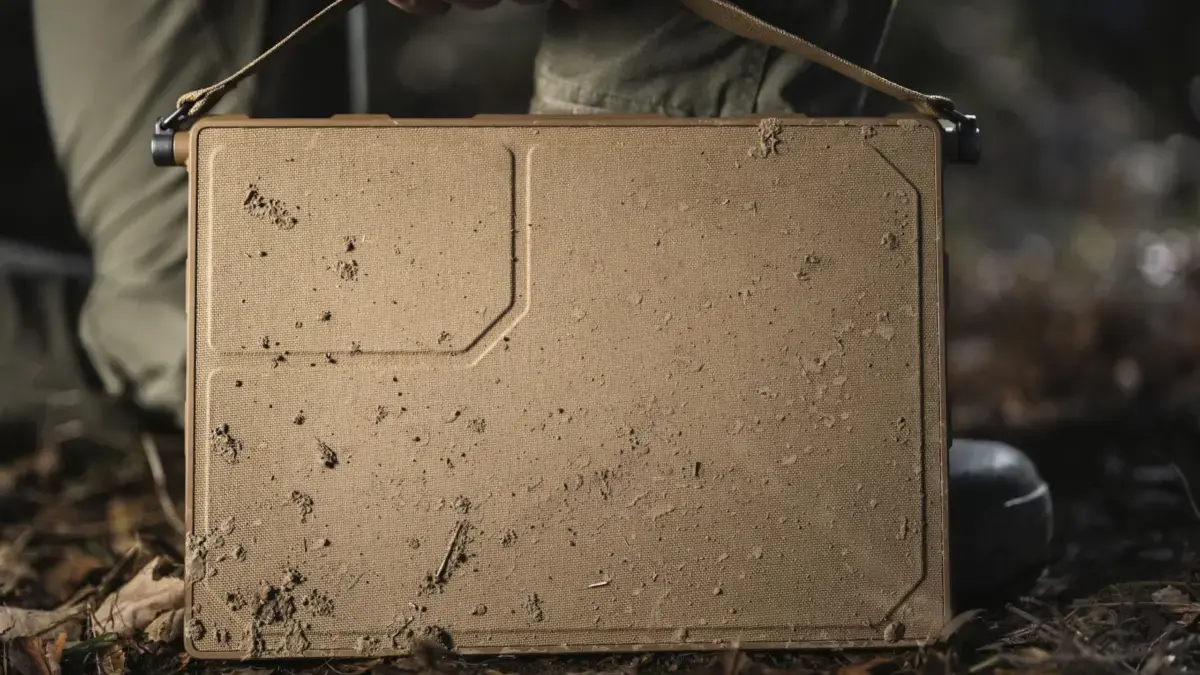
Defense contractor Anduril and chipmaker Qualcomm recently made waves across the tech and defense sectors by announcing a high-profile partnership to build laptops entirely within the United States. The initiative, which targets a commercial rollout with a single model in 2027, also carries a long-term ambition of shifting the broader computer hardware industry toward a fully domestic supply chain.
Even the prospect of a single Made-in-USA laptop comes as a considerable surprise to industry observers. Currently, no major United States computer manufacturer builds its laptops domestically. Industry giants such as Apple, Dell, HP, and Microsoft rely heavily on overseas manufacturing hubs, primarily in Asia, to assemble their consumer and enterprise devices.
The domestic hardware space has a complicated history, marked by projects that ultimately fell short of their grand promises. Over the years, major technology companies have occasionally assembled computers domestically, seemingly in strategic maneuvers to appease political figures like former President Donald Trump, such as Apple’s limited production runs of the Mac Pro in Austin, Texas. Other instances saw companies promise sweeping job creation linked to domestic factories, only for communities to end up with empty industrial buildings, as famously occurred with Foxconn in Wisconsin. Furthermore, the federal government has previously encountered fraudulent entities masquerading as domestic hardware makers to secure government contracts.
Because of this checkered history, watchdogs and journalists naturally ask pointed questions whenever a company proclaims a renewed dedication to domestic manufacturing. This scrutiny is part of an ongoing conversation across the industry. Just over a week prior to the Anduril announcement, similar inquiries were directed at router manufacturer TP-Link regarding its onshoring claims. Following the joint announcement from Anduril and Qualcomm, journalists pressed Anduril founder Palmer Luckey and Qualcomm president and CEO Cristiano Amon for specifics on how the hardware would actually be produced on American soil.
Over the course of just two days following the announcement, Anduril shifted its stance on a critical metric regarding domestic sourcing. Initially hesitant to commit to specific numerical thresholds, the company’s communications leadership eventually clarified that the upcoming laptop will incorporate at least 65 percent of its components from U.S. sources by the time it launches in 2027. That target represents a vital threshold, and one that Anduril representatives had initially declined to guarantee earlier in the week.
During a media call held on Monday, Palmer Luckey spoke candidly about his overarching vision, expressing a desire to manufacture literally every part of a computer inside the United States. He noted that Anduril and Qualcomm had already mapped out a comprehensive plan to achieve that objective over time. Describing the strategic roadmap to journalists, Luckey emphasized that the partnership possesses a clear technical trajectory to reach 100 percent domestic manufacturing in the future.
Luckey also indicated that the forthcoming laptop would be specifically engineered to comply with stringent procurement requirements mandated by the United States military and various federal government agencies. He asserted that the device would meet or even exceed a specific government standard defined by federal acquisition laws. According to Luckey, the project is moving aggressively past the bare minimum required to secure a domestic label, aiming instead for an entirely domestic engineering and production framework that goes beyond the standard expectations of the Buy American Act.
Enacted originally in 1933, the Buy American Act underwent significant revisions during the Biden administration to modernize federal procurement policies. Under the updated framework, at least 65 percent of the total cost of a product’s components must originate domestically for that product to qualify legally as a domestic item. That required percentage is scheduled to increase further to 75 percent by 2029.
A wide array of goods purchased by the federal government must strictly adhere to these domestic content standards, failing which federal agencies are legally barred from purchasing them unless they secure a formal waiver. Luckey pointed out during the media call that government agencies currently rely heavily on such waivers en masse because the commercial market lacks readily available, fully compliant alternatives. He explained that various government entities are mandated by law to purchase American-made computers, yet a substantial portion of those procurements currently proceed only under legislative waivers due to the absence of domestic manufacturing options.
A careful reading of Anduril’s initial press release revealed specific phrasing noting that the inaugural laptop would be “designed and assembled” in the United States, rather than explicitly stating it would be fully “manufactured” domestically, though future manufacturing goals were clearly highlighted. This distinction mirrors similar scrutiny faced by other hardware makers, such as TP-Link, which declined to confirm full domestic manufacturing despite hinting at expanded local operations during interviews.
To clarify these distinctions, journalists asked Luckey precisely what percentage of the first laptop’s components would originate in the United States upon launch. Rather than citing a fixed figure like 65 or 70 percent, Luckey initially answered that the final percentage was yet to be determined. He explained that the makeup of the machine would depend on complex variables, such as the timeline for domestic semiconductor fabrication facilities coming online for memory, CPUs, and GPUs. He also noted uncertainty regarding whether display manufacturing lines could be established locally prior to launch or if those capabilities would have to be integrated at a later stage.
Luckey stressed his commitment to transparency, acknowledging that the initial production run would likely blend domestic components with parts sourced from trusted international allies, particularly while foundational domestic supply chains continue to scale up. He recounted explaining the realities of the current industrial landscape to government stakeholders, emphasizing that while a 100 percent American laptop is the ultimate goal, the current industrial ecosystem requires a pragmatic, step-by-step approach rather than letting the pursuit of perfection hinder immediate progress.
When reporters followed up via email to press for specific commitments regarding the 65 percent threshold, Anduril representatives initially noted that the laptop prototype sat at approximately 32 percent domestic-origin content by component procurement cost, with more than 90 percent sourced collectively from the United States and allied nations. At that stage, the company stated it could not formally guarantee whether the final product at launch would fall above or below the 65 percent mark.
However, subsequent communications from Anduril reversed that cautious stance. A revised statement issued by Anduril communications VP Shannon Prior explicitly confirmed that the company is developing the BlueChip laptop to surpass the 65 percent U.S. domestic-content threshold when it launches in 2027. The updated statement clarified that meeting this federal threshold is a fundamental objective of the program, even as the precise domestic content percentage continues to evolve alongside final supplier agreements and prototype testing.
This clarification marks the first time Anduril has confirmed that government agencies and commercial buyers will not necessarily have to wait for the realization of the company’s ultimate long-term goals to obtain a device meeting the Buy American standard. If the current roadmap holds, the collaborative laptop developed alongside Qualcomm in 2027 should fulfill those statutory requirements right out of the gate.
While follow-up interviews with Luckey regarding the granular mechanics of reaching the 65 percent mark were not immediately available, the initial media briefing provided several concrete examples of how Anduril plans to build out its domestic supply chain. Luckey highlighted that the company has already secured a U.S. glassmaker to supply the laptop’s cover glass. Additionally, Anduril is programming field-programmable gate arrays to handle power management and other essential circuit functions typically reliant on overseas manufacturing, alongside ongoing efforts to develop proprietary American-made batteries.
Furthermore, official project disclosures indicate that the laptop enclosure is purposefully engineered for U.S. machining, utilizing metals that domestic industrial facilities can reliably produce and process at scale.
Regarding the advanced Snapdragon processor powering the machine, Qualcomm president and CEO Cristiano Amon addressed the manufacturing origin during his discussion with reporters. Amon confirmed that the chips will be produced domestically at Taiwan Semiconductor Manufacturing Company’s advanced fabrication facility located in Arizona, anchoring a critical component of the laptop directly within the United States.