
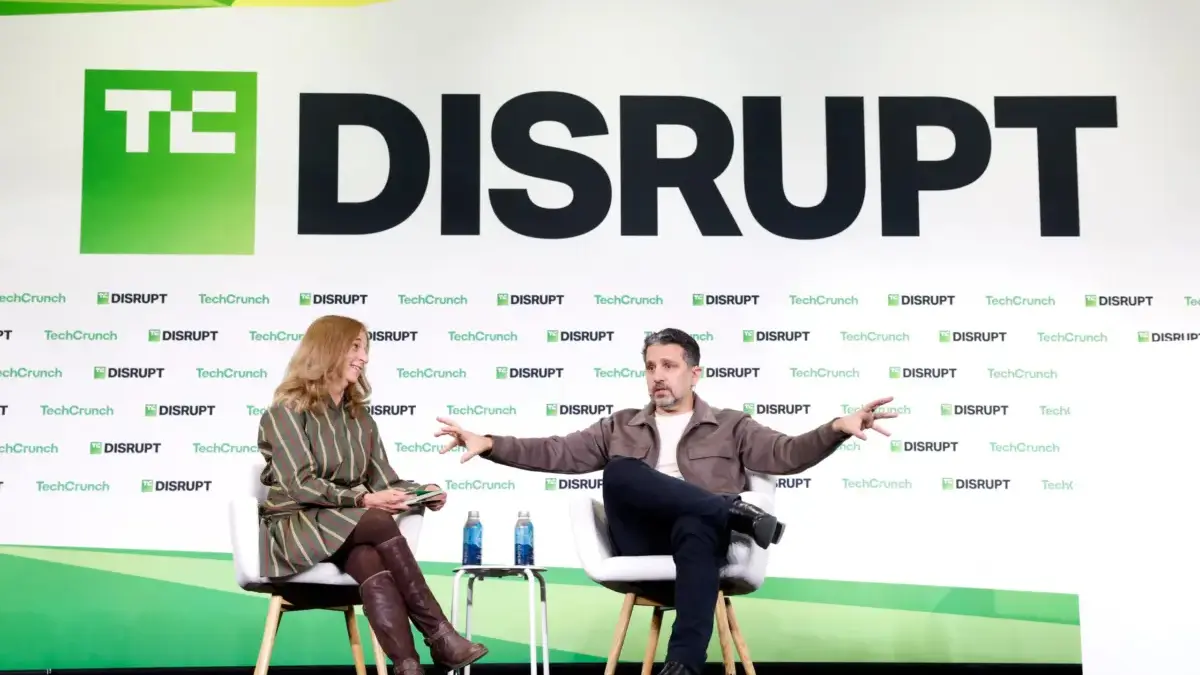
SAN FRANCISCO — Speaking to a packed audience of entrepreneurs, investors, and technology leaders on stage at TechCrunch Disrupt in San Francisco, Amazon executive Panos Panay delivered a clear and unvarnished message regarding the realities of product development: experiencing failure is not merely a possibility to prepare for, but an inevitable and required component of building anything truly successful.
Panay, who currently serves as Amazon’s senior vice president of Devices, Alexa, and Leo, shared these insights while reflecting upon his extensive career in the technology industry. Before joining Amazon, Panay spent more than 19 years at Microsoft, where he oversaw the development of numerous high-profile hardware and software projects, enduring both celebrated triumphs and intensely public setbacks along the way. Drawing directly from those decades of corporate experience, he argued that the pursuit of innovation inherently demands a willingness to stumble, falter, and occasionally face outright catastrophe.
“You have to be willing to fail, and actually, not just willing, you actually have to go fail,” Panay told the audience in San Francisco. “If you haven’t failed, you probably haven’t pushed the boundary. It’s literally about harvesting the lessons learned when you fail. You have to be willing to face it, and as you face it, learn from it.”
According to Panay, modern startup founders and product developers often spend an excessive amount of energy attempting to insulate themselves from risk, operating under the assumption that a flawless launch is the only acceptable outcome. In his view, this mindset is fundamentally counterproductive. True breakthroughs, he suggests, only emerge when teams venture into uncharted territory where the outcome cannot be guaranteed. When those ventures inevitably hit a wall, the distinction between a failed company and a resilient one lies entirely in how leadership handles the aftermath.
Panay stressed that it is entirely possible for organizations and individuals to recover from all varieties of setbacks, even those of a catastrophic scale. To illustrate this point, he opened up about one of the most difficult chapters of his tenure at Microsoft: the ambitious yet troubled launch of the Surface RT.
Introduced as Microsoft’s first-ever tablet computer, the Surface RT was heavily anticipated as a watershed moment for the company as it sought to expand its footprint beyond traditional personal computers and into the mobile hardware market. Instead, the product struggled heavily with consumer adoption, software limitations, and software compatibility issues. The miscalculation ultimately resulted in a massive, highly publicized write-down for Microsoft of nearly $1 billion.
For a product leader, having a multi-million-dollar flagship hardware initiative publicly unravel is a humbling experience, and Panay recalled the intense pressure and public scrutiny that accompanied the period.
“I remember being on the front cover of a newspaper, and it just said failure,” Panay recalled, describing the stark reality of facing the media fallout. “But, here’s the thing, it was easy to admit failure. The trick was, and always is, did you harvest the learnings and understand what happened? All right. What did you learn? Because the failure wasn’t that moment. It was decisions that led up to it two years before that, whether the software wasn’t complete or the inventory was wrong or how we balanced into retail. There were all these steps along the way.”

By breaking down the anatomy of the Surface RT launch, Panay highlighted a critical realization for founders: the moment of public failure is rarely caused by a single isolated mistake on launch day. Rather, it is typically the culmination of a long chain of strategic decisions, logistical missteps, or premature choices made months or even years prior. Understanding this distinction, he argued, allows leaders to stop making excuses, accept the reality of the situation, and begin the rigorous work of analyzing where the process broke down.
Panay emphasized that founders must cultivate the emotional fortitude to look squarely at what went wrong without deflecting responsibility. Avoiding excuses is paramount, he noted, because self-deception prevents a team from gaining any genuine utility out of a bad situation. Once a founder genuinely accepts that a product or strategy has failed, the focus must immediately shift toward extracting actionable insights from the wreckage.
However, accepting failure and learning from it does not mean abandoning the overarching mission that inspired the venture in the first place. Panay was careful to draw a sharp line between a tactical product failure and a strategic surrender of one’s long-term vision.
“Here’s the other side of it,” Panay explained. “You want to succeed, yeah? You take that failure, but you don’t let go of your vision. That’s it. Surface has done pretty well. You don’t let go of your vision. You don’t break it.”
Indeed, despite the disastrous financial and critical reception of the original Surface RT, Microsoft did not abandon the Surface hardware line. Instead, the company iterated, refined the software ecosystem, addressed hardware design challenges, and eventually built the Surface brand into a respected and lucrative product portfolio within the enterprise and consumer markets. That endurance, Panay argued, is the direct result of maintaining an unyielding commitment to the core vision while remaining entirely flexible about the tactical execution.
Throughout his conversation at TechCrunch Disrupt, Panay continually returned to the themes of operational adaptability, continuous learning, and swift corrective action. In his estimation, entrepreneurs who embrace setbacks are ultimately positioned to adapt much faster than those who remain paralyzed by the fear of making a mistake. When a project encounters an obstacle, a leader who has already accepted the reality of failure can pivot smoothly rather than doubling down on a broken strategy out of pride or stubbornness.
“It goes back to the same fundamental, like, have you learned?” Panay said. “Were you learning along the way? Because if you were learning, then you just change your vector. Usually, it’s not 180 degrees. Usually, it’s just 30 degrees. Take your lessons learned, change a little bit, adapt your vision where it needs to be, and then go. I believe there’s people that hang on too long, but it’s because they haven’t accepted the moment of failure at all.”
For the startup founders in the audience, Panay’s perspective offered a pragmatic framework for navigating the volatility inherent in early-stage company building. Rather than viewing failure as an existential threat that signals the end of the road, he urged the tech community to reframe missteps as necessary data points on the path toward genuine innovation. By confronting mistakes honestly, retaining faith in their core objectives, and making subtle, intelligent course corrections along the way, builders can transform their most painful setbacks into the very foundation of their future success.


Leave a Reply