
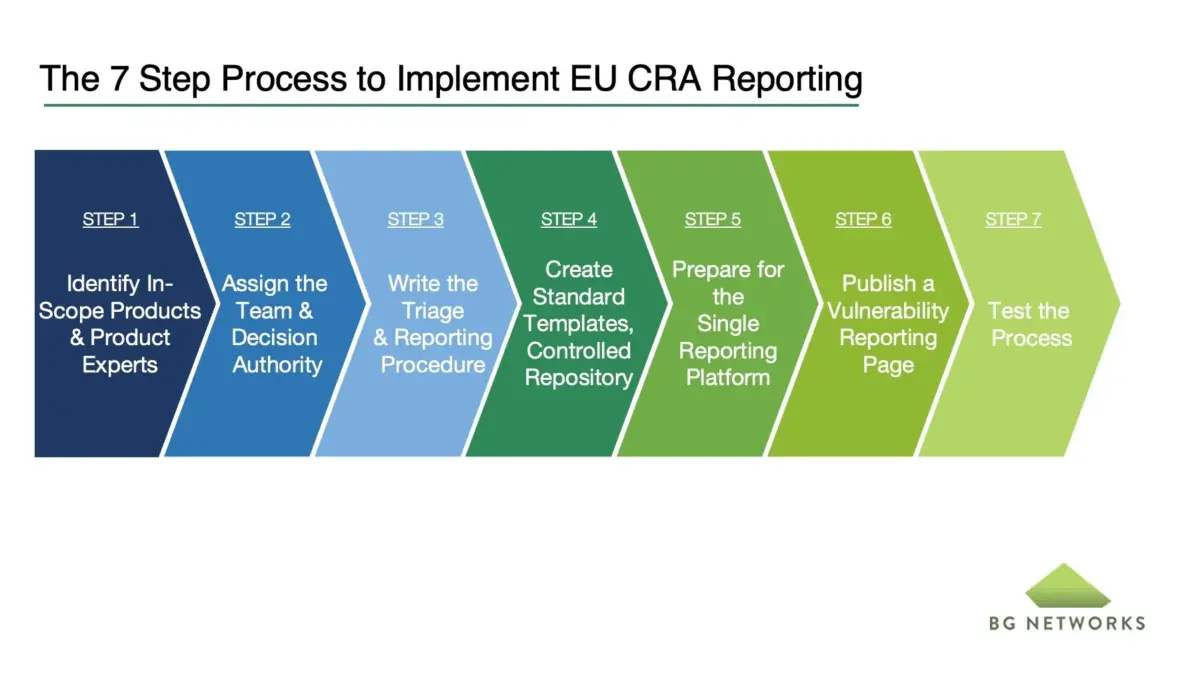
While much of the industry has focused on the broader product-conformity milestones slated for December 2027, hardware and software makers face a much tighter operational deadline under the European Union’s Cyber Resilience Act (CRA). Mandatory reporting obligations will officially take effect on September 11, 2026, requiring organizations to act quickly to establish compliance frameworks, response teams, and secure communication channels.
Beginning on that date, manufacturers placing products with digital elements on the EU market must report actively exploited vulnerabilities and severe security incidents through the European Union Agency for Cybersecurity (ENISA) Single Reporting Platform. The regulation impacts a sweeping range of products sold within the EU that feature network or data connections and are not currently governed by sector-specific rules. This includes desktop and mobile software, consumer tech devices, industrial automation systems, networking hardware, and semiconductors, bringing legacy goods already on the market into the regulatory fold.
The CRA establishes strict reporting triggers that mandate rapid communication with authorities. When an actively exploited vulnerability is discovered, companies must issue an early warning within 24 hours of awareness, detailing the alert and a list of countries where the product is available. This must be followed within 72 hours by a formal notification outlining the affected product versions, the nature of the exploit, initial mitigating actions taken, guidance for users, and the sensitivity level of the report. A comprehensive final report is required no later than 14 days after a corrective or mitigating measure becomes available, providing a full description of the vulnerability, its impact, malicious actor details, and the remedy applied.

A similarly rigorous timeline applies to severe security incidents. Manufacturers must submit an early warning within 24 hours of awareness, followed by a notification within 72 hours that includes an initial impact assessment and immediate mitigation steps. A final report providing a thorough description of the incident, severity, root cause, and ongoing remediation measures must then be submitted within one month of the initial notification. Industry experts note that response teams are not expected to complete a full root-cause analysis within the first 24 hours, as the phased reporting structure is designed to accommodate initial findings with limited available data.
To meet these demanding timelines, manufacturers are being urged to evaluate their operational readiness well in advance of the September deadline. Preparing for these obligations involves identifying all in-scope product families and assigning internal product experts long before an incident occurs. Because the statutory clock starts the moment a company becomes aware of an exploit or incident—rather than upon the completion of an internal investigation—organizations must avoid sluggish approval chains and establish clear decision-making authority.
Companies must also formalize their triage and reporting procedures by monitoring intelligence feeds, establishing secure evidentiary protocols, and identifying the designated Computer Security Incident Response Team (CSIRT) in the relevant member state. Alongside regulatory notifications, manufacturers carry an obligation to inform impacted users about vulnerabilities and deployable mitigations, making clear customer communication channels essential.

Operational readiness further requires establishing standardized internal templates that mirror ENISA’s reporting stages, supported by controlled repositories with secure access controls and event chronologies. Manufacturers must prepare to interact directly with ENISA’s Single Reporting Platform by assigning authorized representatives with active EU login credentials and rehearsing submission workflows.
Additionally, organizations need to implement coordinated vulnerability disclosure policies and provide a reliable, monitored single point of contact for external security researchers, customers, and integrators. Conducting tabletop exercises before the deadline can help expose bottlenecks in product ownership, slow approval workflows, or unavailable backup personnel while there is still time to remediate them.
Ultimately, compliance with the early CRA reporting mandate is not merely an administrative registration exercise. It requires accurate product inventories, dedicated cross-functional response teams, structured triage criteria, and tested workflows capable of operating under intense time pressure. As the September 11, 2026 deadline approaches, manufacturers must ensure that vital security information can flow seamlessly from internal technical teams to European authorities without delay.



Leave a Reply