
Take-Two Interactive has informed U.S. federal courts that its ongoing investigation into the high-profile leak of Grand Theft Auto VI is "rapidly evolving." Fresh legal maneuvers filed in a New York federal court reveal that the gaming giant is intensifying its hunt for the individuals responsible for distributing unauthorized gameplay footage months ahead of the title’s anticipated November launch.
Coming on the immediate heels of an extended preview showcased by Rockstar on Netflix, Take-Two has submitted a new Digital Millennium Copyright Act (DMCA) subpoena request. However, unlike its earlier public filings, the company has asked the court to keep the latest document strictly sealed to prevent tipping off the alleged infringers. Simultaneously, Take-Two has officially dropped its previous DMCA subpoena against Google’s YouTube, determining that the platform-specific data is no longer necessary for its current legal strategy.
The unfolding legal battle began roughly two weeks ago when an online user operating under the moniker "Cyberleek" started posting gameplay footage from Grand Theft Auto VI. The leaks surfaced months ahead of the game’s scheduled market debut, prompting Take-Two Interactive to launch an immediate and aggressive response. The company rolled out a widespread wave of digital takedown notices across the internet, alongside a cluster of DMCA subpoenas filed in federal court with the ultimate goal of unmasking the perpetrators behind the breach.
DMCA subpoenas represent a specialized legal mechanism designed to empower copyright holders. This tool allows rightsholders to compel third-party service providers to hand over identifying information regarding alleged infringers without the immediate necessity of filing a formal lawsuit. In this particular instance, Take-Two leveraged the mechanism for a broad initial sweep, casting a wide net that ultimately targeted thousands of individual Discord users.

As legal developments progressed, the scope of Take-Two’s investigation rapidly expanded. Previous reporting highlighted how the corporate net widened to encompass tech giants and communication platforms, including Microsoft, X, and Google’s YouTube. Recent court filings confirm that this hunt is not only moving forward but adapting to new information gathered by the publisher’s legal team.
On Friday, just one day after Rockstar Games streamed an extended look at Grand Theft Auto VI on Netflix, Take-Two returned to the federal court system. The company submitted a request for another subpoena targeted squarely at Discord. However, breaking from its previous approach, Take-Two asked the court to keep the contents and targets of this latest filing completely out of public view.
A Sealed Second Discord Subpoena
Take-Two’s initial DMCA subpoena request was entirely public, enabling media outlets and interested observers to comb through the legal demands. Those documents identified three specific community servers named by the publisher, including one connected to prominent content creator DarkViperAU.
That initial request remains active. According to statements filed by Take-Two, the first subpoena was issued on August 21 and promptly served on Discord, even though standard court records did not immediately list the clerk’s issuance as typically expected in such proceedings.
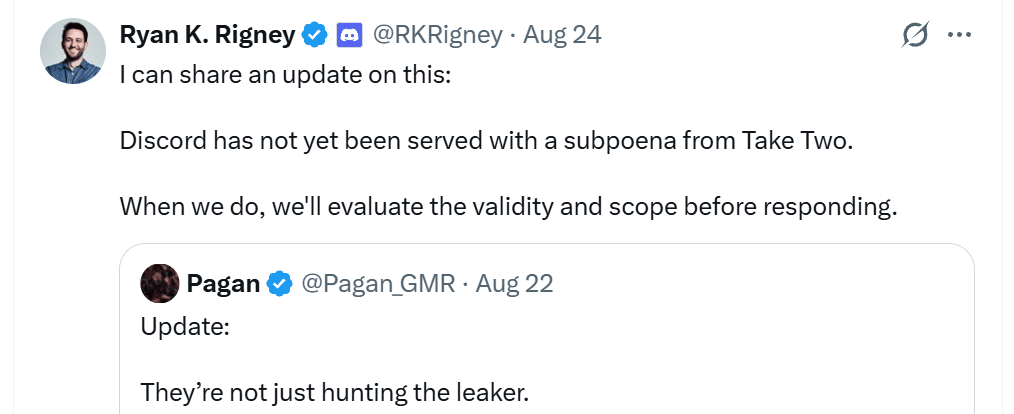
Shortly after the initial filing, Discord’s Ryan Rigney stated on the social media platform X on August 24 that the company had not yet been formally served with a subpoena from Take-Two. Rigney added that Discord intended to carefully evaluate the validity and scope of the demands before issuing a response. While it remains unclear whether Discord’s public stance influenced Take-Two’s subsequent legal tactics, the timing of the events remains a notable element of the ongoing dispute.
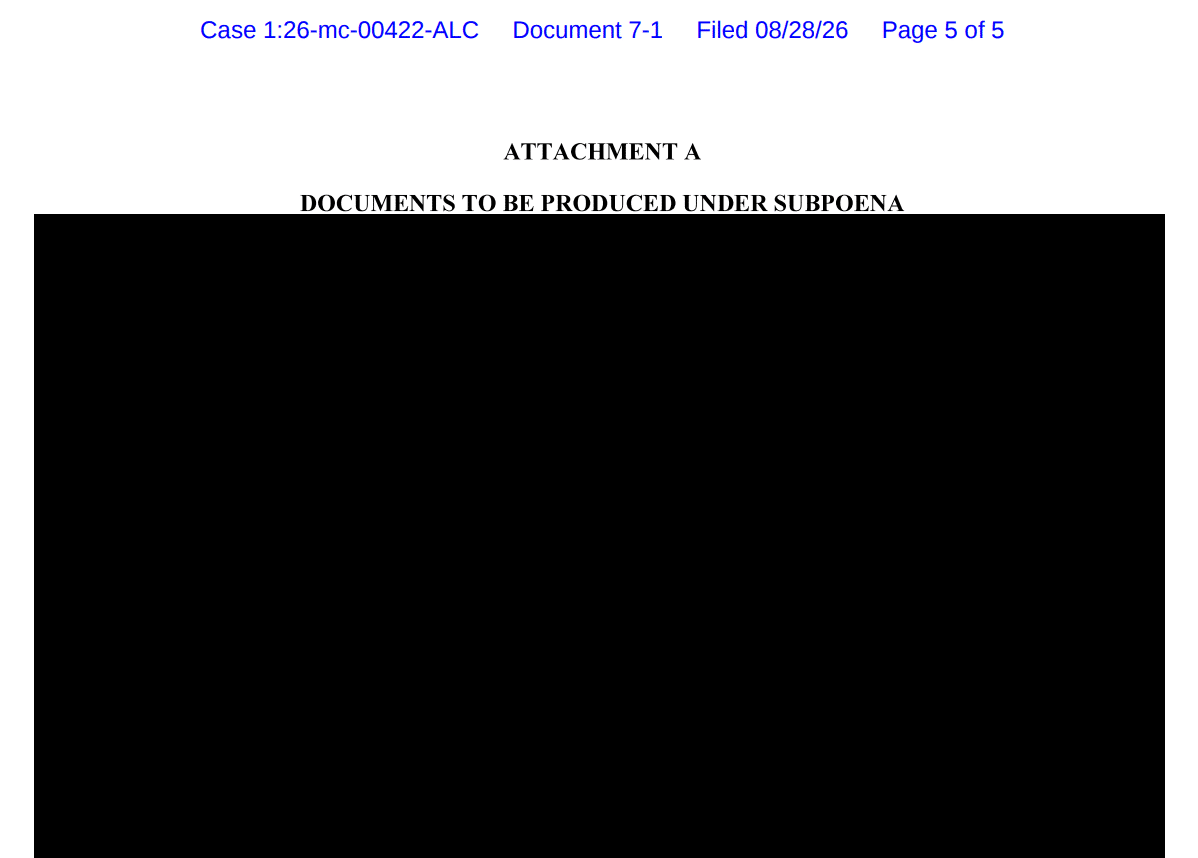
The second subpoena request submitted to the New York federal court marks a distinct shift in strategy. Instead of transparently listing the targeted Discord servers and accounts, Take-Two petitioned the court to file the entire request under seal, effectively blacking out the identities of the targets.
While the specific names remain hidden behind the court-ordered seal, accompanying legal descriptions indicate that the second request is much more narrowly focused. The motion targets one additional Discord user, seeks further identifying information for a previously flagged user, and requests deeper data regarding the community servers identified in the initial subpoena.
"Rapidly Evolving" Investigation
According to Take-Two, maintaining strict secrecy is crucial because exposing the request to the public would unfairly advantage the alleged infringers. The formal motion to seal argues that the subpoena attachments contain highly sensitive and confidential information detailing an ongoing investigation into copyright infringement and the unauthorized misappropriation of Take-Two’s confidential trade materials.
Public disclosure of this information, Take-Two argues, could easily compromise the ongoing inquiry. The company cautions that an open filing would tip off the alleged infringers regarding the exact nature and progress of the investigation, as well as reveal the specific intelligence Take-Two has already managed to gather about the source and spread of the leaks.
The publisher expressed a primary concern that if the targets are made aware of the current state of the investigation, they could actively destroy, conceal, or alter important digital evidence before law enforcement or corporate investigators can secure it.
To emphasize the dynamic nature of the case, Take-Two stressed that its investigation is both rapidly evolving and continuously active. This ongoing evolution is precisely why the second subpoena seeks different categories of information compared to the first broad sweep. For the time being, these new legal demands remain hidden from public view, and the federal court has yet to formally rule on whether the seal will be sustained or when the subpoena will be issued.
YouTube Subpoena Dropped
The theme of a rapidly evolving investigation was also invoked by Take-Two in a separate update concerning its YouTube subpoena, though that particular track yielded the exact opposite result.
Earlier in the legal proceedings, Take-Two had petitioned Google to identify the individuals operating three specific YouTube personas connected to a leaked video: CyberLeeks, Surfer24k, and CyberLeek_ar_io. However, U.S. District Judge John P. Cronan initially declined to sign off on the request, noting that the publisher needed to provide more concrete information demonstrating how the targeted accounts were directly linked to the leaked material.
Although Take-Two subsequently submitted additional details in an attempt to satisfy the court’s requirements, the company ultimately decided to abandon the request entirely. Citing the rapid evolution of its wider investigative efforts, Take-Two informed the court that it no longer requires the specific data held by Google.
In its formal notification to the court, the publisher stated that it had determined it no longer needed the particular information previously requested from Google, and accordingly chose to respectfully withdraw the subpoena application.
While Take-Two explicitly reserved the right to return to Google with a fresh request at a later date should circumstances change, the YouTube subpoena is entirely off the table for now. Attention has firmly shifted toward the Discord demands as the primary focal point of the publisher’s anti-piracy campaign. Whether these concealed legal maneuvers will successfully lead Take-Two to the ultimate source of the leaks remains to be seen as the federal proceedings continue.
Leave a Reply