
Debian has earned widespread praise within the open-source community following a presentation at MiniDebConf Winterthur by CERN engineers Federico Vaga and Nikos Tsipinakis. The engineers detailed an ambitious and large-scale migration plan that will see the European Organization for Nuclear Research transition its critical particle accelerator control computers onto Debian 13. By the end of 2026, more than 2,200 industrial computers and embedded systems across the facility are scheduled to run the popular Linux distribution.
While the announcement marks a significant vote of confidence for Debian, it is important to clarify the scope of the transition. The migration does not encompass the entirety of CERN’s massive IT infrastructure, which spans extensive data centers, administrative systems, and scientific computing grids. Instead, the focus is squarely on the accelerator control layer—the specialized front-end computers that interface directly with the hardware managing the particle beams. These systems require extreme reliability, precise timing, and robust stability to ensure the safe and efficient operation of the world’s most powerful particle physics laboratories.
Why Move?
The decision to migrate away from CERN’s previous operating system ecosystem was driven by mounting technical and financial pressures. Back in the second quarter of 2023, CERN conducted a comprehensive risk analysis to evaluate the implications of remaining within the Red Hat ecosystem. The financial and operational projections were stark. Staying put would have cost the organization roughly 5.4 million Swiss Francs.
Beyond the direct financial burden, the technical obstacles were formidable. The transition would have required a full hardware redesign for approximately 11 different hardware boards. To execute this overhaul, CERN would have been forced to expand its personnel significantly, hiring two electronic engineers, two software engineers, and two technicians solely dedicated to managing the hardware redesign and infrastructure refitting.
Furthermore, the physical infrastructure would have required substantial disruption. Racks across the facility would need to be reorganized and completely rewired. Operational continuity would also take a major hit, as most systems would be directly affected during the commissioning phase. Even under the most optimistic projections—assuming entirely bug-free hardware replacements—CERN’s internal risk assessment estimated the overall odds of success at a meager 20 percent.
The root cause of these complications boils down to a specific compiler flag. When Red Hat builds successive iterations of Red Hat Enterprise Linux, it designates a minimum CPU generation required to run the software. The introduction of RHEL 9 already effectively excluded CERN’s oldest legacy boards. These older systems, running chips such as Intel’s Core 2 Duo processors, account for approximately 47 percent of CERN’s existing front-end fleet.

The situation was slated to worsen with the release of RHEL 10, which raises the hardware cutoff bar even higher. Under the requirements of RHEL 10, another significant portion of CERN’s hardware—specifically, newer Ivy Bridge-generation boards representing an additional 17 percent of the fleet—would fall on the wrong side of compatibility standards. Faced with the prospect of discarding perfectly functional industrial hardware or undertaking a multi-million-dollar refitting campaign, CERN looked for a more flexible and long-term operating system solution, ultimately landing on Debian.
The Release Strategy
To ensure a seamless transition that aligns with the rigid operational schedules of its particle accelerators, CERN evaluated multiple long-term support pathways. The organization ultimately mapped out two primary strategic plans, both designed to maintain stability across the accelerator control infrastructure.
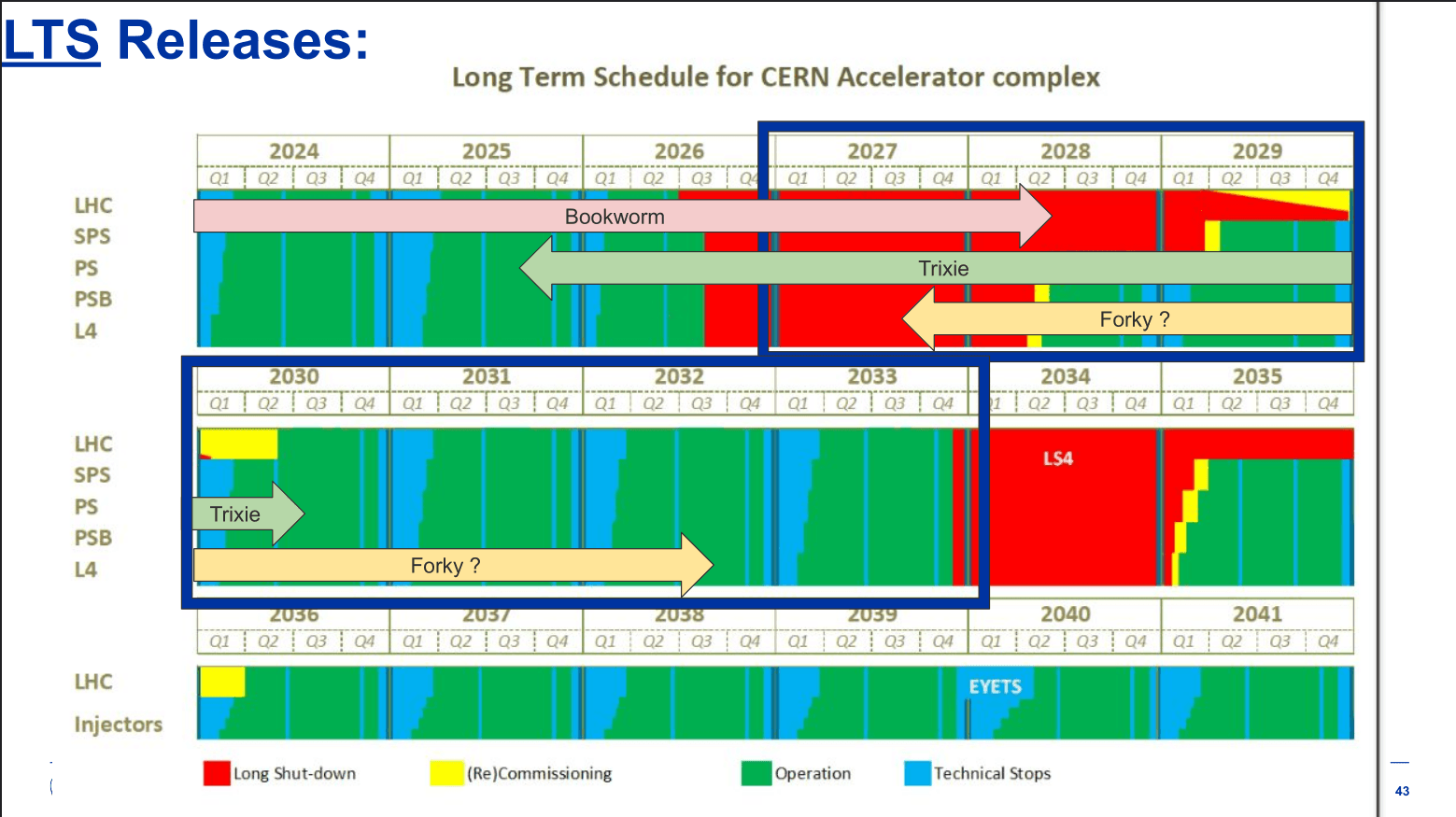
Under the first approach, designated as Plan A, CERN development teams will focus on Debian Bookworm through the end of 2026. Following that initial phase, the organization plans to deploy Debian Trixie as its core long-term support release, maintaining it from 2026 through 2030. Once that lifecycle concludes, the infrastructure would subsequently transition to Debian 15, which carries the codename Duke.
Alternatively, Plan B offers a slightly more consolidated trajectory. This strategy involves adopting Debian Trixie but bypassing the subsequent jump to Debian 15. Instead, CERN would remain on Trixie by leveraging extended long-term support programs, pushing the support horizon all the way out to 2033. During their evaluations, engineering teams considered a third option—running Bookworm under extended support for the entirety of the timeline—but ultimately ruled it out in favor of the more modern Trixie pathways.
The viability of both long-term support strategies relies heavily on the ongoing health and sustainability of Debian’s dedicated support ecosystem. Recognizing the critical nature of these support programs, CERN has actively initiated sponsorships for Freexian, the specialized Debian-focused services company that oversees and delivers these extended maintenance and security initiatives.
How It Will Be Built
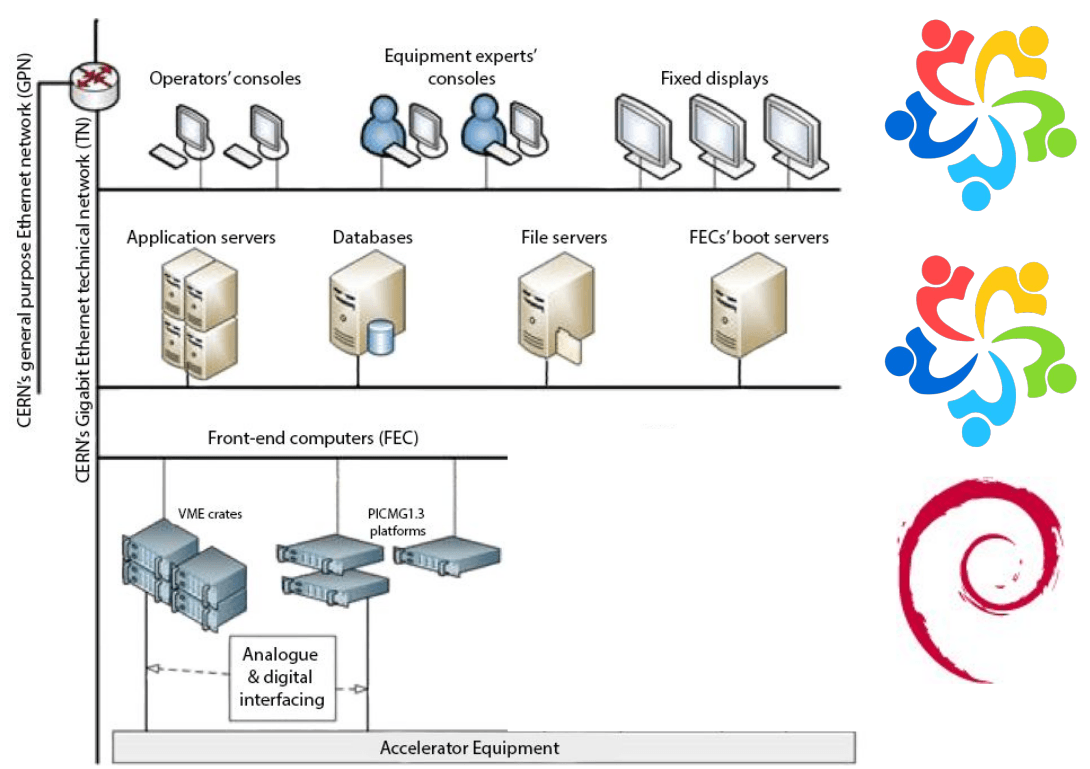
The architectural overhaul accompanying the migration represents a massive modernization of CERN’s deployment methods. The legacy infrastructure relied heavily on Network File System and tftpd, utilizing a traditional bootserver model that traced its origins back to around 2005. While dependable for its era, this older model lacked the agility and automated consistency demanded by modern facility management.
The new infrastructure fundamentally decouples the core operating system components. Under the modern architecture, the bootloader, kernel, initialization RAM disk, and userspace are separated into distinct, modular pieces. Delivery and orchestration are then rebuilt around Kubernetes, bringing containerization principles and declarative management to the industrial control layer.
In this updated framework, a centralized controller continuously compares the precise configuration desired by CERN engineers against the actual state of deployed systems. If the controller detects that a machine has fallen out of sync with the intended specification, it initiates an automated redeployment. This eliminates the outdated practice of administrators manually pushing configuration files over NFS, significantly reducing the potential for human error and accelerating maintenance cycles.
While this sweeping modernization represents a massive shift in how CERN manages its beam-line hardware, leadership emphasizes that the changes remain contained within the accelerator control domain. The migration does not touch CERN’s broader corporate or scientific data centers, which operate under separate technical frameworks. With planning, testing, and strategy already well underway, CERN remains on track to complete the transition of its 2,200 industrial systems before the final quarter of 2026 draws to a close.
Leave a Reply