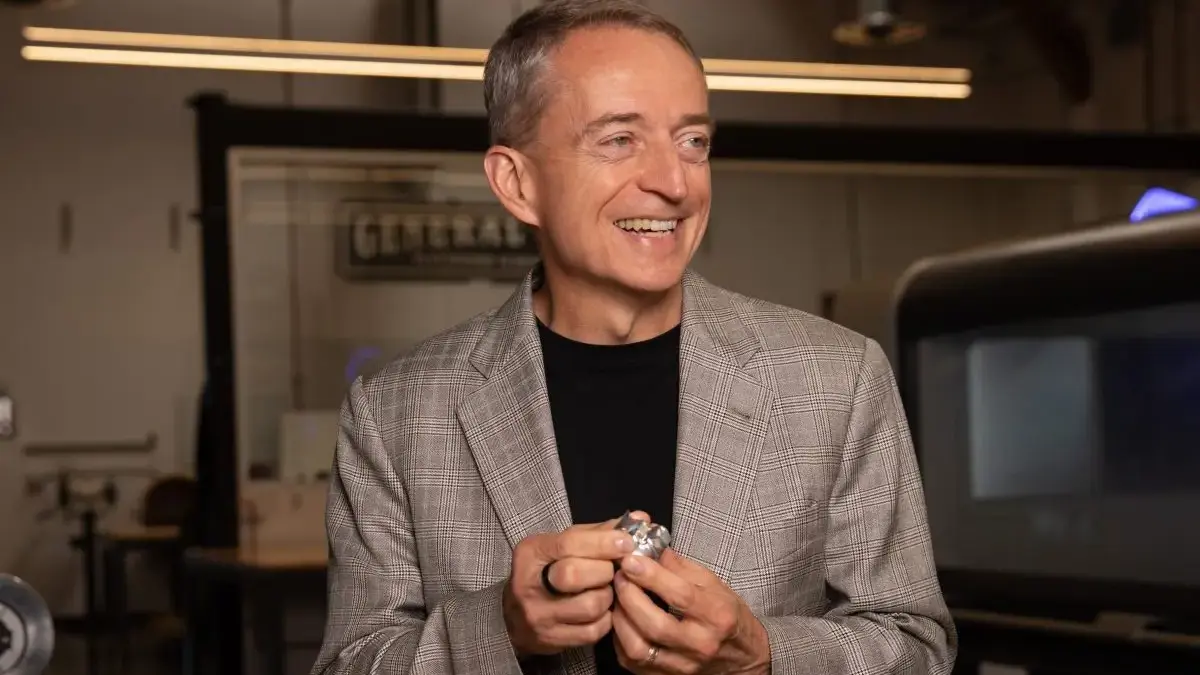
Europe cannot simply spend its way back into the conventional race for leading-edge logic, according to former Intel CEO Pat Gelsinger. As the global semiconductor industry becomes increasingly concentrated among a handful of players capable of financing multi-billion-dollar fabrication processes, the rules of engagement are shifting. Gelsinger, now operating as a general partner at deep-tech venture capital firm Playground Global, argues that attempting to outspend established giants on the latest node scaling is a losing battle for the continent.
“If you want to go compete on 14A, the starting point is 50 years of lithography expertise and $50 billion,” Gelsinger told EE Times. “Otherwise, don’t show up for the race.”
While that assessment might initially sound like an argument for surrender, Gelsinger means almost the opposite. The semiconductor industry is undeniably dominated by a shrinking number of companies capable of financing its most advanced processes. However, the fundamental basis of competition is beginning to change as traditional scaling approaches physical limits and economic barriers.
“In the next phase, as we see it, the entire stack changes,” Gelsinger said.
That coming transformation is the driving force behind a strategic partnership formed between Playground Global and the French research organization CEA. Announced in July, the memorandum of understanding covers advanced computing, microelectronics, artificial intelligence, quantum technologies, energy, and biotechnology. The collaboration pairs CEA’s extensive researchers and specialized infrastructure with Playground’s capital, company-building experience, and international networks. Put less formally, Gelsinger has come to Europe looking for companies that do not exist yet.
Companies Made from “Raw Cloth”

Playground Global describes itself as an early-stage investor, but that label does not fully capture how early the firm is willing to arrive in a technology’s lifecycle. Rather than waiting for a startup to form its own management team and secure initial commercial traction, Playground often steps in at the inception phase of scientific discovery.
“In a number of cases, we’re forming companies out of pretty raw cloth,” Gelsinger said.
The firm scours laboratories, universities, and research institutes for nascent technologies that possess the potential to become the foundation of a scalable commercial enterprise. In many instances, an initial encounter consists of only a pair of researchers, a promising scientific result, and a rough sense that something entirely new has become technologically feasible.
Once a promising avenue is identified, Playground assists in recruiting executive leadership, defining target markets, building out the business model, navigating complex government relationships, and raising subsequent rounds of capital. The firm routinely takes a board seat to guide strategy, and in select cases, portfolio companies even place commercial staff directly inside Playground’s Silicon Valley facility to maintain close proximity to the broader tech ecosystem.
“Some venture capitalists are very hands-off,” Gelsinger said. “We are absolutely hands-on.”
The firm focuses its efforts on areas including new computing architectures, novel materials, advanced biology, energy systems, and modern manufacturing paradigms. Demonstrating the scale of its commitment to this thesis, the firm announced a $475 million fourth fund in May dedicated entirely to early-stage deep-tech investments.
Given this philosophy, the attraction to CEA is easy to understand. The organization’s laboratories house precisely the sort of difficult, capital-intensive, and initially ambiguous technologies that conventional venture capital investors frequently struggle to evaluate. The more compelling question for the industry is whether those laboratory breakthroughs can successfully escape the confines of academic and research institutions to reach broader commercial markets.

From Lab to Fab—and Then to Market
Julie Galland, director of CEA’s Technological Research Division, describes the organization’s mission as taking technology “from lab to fab.” That mandate entails far more than merely demonstrating that a scientific concept works under controlled laboratory conditions. Researchers must transform discoveries into repeatable processes that can be successfully manufactured, transferred to established industrial partners, or integrated directly into newly formed startups.
Galland emphasizes that the agreement extends well beyond CEA-Leti, the specific research institute within CEA that specializes in microelectronics and digital technologies. While Leti is a crucial cornerstone, the partnership spans across other divisions of CEA, drawing upon deep institutional capabilities in fields like energy and healthcare.
The arrangement also represents a significant milestone for CEA itself. Galland noted that this partnership is the organization’s first dedicated arrangement of its kind with a U.S. venture capital firm, although approximately 20% of CEA’s industrial partnerships are already held with American companies.
While CEA maintains robust technology transfer programs, industrial partnerships, and internal mechanisms for supporting spinout companies, what Playground brings to the table is direct access to the wider networks surrounding a global technology business. This includes potential executive talent, global suppliers, prospective customers, strategic partners, and later-stage investors who can scale a business internationally.
CEA’s startups may originate in France, Galland observed, but “their ambition is to be global.”
Building a successful deep-tech enterprise requires more than brilliant technology, technical skills, a solid business plan, and funding. A fledgling company must also understand the intricate value chain it is about to enter—knowing precisely who will supply its raw components, who might buy its finished products, and how to reach those buyers efficiently. Playground’s extensive U.S. network and deep-seated company-building experience are intended to bridge those critical gaps.

To manage the collaboration, a dedicated steering committee reviews prospective opportunities on a quarterly basis. The operational traffic is designed to flow fluidly in both directions: CEA can present prospective spinouts to Playground for evaluation, while Playground can connect its existing portfolio companies with CEA researchers, specialized equipment, and advanced development programs.
Rasheed Auguste, an investor at Playground with a background in nuclear engineering and the U.S. Department of Energy, helps apply the firm’s strict filter to prospective projects coming out of the European research pipeline.
“Is the technology hard enough that most people won’t attempt it?” Auguste asked. “Is the market large enough that it matters?”
Those guiding questions deliberately exclude incremental improvements, even those that might be technically impressive. Playground is searching exclusively for technologies capable of disrupting an existing market or creating an entirely new one—and thereby generating the scale of financial return demanded by venture capital economics. Auguste refers to this rigorous evaluation process as the “Playground gauntlet.”
When Old Fabs Meet New Physics
The entire collaboration rests on a foundational bet about the future trajectory of the semiconductor industry: the next major computing platform may not emerge solely from shrinking transistors further.
Gelsinger pointed to cryogenic computing, quantum technology, photonics, superconducting devices, and advanced materials as domains where the ultimate rules of the road remain completely unsettled. Many of these emerging fields depend on physical phenomena that conventional semiconductor computing has historically left unexploited.

Such a shift could fundamentally alter which manufacturing assets hold true value. A mature semiconductor manufacturing process, when combined with unfamiliar material science or novel device architectures, could easily become more economically and functionally valuable than its microscopic feature size might otherwise suggest.
“Now, all of a sudden, the 28-nm process technology with new material science may be the new winner,” Gelsinger said.
This dynamic creates a strategic opening for Europe. While the region may not control the bleeding-edge logic processes required for standard high-end microprocessors, it possesses world-class research institutes, exceptional scientists, deeply rooted industrial expertise, and specialized infrastructure. If the computing world transitions into a prolonged period of architectural and materials-based experimentation, those regional assets will suddenly matter far more.
Playground portfolio company Snowcap offers an early real-world example of this thesis in action. Its ongoing work in superconducting computing has already fostered operational links with CEA, providing both organizations with a working model for how the broader partnership can function in practice.
Galland envisions photonics following a remarkably similar trajectory. Optical technology is currently moving beyond simple communication between distinct components and pushing deeper into the core of computing systems themselves.
“Some of my teams are dreaming about photonics in the computer,” she said.
The vision is technically alluring because light could eventually shoulder workloads currently handled by traditional electrical signals, potentially overcoming stubborn physical limitations in bandwidth and power consumption. Yet, the distance between an encouraging laboratory result and a dependable, mass-manufacturable product remains vast. Bridging that gap demands sustained capital, specialized equipment, willing customers, and considerable time.

That reality brings the partnership directly into contact with its most politically sensitive challenge.
The Sovereignty Problem
European policymakers and governments harbor clear ambitions regarding sovereign technology capabilities, strategic domestic manufacturing, and the cultivation of homegrown companies headquartered on the continent. Conversely, Playground Global’s primary objective is building high-growth businesses tailored for global markets—and its venture capital backing carries no inherent guarantee that a company born out of a French laboratory will remain permanently domiciled in Europe.
“Some of those companies that may emerge may be French-based or maybe domiciled elsewhere,” Gelsinger acknowledged.
A breakthrough technology might originate at a CEA facility, employ talented French researchers, and benefit directly from public European investment, yet ultimately find itself incorporated, financed, or expanded elsewhere in the world. The very international networks that help transform a local startup into a global powerhouse can simultaneously loosen its institutional ties to Europe.
Galland does not view global commercial ambition and European strategic sovereignty as mutually exclusive goals. The French government understands that high-tech strategic industries operate on an international stage, she noted, while CEA and its domestic partners continue to strive for local investment, high-value employment, and vibrant industrial activity within France.
“There is no inconsistency between these needs,” she said.

At the same time, a negotiation is clearly taking place beneath the surface. Playground is not functioning as a regional economic development agency, nor is CEA merely an intellectual property farm for Silicon Valley venture capitalists. Each entity brings distinct priorities to the table.
“We think the best companies serve global markets,” Auguste said.
For Playground, that philosophy translates to searching wherever the underlying science is strongest and connecting it to customers and capital across international borders. For CEA, the objective is leveraging those international connections without letting globalization devolve into a one-way extraction of European research capital.
A Long Search
Gelsinger does not expect the partnership’s most impactful achievements to materialize within Playground’s current $475 million investment vehicle, known as Fund IV—and suggests they may not even surface in the fund that follows it.
While certain CEA projects may be mature enough to receive early-stage investment relatively soon, others will require years of patient scientific maturation. Still others may eventually reveal commercial possibilities that neither side can yet articulate.
“So that’ll be the one past Fund 4,” Gelsinger said, “and the one past that, and the one past that.”

Ultimately, that long-term horizon may prove to be the partnership’s most consequential feature. Playground is not simply shopping for polished startups that CEA has already prepared for market; it is embedding itself early enough in the pipeline to influence which underlying technologies evolve into companies, which specific markets they choose to pursue, and how they are introduced to the global economy.
Europe’s next major computing enterprise may not begin by attempting to outpace today’s dominant industry players at their own game. Instead, it may start with an overlooked material, an older manufacturing process node, an unfamiliar piece of physics—and two researchers who do not yet realize they are running a company.
Gelsinger has come to Europe to help them build one.