Newly unredacted court documents in an ongoing legal battle have shed light on Meta’s internal investigations, revealing that several employees appear to have interacted with adult films produced by Strike 3 Holdings and Counterlife Media. The adult content producers originally filed a high-profile lawsuit accusing the tech giant of downloading thousands of their copyrighted films via BitTorrent to train artificial intelligence models.
Meta has vehemently denied the allegations from the outset, maintaining that any such activity was entirely unauthorized, unrelated to corporate operations, and certainly not utilized for AI training. As the legal discovery process moves forward, both sides are clashing over the significance of internal findings, the identity of anonymous downloaders, and the digital infrastructure associated with the alleged infringement.
The legal dispute began last year when adult film producers Strike 3 Holdings and Counterlife Media launched a copyright infringement lawsuit against Meta. The plaintiffs claimed that the multinational tech corporation systematically downloaded vast quantities of their adult video catalog using peer-to-peer BitTorrent networks. According to the lawsuit, these files were allegedly acquired to serve as training data for Meta’s expanding suite of artificial intelligence models, a sector where massive datasets are routinely harvested to improve machine learning capabilities.

Meta immediately pushed back against the accusations, denying any corporate involvement or authorization of piracy. Early in the proceedings, the company suggested that if any downloads of the specified films had occurred, they were likely carried out by individual employees or office visitors for purely personal use, completely detached from company business or AI development initiatives.
That defense is currently being thoroughly tested during the discovery phase of the litigation. A joint status report filed by legal representatives from both parties indicates that internal searches conducted by Meta successfully identified multiple employees who appear to have interacted directly with the plaintiffs’ copyrighted videos and associated torrent files.
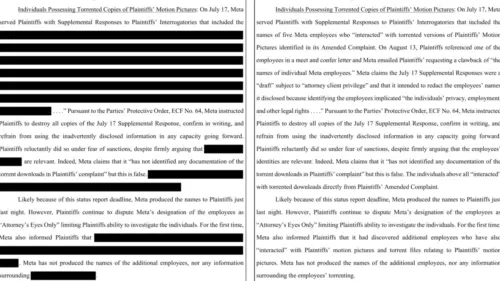
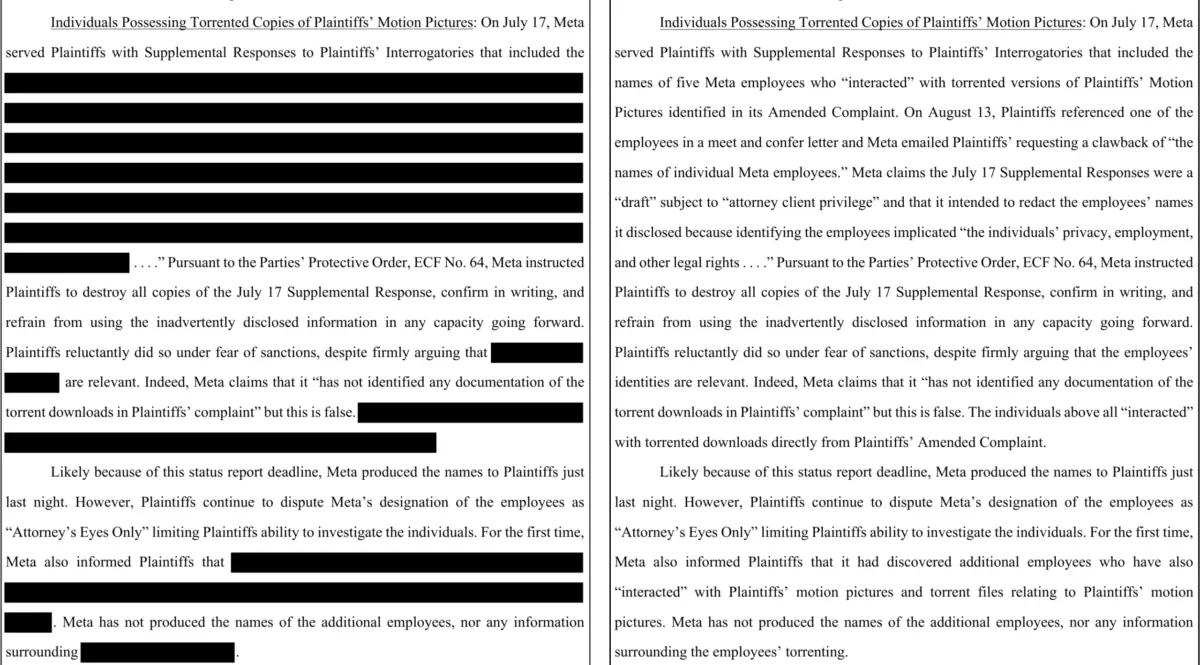
The status report was initially submitted to the court with extensive blacked-out sections, obscuring critical details from public view. However, a week later, Meta narrowed its redactions and refiled a revised version of the document, lifting the veil on previously hidden information and bringing the internal findings into sharper focus.
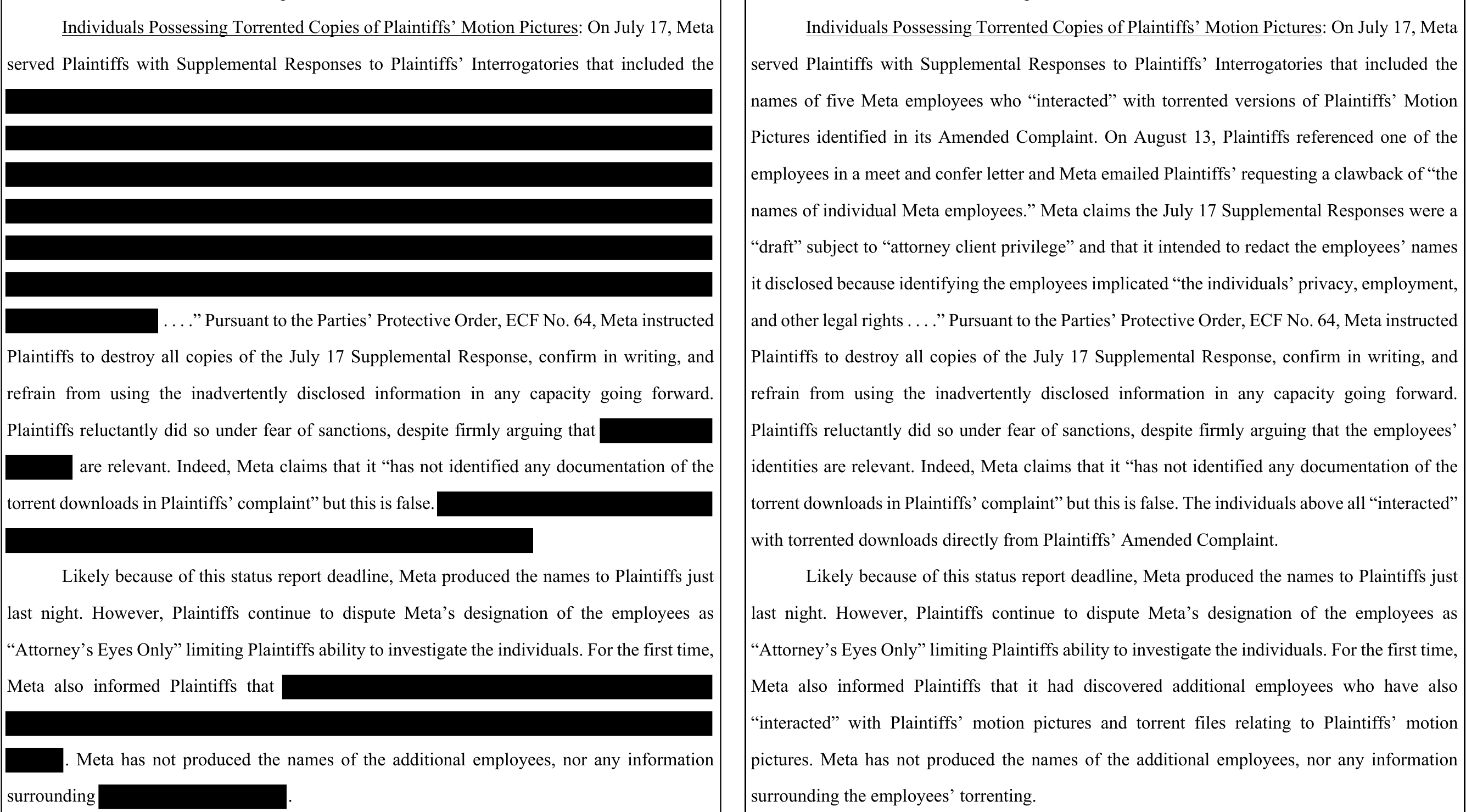
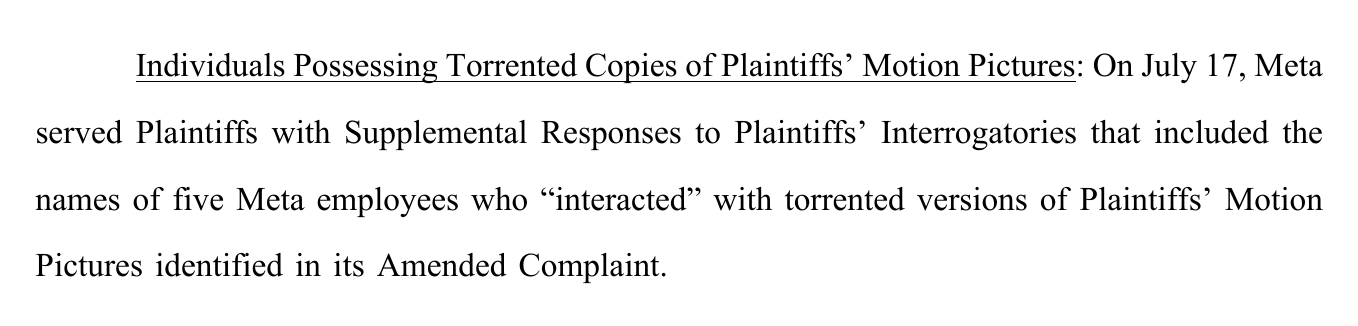
According to statements from Strike 3, Meta initially disclosed the names of five employees back in July who appeared to have interacted with torrented versions of the adult films. Meta later contended that this initial disclosure was merely a draft sent by mistake and subsequently attempted to claw it back.

The tech company later shared the employee names once again, but under strict legal limitations, designating the information under an "Attorney’s Eyes Only" restriction. Strike 3 has expressed frustration regarding this limitation, arguing in the status report that the restrictive designation severely hampers its legal team’s ability to thoroughly investigate the individuals involved and understand the full scope of the activity.
Furthermore, the pool of individuals may extend beyond the initial disclosures. Meta has reportedly informed Strike 3 about additional employees who interacted with the adult films and related torrent files, though their identities have not yet been formally disclosed in the available filings. The reasoning behind withholding these specific names has not been detailed in the public documentation.
Despite identifying personnel who interacted with the content, Meta continues to emphasize that it has discovered no concrete evidence demonstrating that the videos were actually downloaded via torrents by these employees, or anyone else, on behalf of the company. Meta maintains that the identified individuals merely "appear to have interacted with (e.g., viewed or opened)" the films in question.
In its court filings, the tech giant formally stated that to date, it has found no evidence supporting the plaintiffs’ claims that the alleged torrent downloads were performed with Meta’s knowledge, authorization, or for its corporate benefit. The company reiterated that none of the user activity uncovered during its internal investigations was authorized or bore any relationship to its artificial intelligence training programs.
Meta has also offered a technical explanation regarding the suspicious IP addresses flagged by Strike 3 during their initial investigations. The company points out that the vast majority of the IP addresses tied to the alleged downloads belong to third parties over which Meta exercises no direct control or administration.
Meanwhile, corporate IP addresses belonging to Meta that appeared in connection with the data largely trace back to an internet service the corporation acquired years ago. This unnamed service was previously offered to the general public before being officially phased out and shut down in 2019. While the legal paperwork does not explicitly name the service, the description closely matches Onavo, a controversial virtual private network service owned and operated by Meta until its closure in early 2019.
The unredacted joint filing also provides updates regarding a parallel legal maneuver involving an anonymous subscriber. In late August, Strike 3 successfully unmasked an anonymous AT&T subscriber, identifying the individual as a former Reality Labs executive at Meta. The adult film producer subsequently asked the court to relate this "John Doe" case directly to the broader Meta copyright lawsuit.
Initially, Judge Eumi K. Lee denied the request without prejudice, noting that Strike 3 needed to secure formal permission before disclosing the individual’s identity. On October 15, Magistrate Judge Virginia K. DeMarchi granted the necessary permission, allowing the name to be brought into the proceedings.
Following the disclosure, Meta informed Strike 3 that it intends to vigorously oppose any renewed motion to relate the cases, arguing that the individual in question had already departed from the company by the time the alleged torrenting activity took place.
Strike 3 strongly disagrees with this timeline, asserting in court papers that it has successfully traced the John Doe defendant’s copyright infringement activities to a period several years before he officially left Meta’s employment. The adult film producer still intends to pursue the consolidation of the related cases, though a formal motion reflecting this has not yet been filed on the docket.
As the litigation proceeds, the names of the Meta employees identified in the internal investigation remain heavily protected under the "Attorney’s Eyes Only" designation, shielding them from public scrutiny. Whether the internal activity uncovered by Meta’s investigation will ultimately be proven entirely independent of the company’s corporate initiatives or its AI training ambitions remains to be determined as discovery continues.