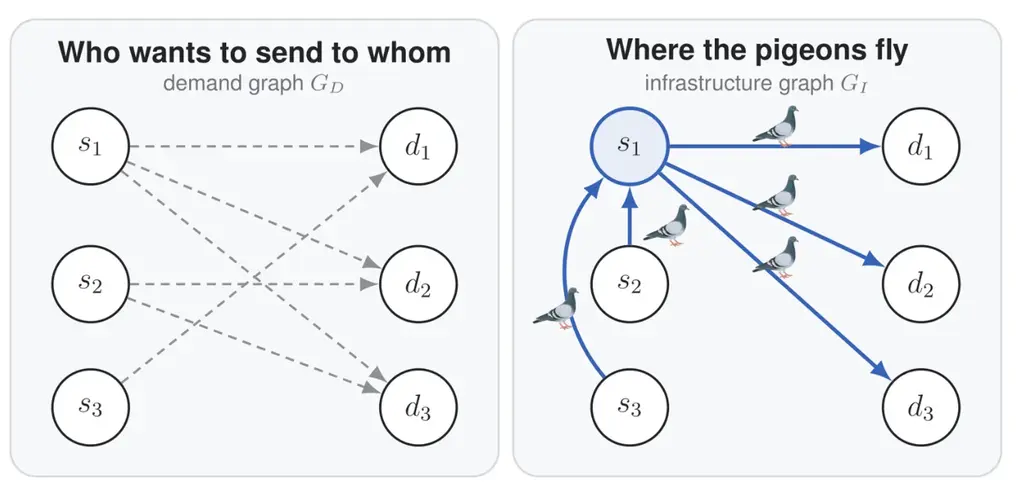
The modern race to scale and train artificial intelligence models relies heavily on the relentless transmission of colossal datasets between distributed machines. To prevent massive GPU clusters from sitting idle, researchers in distributed systems and machine learning constantly strive to engineer faster networks and invent smarter ways to route data. However, in a recent academic paper that bridges the gap between historical curiosity and rigorous computer science, a team of researchers decided to step away from traditional fiber-optic cables and modern data center interconnects to investigate a remarkably different kind of network medium: carrier pigeons.
The whimsical notion of transmitting internet traffic via avian carriers is far older than many might assume. On April 1, 1990, the Internet Engineering Task Force published RFC 1149, a classic technical report humorously detailing a protocol for the transmission of IP datagrams by avian carriers. Although the document was originally conceived as an April Fools’ Day joke, intrepid technologists and enthusiasts over the decades have actually tested the concept in practice. In several publicized publicity stunts and localized races, a resilient pigeon equipped with a modern flash memory card strapped to its leg managed to physically transport data faster than a sluggish, bottlenecked broadband connection.
Beneath the lighthearted veneer of avian data delivery, however, lies a fundamental and serious networking challenge that resonates deeply with contemporary high-performance computing. Modern data centers frequently employ dynamic optical circuit switches to reconfigure their internal network links on the fly, tailoring topologies to match fluctuating communication demands. This capability raises complex architectural questions regarding how to execute network reconfiguration with maximum efficiency. A closely related domain is the study of temporal graphs, where communication links are intermittent and available only at specific windows in time, meaning the precise chronological order of connections dictates whether a message can successfully reach its destination.
These exact theoretical constraints surface naturally when designing a functional pigeon-based communication network. While RFC 1149 famously described the theoretical encapsulation of data packets for avian transport, it completely omitted any framework for organizing their flights efficiently or managing the underlying logistics. To address this gap, a collaborative research team authored a paper titled “The Carrier Pigeon Internet Protocol: An Algorithmic (and Lighthearted) Perspective,” formally investigating how to architect such an unconventional network while minimizing the total number of birds required.
From the Internet to Pigeon Post
The core operational difficulty of a carrier pigeon network stems from a unique biological constraint: a homing pigeon instinctively flies home exclusively to the specific location where it was bred and raised. Suppose an engineer wishes to transmit an urgent data payload from the Technische Universität Berlin to the Technion in Haifa. Accomplishing this task requires a pigeon that was originally born and raised at the Technion, physically transported to TU Berlin beforehand, and subsequently released to fly back to its home loft while carrying the digital message.
Once that individual pigeon arrives safely at the Technion, it cannot simply be turned around and flown back to Berlin to deliver a return message. A different bird would be required for the reverse journey. Unlike traditional copper or fiber-optic cables, which can transmit bidirectional data streams indefinitely, a carrier pigeon is effectively "used up" in a single operational direction every time it completes a delivery. Recognizing this asymmetric reality, the researchers sought to answer a crucial logistical question: If an organization were to genuinely operate a pigeon-based postal network, exactly how many birds would be required, and where should their breeding lofts be established?

To rigorously study this problem, the team modeled communication demands as a directed graph. In this mathematical representation, nodes corresponded to geographical locations, while directed edges represented individual messages that needed to be delivered from a sender to a receiver. The overarching computational task was to determine optimal strategies for where pigeons should be raised, where they should be stationed, and how their individual flights should be scheduled to minimize the total avian population needed. The framework accounted for the reality that messages arriving at remote locations could be safely buffered and held indefinitely, allowing them to be bundled together for a subsequent flight.
The researchers analyzed three distinct operational versions of the communication problem: the single-hop case, the two-hop case, and the general multihop case. In the single-hop scenario, messages must travel directly from their source to their destination without any intermediate stops. In the two-hop and multihop scenarios, messages are permitted to make one or more intermediate stopovers at various nodes along their journey, allowing packets to be offloaded, sorted, and routed onto different birds heading toward downstream destinations. Allowing intermediate stopovers fundamentally changes the mathematics of the system, dramatically reducing the total number of pigeons required while simultaneously making the underlying computational problem significantly more difficult to solve.
Results and Computational Complexity
When analyzing the single-hop case, the research team found that the solution is mathematically straightforward but resource-intensive: the network requires exactly one specialized pigeon for every unique source-destination pair. While this single-hop configuration is optimal for direct point-to-point delivery, the total number of required birds escalates rapidly as the network scales. For instance, if a modest system consisting of just 20 distinct academic or corporate locations wants to maintain full, direct communication capabilities with every other site, the network would demand an astonishing 380 pigeons.
The mathematical landscape shifts dramatically as soon as messages are permitted to make intermediate stopovers. The researchers proved that finding the optimal routing and breeding strategy for two-hop and multihop networks is NP-hard. To establish this complexity, the authors provided formal mathematical reductions from well-known foundational problems in computer science, specifically utilizing 3SAT and Vertex Cover for both the two-hop and multihop scenarios.
Fortunately, the team also designed efficient approximation algorithms to navigate this computational complexity. The paper proposed the Coordinator algorithm, a clever heuristic strategy that selects the network location with the highest number of active links to act as a central coordinator. Under this approach, every source node transmits its messages to the coordinator node. The coordinator then sorts the incoming data payloads by their ultimate destinations and dispatches a single pigeon from that central hub to each respective destination.
Revisiting the earlier example of 20 communicating locations, the implementation of the Coordinator algorithm drastically reduced the required pigeon population from 380 down to just 38. Specifically, the network consumed 19 pigeons to collect all origin messages at the central coordinator node and another 19 pigeons to distribute those sorted payloads onward to their final destinations. The researchers mathematically proved that the Coordinator algorithm never utilizes more than twice as many pigeons as an optimal solution, and that it executes efficiently in polynomial time. For smaller network instances where exact optimal solutions are desired, the team also formulated integer linear programs for both the two-hop and multihop cases.

Open Problems and Real-World Applications
To maintain mathematical tractability and keep the initial model clean, the researchers assumed that their carrier pigeons possessed unlimited data-carrying capacity. However, a natural and practical extension for future study involves investigating how network performance and routing behavior change when pigeons are constrained by strict physical payload limits. Furthermore, the initial model focused strictly on minimizing the total headcount of birds without accounting for temporal delays. Because fewer pigeons necessitate more intermediate stopovers, and every stopover introduces time delays, the network configuration boasting the absolute lowest bird count may well turn out to be the slowest.
Additional practical considerations include the energy footprint and financial cost associated with transporting pigeons back to their remote breeding nodes. Birds heading in identical geographical directions could theoretically share a ride to minimize overhead. Moreover, the initial model operated on the assumption that all communication demands were known in advance. In real-world operational environments, traffic demands arrive dynamically over time, either following predictable statistical processes or emerging adversarially.
Although the research project adopted a lighthearted approach centered on avian transport, the underlying mathematical principles carry profound implications for real-world distributed systems. Predictable data center network traffic—such as the massive, periodic synchronization phases required during modern AI training workloads—relies heavily on optical circuit switches that dynamically rewire physical links to match anticipated traffic matrices. In fact, numerous optimization problems in modern telecommunications traffic engineering rely on similar demand matrices. Beyond computer networks, demand-aware graph optimizations of the exact type utilized to model pigeon traffic are routinely applied to streamline vehicle routing, supply chain logistics, and physical commodity flows across global networks.
The research was co-authored by Matthias Bentert, Shay Kutten, Darya Melnyk, Tijana Milentijević, and Stefan Schmid, representing both the Technische Universität Berlin and the Technion. Tijana Milentijević is a doctoral student at TU Berlin whose research explores the intersection of distributed systems and machine learning, with a particular emphasis on robust federated learning and distributed algorithms.