The ongoing battle against unauthorized digital broadcasting in Latin America has escalated significantly as Chilean telecommunications authorities double down on enforcement. What began earlier this year as a targeted legal action by major entertainment conglomerates against a handful of rogue streaming providers has now blossomed into a nationwide campaign involving extensive collaboration between regulatory bodies, law enforcement agencies, and commercial internet service providers.
Earlier this year, a civil court in Santiago delivered a decisive ruling in favor of Warner Bros., taking direct aim at MagisTV, FlujoTV, and XuperTV, three of the most prominent unauthorized streaming and IPTV brands operating across the region. Acting upon this legal precedent, the 19th Civil Court of Santiago ordered the immediate network-level blocking of all digital variants associated with these services. To execute the mandate, the court instructed the Chilean telecommunications regulator, Subtel, to formally notify the country’s licensed internet service providers. Subtel swiftly dispatched these blocking instructions to telecom operators in January, a move that was subsequently reinforced when Warner Bros. initiated a separate criminal complaint against a local IPTV operator amid concerns over rapid, unchecked piracy growth.
New information released by Subtel this week reveals that those initial directives served merely as the opening salvo in an aggressively expanding digital blockade. According to the regulator, major national internet service providers—including GTD, DirecTV, Entel, WOM, Mundo, ClaroVTR, Netline, and Movistar—have collectively blocked a total of 1,954 unique URLs linked to illegal IPTV and streaming infrastructure. Rather than happening all at once, these network restrictions are implemented through regular, rolling batches of updates coordinated between industry stakeholders and authorities.

Monthly figures provided by Subtel illustrate a dramatic escalation in enforcement activity over the course of the year. Beginning with recorded blocks in the middle months, the campaign steadily gained momentum. In June, authorities targeted 221 URLs, followed by 180 URLs in July. The volume increased notably in August with 469 blocks, dipped slightly to 319 URLs in September, and then spiked dramatically in October to 765 blocked URLs, bringing the cumulative total to nearly two thousand neutralized access points.
The scope of the targeted domains has broadened far beyond the initial trio of streaming brands. Subtel’s active blocking registry now encompasses a wide array of high-traffic unauthorized platforms, including Cuevana, Oleada TV, Stella TV, TeleLatino, PelisPlus, Cinecalidad, and Fútbol Libre, alongside their numerous operational variants, mirrors, and affiliate domains. This expansion coincides with separate, aggressive law enforcement operations, highlighted by the recent arrest of 16 individuals tied to competing pirate IPTV services UltraIPTV and MegaIPTV in an unrelated criminal investigation conducted by Chilean police.
A Matter of Data Protection
While the underlying legal framework originated in copyright enforcement, Subtel has notably framed its ongoing announcements around a different pillar of public interest: digital security and consumer data protection. In official communications, the regulator places digital safety at the forefront, asserting that the systematic blocking of these platforms is fundamentally necessary to shield everyday citizens from aggressive cybercrime, data theft, and financial fraud.

Subtel officials warn that downloading and installing informal, unauthorized streaming applications exposes users to severe security vulnerabilities, often leaving their personal devices and private accounts entirely unprotected. According to Undersecretary of Telecommunications Romina Garrido, utilizing these unverified applications effectively hands over the keys to private digital lives to anonymous, unregulated entities operating outside the law. Garrido cautions that consumers who install such informal apps risk compromising sensitive information, including bank passwords, personal identification data, and private device access, all without any form of consumer protection or technical recourse.
This cybersecurity-centric narrative mirrors arguments utilized by copyright holders in court. During earlier legal proceedings, representatives for Warner Bros. similarly emphasized that unauthorized streaming platforms inherently endanger consumer data security by operating shady digital ecosystems designed to harvest and exploit user information. By cutting off access to these malicious networks, the government hopes to steer consumers toward legitimate, regulated platforms. Garrido emphasizes that these blocking measures successfully disrupt the operational chain of cybercrime while simultaneously promoting a formal telecommunications marketplace that genuinely guarantees privacy, consumer support, and secure data handling standards.
MagisTV and Beyond
The legal foundation for the sweeping digital blockade remains rooted in the Santiago court’s initial order targeting MagisTV, FlujoTV, and XuperTV. However, because those specific brands were the primary focus of the original lawsuit, the rapid inclusion of hundreds of additional domains required a collaborative administrative protocol. According to industry reports from Chilean media outlets such as La Tercera, the expanded blocklist was formulated through a cooperative agreement established between Subtel, the Public Prosecutor’s Office, Warner Bros., and the Alliance Against Digital Piracy.
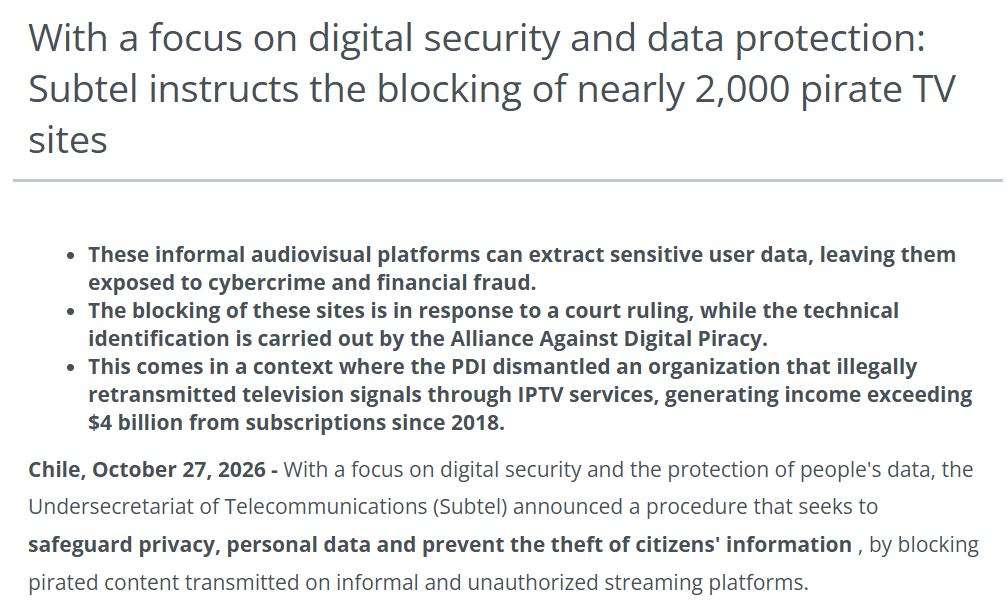
Although Subtel’s published monthly statistics begin in June—several months after the initial January notifications—observers note that the administrative gap was likely spent finalizing this multi-agency operational protocol. Under the current working arrangement, the anti-piracy Alliance continuously identifies and compiles comprehensive lists of illicit URLs, specific IP addresses, and operational domains. Subtel then reviews and processes these lists, officially instructing domestic internet service providers to implement the corresponding blocks across their nationwide networks.
The administrative scope of these directives is intentionally comprehensive. As detailed in reports from local news publications, the judicial orders and subsequent administrative instructions cover every imaginable variant of the blacklisted services. This includes any associated domain name, subdomain, direct link, IP address, automatic redirect, or third-party mirror site designed to reproduce copyrighted audiovisual content without explicit authorization, whether broadcast in full or in part.
Despite the deployment of sophisticated network-level blocking mechanisms and the steady accumulation of thousands of disabled URLs, the ongoing enforcement campaign continues to face the classic challenges of digital remediation. Investigative reports published by outlets like BioBioChile indicate that a number of the targeted streaming platforms manage to remain operational by swiftly adapting their infrastructure. Independent searches confirm that various alternative access points, copycat portals, and decentralized domains utilizing popular brand names such as Cuevana, Fútbol Libre, and MagisTV remain stubbornly accessible online.
With October registering the highest monthly volume of blocked URLs to date—surpassing 765 interventions with days remaining in the month—authorities expect the total tally to climb even higher. As digital enforcement agencies press forward with their coordinated blocklist updates, the ongoing struggle against unauthorized streaming continues to play out as a high-stakes cat-and-mouse game across the digital landscape of Chile.