The urge to buy often strikes in a fraction of a moment—eleven seconds on a couch, an active shopping app, a saved credit card, and a stark banner warning that a price will reset at midnight. For millions attempting to curb their spending, general resolutions to save money routinely fail against these precise, frictionless digital traps. A broad personal vow to spend less must win every single time it faces such a test, yet it only needs to lose once a week to completely unravel a monthly budget.
Those caught in this cycle are typically far from careless with their personal finances. Many monitor their accounts regularly, study personal finance guides, and implement classic waiting periods before making purchases. Yet, despite holding firm for a week or two, the spending inevitably returns in familiar patterns: the same application, the same late-hour window, and the same stressful week. Behavioral researchers and financial experts note that recurring purchases sharing these distinct fingerprints point to an established pattern, one that can be altered without requiring a complete shift in personality.
The Breakdown of Traditional Spending Rules
To understand why common interventions fail, financial analysts point to the geographical and temporal gap between where a spending rule is created and where a purchase actually occurs. A rule is usually established under calm conditions, such as sitting at a kitchen table on a Sunday morning. The purchase, however, happens under entirely different circumstances, such as late at night during a moment of fatigue.
A personal spending rule must successfully travel between these two vastly different mental spaces, bypassing streamlined checkouts designed to process payments in three taps, countdown timers designed to induce panic, and the emotional exhaustion of a difficult workday. Most rules never make that journey because they fail to intersect directly with the point of sale.
Retail platforms invest heavily in shortening the psychological gap between desire and acquisition. Saved payment credentials, one-tap checkouts, free return policies, and expiring discount banners are all meticulously engineered to eliminate friction. On a platform with a saved card, completing a transaction requires fewer taps than checking whether the purchased item is actually necessary.
Consequently, traditional advice—such as avoiding shopping malls, writing down shopping lists, waiting 24 hours before buying, or switching exclusively to cash—often proves ineffective. While none of these strategies are inherently incorrect, they are generally aimed at a broad audience rather than the specific psychological triggers driving an individual’s behavior.
Uncovering the True Triggers Behind Purchases
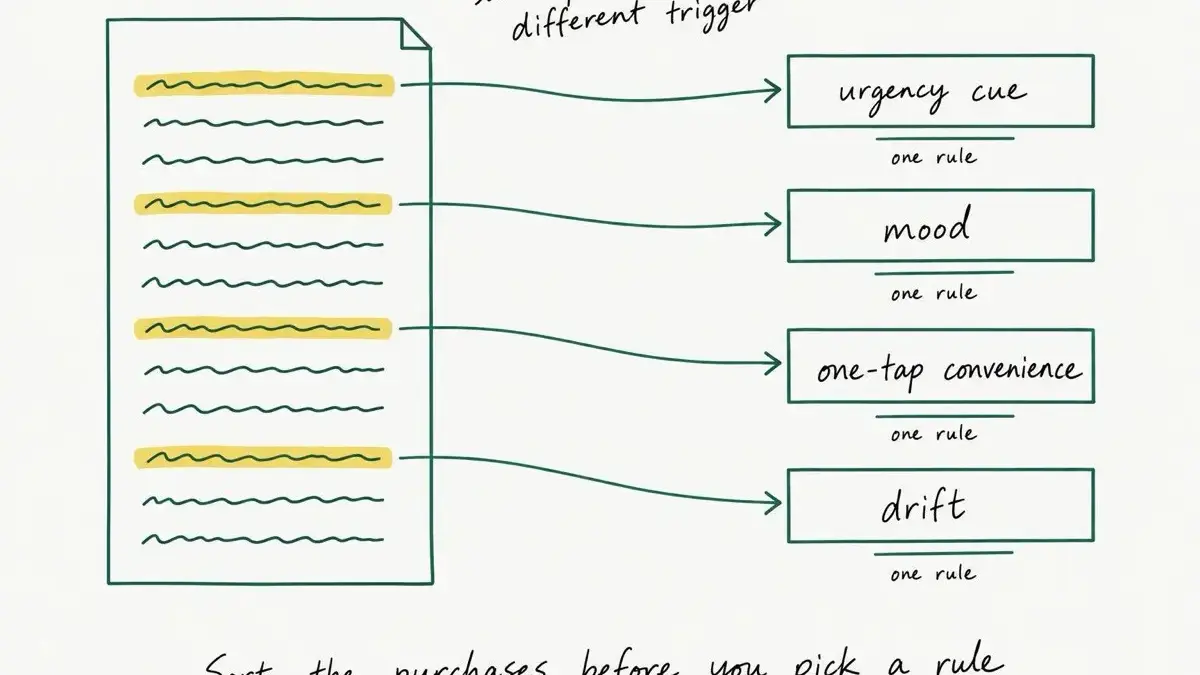
Standard financial advice frequently relies on rules chosen before an individual examines their actual transaction history. Financial behavior specialists suggest that a comprehensive review of the last thirty days of card statements can reveal the true catalysts behind unplanned spending. The critical question is whether unplanned purchases cluster around repeating, predictable situations, because a corrective rule only functions when it directly neutralizes one of those specific triggers.
While traditional advice heavily promotes mandatory 24-hour or 48-hour waiting periods, researchers note a lack of empirical studies formally testing what consumers actually purchase or subsequently regret after such enforced delays. Similarly, ongoing debates regarding the psychological impact of cash versus card spending lack definitive consensus. While these auxiliary rules are simple to test, financial researchers warn against relying on them as primary mechanisms, or viewing a breached rule as a reflection of personal character.
Instead, scientific literature increasingly points to two primary drivers behind impulse purchases: external urgency cues embedded within storefronts or digital interfaces, and the buyer’s emotional state during the hour of purchase. Identifying these specific triggers allows individuals to implement targeted rules designed to block them effectively.
While comprehensive diagnostic frameworks for auditing spending habits are often built on observations rather than clinical trials, they align closely with established research regarding consumer psychology. Conducting a retrospective audit of recent transactions provides a diagnostic view of spending habits, helping individuals transition from broad, ineffective resolutions to targeted, actionable interventions.
Analyzing Spending Patterns and Diagnosing Behavior
A thorough review of personal financial records typically involves examining credit card statements alongside the order history of the applications used most frequently. By compiling every unplanned purchase—noting the amount, date, time, location, and the emotional context prior to the transaction—individuals can identify distinct behavioral clusters.

For instance, identifying that a significant portion of unplanned spending occurs within a single application late at night aligns with broader scientific understandings of decision fatigue, which increases vulnerability as the day progresses. When spending clusters around specific times or platforms, it provides a clear focal point for intervention.
Behavioral researchers categorize these spending catalysts into distinct triggers. Urgency cues involve countdown timers, flash sales, and low-stock warnings. Studies published in psychological journals indicate that limited-time and limited-quantity scarcity appeals significantly influence impulse-buying intentions, largely driven by the fear of missing out, while anticipated regret can modulate this effect.
Mood represents another powerful catalyst, with research demonstrating a particularly strong link between sadness and increased spending behavior. Experimental studies show that individuals experiencing sadness consistently set higher valuations for goods compared to those in neutral emotional states. While stress and boredom are also frequently cited by consumers as primary drivers of unplanned purchases, targeted interventions must account for these recurring personal patterns regardless of whether specific academic studies cover every emotional variant.
Establishing Targeted Interventions and Routine Check-Ins
Effective spending rules require specificity. Rather than relying on vague commitments to reduce consumption in broad categories, successful interventions explicitly name the trigger and dictate a precise physical action located precisely where the trigger occurs.
When addressing urgency-driven spending, effective rules eliminate the immediate path to purchase. For example, encountering a countdown timer or a low-stock banner can prompt closing the browser tab immediately and recording the item in a note with the current date. If the item is still desired days later, it can be purchased deliberately at full price.
To combat one-tap convenience, removing saved payment credentials from frequently problematic applications and logging out of those accounts introduces necessary friction. For mood-driven spending, establishing pre-planned replacement actions—such as a brief nervous system reset or a non-financial coping mechanism—provides an alternative response during vulnerable hours. For drift shopping, enforcing a strict boundary against opening shopping apps or entering physical stores without a predetermined list prevents aimless browsing.
To ensure these interventions remain effective, individuals often schedule periodic check-ins to re-evaluate their transaction logs. If a specific rule is breached repeatedly, it indicates that the rule itself is poorly suited to the individual’s habits and should be swapped for an alternative approach rather than layered with additional, overly complex restrictions.
Addressing Persistent Financial Distress
While targeted behavioral adjustments successfully curb routine impulse buying for many, recurring overspending can sometimes signal deeper, more persistent patterns that cause significant personal distress. Clinical literature examines compulsive buying behavior as a distinct phenomenon characterized by excessive shopping thoughts and behaviors tied to psychological impairment or financial distress.
Epidemiological studies estimate that the adult prevalence of compulsive buying behavior varies across populations, depending on the diagnostic thresholds and measures utilized in specific studies. While occasional unplanned purchases are a common aspect of modern consumer environments, persistent spending that feels impossible to control, accompanied by hidden purchases or unmanageable debt, often requires support from qualified mental health or financial counseling professionals rather than self-guided behavioral rules.
For most individuals, however, beginning with a straightforward review of the previous month’s financial statements provides the clarity needed to identify primary spending triggers. By shifting the focus from general financial resolutions to specific, trigger-based boundaries, consumers can better manage the digital and psychological pressures driving modern impulse purchases.