The global Domain Name System (DNS) has successfully navigated another major cryptographic milestone. Following the highly anticipated DNS root Key Signing Key (KSK) rollover on October 11, 2026, network measurements indicate a smooth transition with no widespread service outages. This latest event marks a crucial follow-up to earlier preparations detailed by network analysts throughout May and October 2026, utilizing the innovative KSK Sentinel signal to monitor which networks successfully tracked the cryptographic transition of the root key.

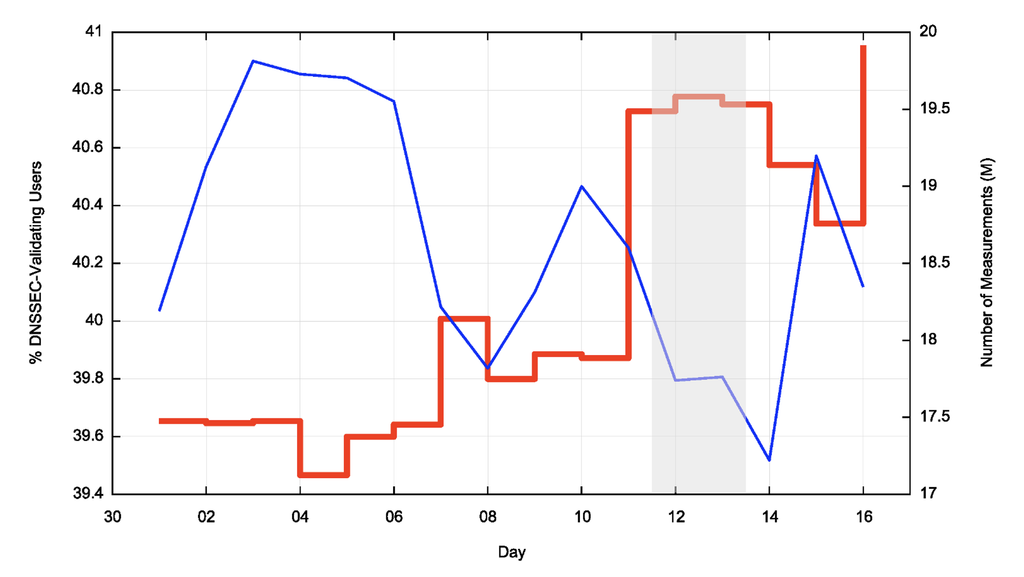
To evaluate the impact of the rollover, data was collected using advertisement-based measurement networks during the first sixteen days of October. The observation window centered heavily on the 48-hour period immediately following the formal start of the KSK roll at 14:00 UTC on October 11, aligning with the standard cached lifetime of root zone DNSKEY records in validating resolvers. Daily measurement ad presentation rates remained stable, staying well within normal statistical levels of variation and confirming that baseline measurement infrastructure operated without disruption.
Prior to October 11, verifying the authenticity of DNS responses required that outgoing KSKs were fully trusted by local resolvers. Once the locally cached DNSKEY resource records refreshed—a process completed across the global ecosystem before 14:00 UTC on October 13—validating resolvers were forced to rely entirely on the incoming KSK to maintain successful validation operations. Global telemetry data reveals that the overall worldwide average DNSSEC validation rate actually increased slightly, moving from a pre-roll baseline of 39.7% to a post-roll value of 40.6%. This positive shift underscores the immense collaborative work carried out by the global internet community in standardizing, implementing, and deploying resilient DNSSEC validation software.

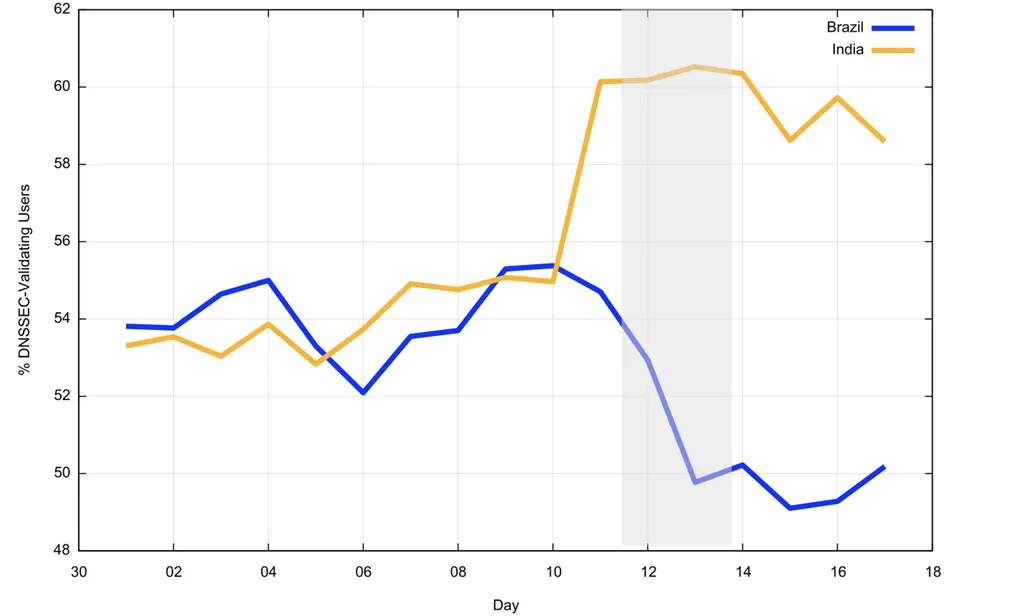
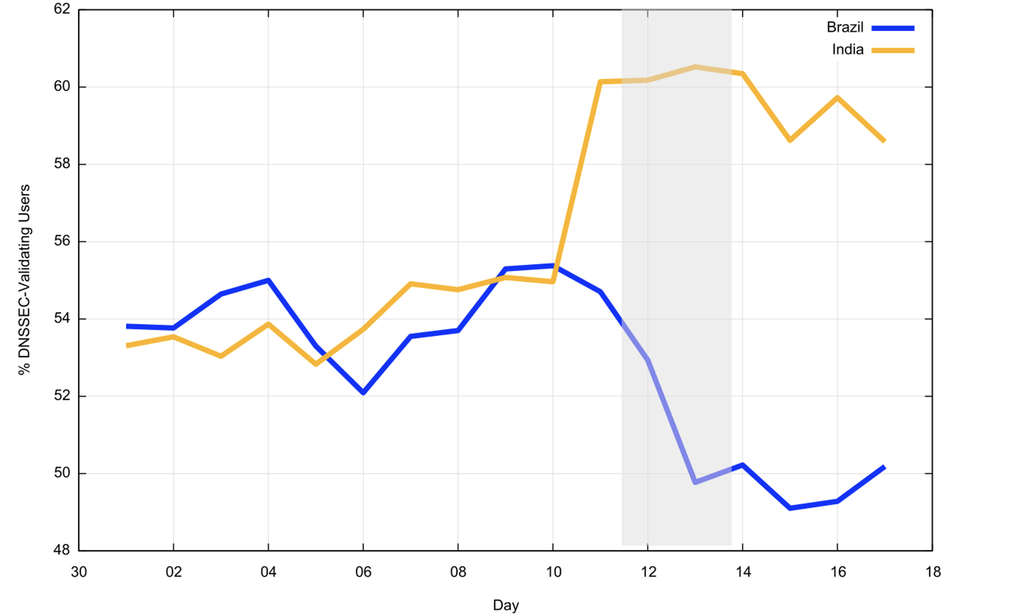
Despite the positive global average, aggregated metrics can frequently obscure localized anomalies and divergent behaviors among specific regional operators. A closer examination of economies with significant populations of DNSSEC-validating users reveals starkly different trajectories. Brazil and India, for instance, both rely heavily on ISP-provisioned recursive resolvers that implement DNSSEC validation by default, making them prime candidates for detailed regional analysis.
Proactive intervention played a vital role in shaping outcomes for specific operators. Network researchers successfully contacted a major Indian internet service provider just days before the event, on October 9, alerting them to KSK Sentinel signals indicating that their local resolvers had not yet established trust in the incoming KSK. Because the ISP was able to react swiftly, the overall DNSSEC validation rate among measured users in India actually rose from 55% to 59% as the rollover concluded. Unfortunately, identical signals detected among Brazilian ISPs could not be addressed through direct outreach during the same window, resulting in a noticeable drop in the local DNSSEC validation rate from 54% to 50% following the key rollover.
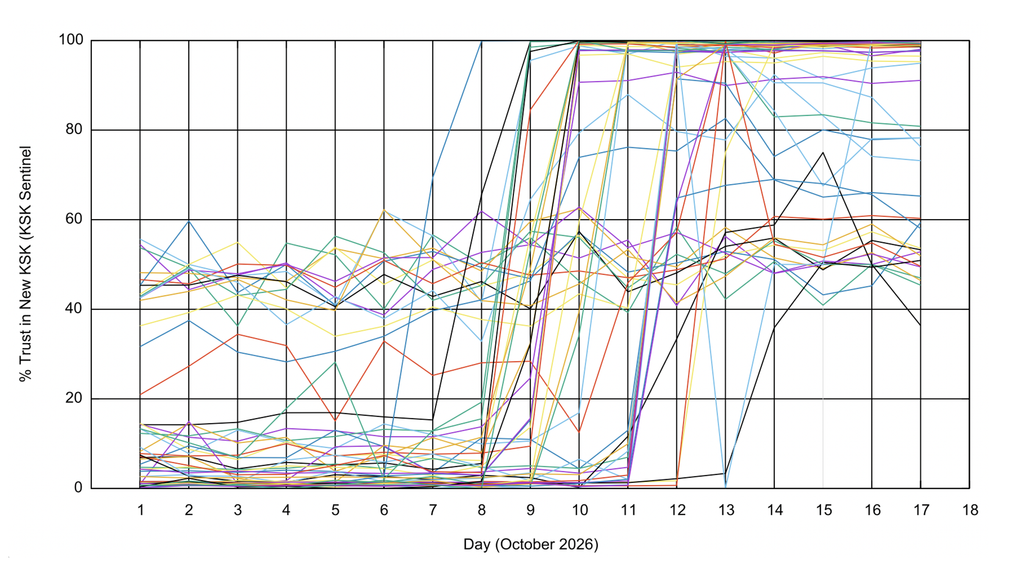
Further analysis focused on a cohort of fifty distinct networks that had previously exhibited the lowest acceptance rates for the incoming KSK during the first week of October, while still demonstrating support for the Key Sentinel mechanism. Tracking these specific networks through October 18 revealed a surprising outcome: none of them were stranded or knocked offline when the root key rolled. Every single one of these previously lagging networks managed to incorporate the new KSK into their trusted key sets during the critical transition window between October 7 and October 13. Such a uniform pattern of corrective behavior is highly unusual within the inherently decentralized landscape of the global DNS.
To measure individual network disruptions, researchers analyzed shifts in DNSSEC validation rates by comparing post-roll performance against the first ten days of October. Out of 13,538 networks generating sufficient sample sizes, 35 networks recorded a dramatic positive surge in validation exceeding 50%, likely driven by configurations that favored the incoming KSK over the incumbent key. Expanding the criteria, 594 networks experienced a positive increase of 10% or more. Conversely, 58 networks saw their validation rates plunge by 50% or more, while 660 networks experienced a decline of 10% or more.
Translating these percentages into estimated user populations highlights the tangible human impact of the infrastructure update. Total global internet users situated behind DNSSEC-validating resolvers reached approximately 1.7 billion out of an estimated total user base of 4.3 billion. Before the key rolled, the validating population stood at roughly 1.65 billion, meaning the ecosystem ultimately registered a net global increase of approximately 45.8 million DNSSEC-validating users across the transition.
Regionally, economies such as India, Viet Nam, Algeria, Morocco, Kazakhstan, Slovakia, Iran, Thailand, Sri Lanka, and Lithuania saw the largest net growth in validating users, led by significant gains in India and Viet Nam. On the other hand, economies experiencing the most substantial drops in validating user counts included Brazil, the Russian Federation, China, the United States, Bulgaria, Bangladesh, Japan, Uganda, Pakistan, and Egypt, with Brazil and Russia recording the steepest net declines.
Assessing the overall success of such a massive cryptographic update requires acknowledging the realities of a highly distributed yet loosely coupled infrastructure. Because precise synchronization across millions of independent networks is practically impossible, minor variations and localized friction are inevitable. Evaluated against this backdrop of structural complexity, the empirical data confirms that the October 2026 KSK rollover was a resounding operational success. Detailed datasets, supporting CSV files, and long-term measurement metrics regarding global DNSSEC validation continue to be maintained and published publicly through APNIC Labs.