The global internet infrastructure faces a growing architectural challenge as network engineers and researchers grapple with the intersection of Post-Quantum Cryptography (PQC) and the Domain Name System Security Extensions (DNSSEC). While quantum computers remain in their infancy, the theoretical threat they pose to conventional cryptographic practices has accelerated discussions around long-term digital security. Specifically, a sufficiently powerful quantum computer—known as a cryptographically relevant quantum computer, or CRQC—could theoretically derive a private key from exposed public information, including public keys and encrypted text, well within a timeframe that allows for subsequent exploitation. Within the scope of DNSSEC, this vulnerability centers on the possibility that a CRQC could calculate a private key during the operational lifetime of a DNSSEC key pair.
Recent years have seen considerable interest in developing quantum computing systems that exploit quantum mechanical phenomena. Unlike classical computers that rely on binary bits valued at 1 or 0, quantum systems utilize qubits capable of existing in a superposition of both basic states simultaneously. While optimism remains high that these systems will eventually scale to solve massive computational problems, current quantum hardware is still in its earliest stages of development. These early systems represent an equivalent to massively parallel processing at an exponential scale.
The engineering hurdles associated with building quantum computers are immense, resulting in slow and costly progress. Nonetheless, the prospect of overcoming these challenges continues to drive research forward, as a sufficiently large quantum system could resolve computational problems currently beyond the practical limits of binary computers. Long before hardware engineering caught up with theory, academic research highlighted the potential for quantum computers to solve specific classes of problems exponentially faster than classical systems. In 1994, Peter Shor published a foundational algorithm for finding the prime factors of an integer. This breakthrough carries profound implications for cryptography, as the exponential speedup over classical algorithms threatens to undermine widely used encryption methods.
Ciphertext encrypted using standard RSA and Elliptic Curve Cryptography (ECC) algorithms will remain vulnerable once quantum computers achieve the requisite scale and reliability. Because predicting the exact arrival date of a functional CRQC is impossible, cybersecurity planners increasingly look to timelines fueled by heavy financial investments in quantum research. While optimistic projections point toward the year 2030, this horizon falls comfortably within a standard twenty-year intelligence retention window. Organizations seeking to protect sensitive data for two decades must prudently assume that quantum algorithms could be leveraged to break current encryption schemes within that timeframe.
Consequently, the cryptographic community recognizes an urgent need to adopt quantum-resistant algorithms in environments where long-term data integrity is paramount. The immediate danger lies in the practice of data harvesting, where malicious actors intercept and store encrypted traffic today in anticipation of post-processing it with a future CRQC—a threat commonly designated as Harvest Now, Decrypt Later (HNDL).

Cryptography also underpins digital signatures, which establish message authenticity and verify the identity of an author. If an attacker compromises a key pair, they can effectively impersonate the author. The period of vulnerability is directly tied to how long a specific key pair remains in active use, giving attackers a wider window to calculate private keys for long-lived keys.
Studies of DNSSEC key lifetimes across Top-Level Domains, such as an extensive 2022 publication by ICANN authored by Ed Lewis, reveal varied key management practices. Generally, the findings indicate that a zone’s Key-Signing Key (KSK) remains active for a year or more, while Zone-Signing Keys (ZSKs) typically rotate on a monthly basis.
An initial defensive response to the looming CRQC threat involves accelerating key rotation schedules, introducing new ZSKs every month and fresh KSKs every six months or year. While these rotations exceed historical averages, they do not represent a radical departure from current administrative practices. However, if quantum computing development outpaces current expectations, shorter key lifetimes alone will prove insufficient, necessitating a complete transition to Post-Quantum Cryptography within DNSSEC configurations.
This reality forces the internet community to evaluate the technical impacts of post-quantum cryptography on the Domain Name System. A defining characteristic of many post-quantum cryptographic algorithms is their reliance on significantly larger key sizes compared to conventional pre-quantum public key algorithms. A clear illustration of this expansion appears when comparing DNSSEC algorithm 13, which uses ECDSA P-256 with SHA-256, against the proposed post-quantum DNSSEC algorithm 18, ML-DSA-44. Under these specifications, an ECDSA P-256 public key requires 32 bytes, a private key requires 32 bytes, and a generated signature requires 65 bytes. By contrast, an ML-DSA-44 public key spans 1,312 bytes, its private key demands 2,560 bytes, and its resulting signature reaches 2,420 bytes.
When a DNSSEC signature generated via a post-quantum algorithm is appended to a DNS response, the overall payload swells dramatically. When a stub resolver queries a recursive resolver for an ECDSA P-256 signed name with the DNSSEC OK bit set, the resulting response contains a compact 65-byte signature. At a total size of 191 bytes, this response fits comfortably inside an unfragmented User Datagram Protocol packet. Repeating that identical query for a name secured by the post-quantum ML-DSA-44 algorithm yields a response measuring 2,551 bytes.
This massive payload triggers a truncation response from the recursive resolver over UDP, forcing the stub resolver to initiate a separate Transport Control Protocol session to complete the lookup. Instead of a streamlined two-packet exchange over UDP, the transaction balloons into a ten-packet process encompassing truncation signals, TCP handshakes, data transmission, and session teardown packets.

While network administrators might ponder relying on conventional IP packet fragmentation to preserve UDP transport, internet measurements demonstrate that IP fragmentation remains unreliable and risky. The broad consensus within the DNS community holds that the unreliability of IP fragmentation across both IPv4 and IPv6 networks outweighs any remaining utility for managing oversized payloads at the network layer.
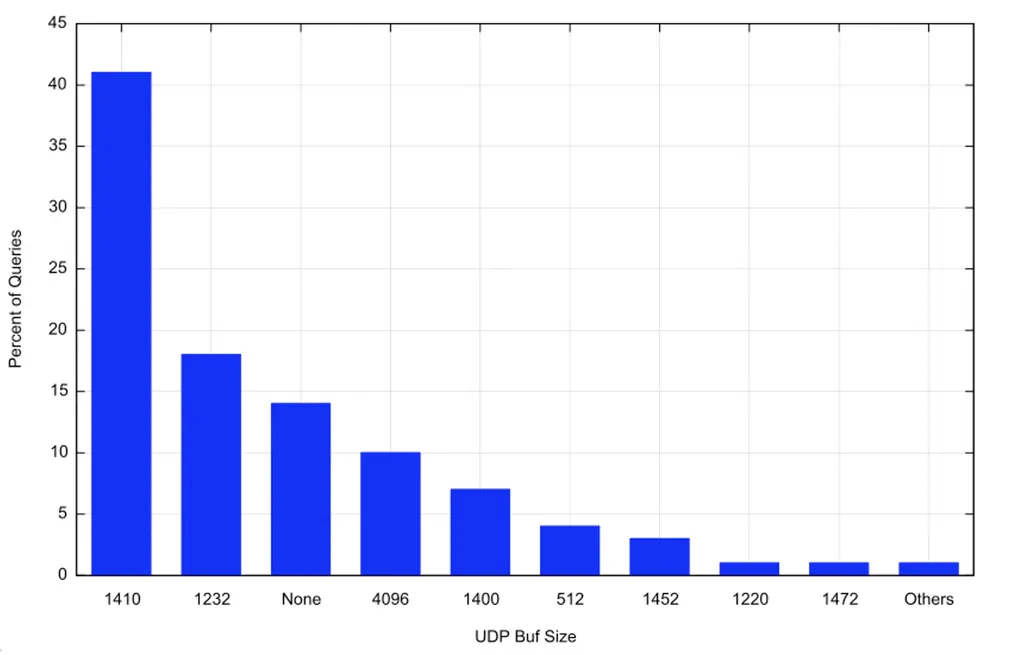
Historically, the DNS specification limited UDP payloads to 512 bytes, a limit later revised through Extension Mechanisms for DNS, known as EDNS, which introduced requestor UDP payload size definitions. For years, standards suggested a maximum payload size of 4,096 octets as a practical compromise. However, empirical studies examining IP fragmentation performance—particularly over IPv6—revealed severe vulnerabilities, prompting initiatives like DNS Flag Day to recommend a conservative EDNS buffer size of 1,232 bytes to prevent network-layer fragmentation.
Dataset measurements gathered by the APNIC Labs platform illustrate how modern recursive resolvers approach these buffer sizes. While a majority of queries utilize buffer sizes configured to fit comfortably within standard 1,500-byte IP packets, a substantial minority of queries continue to signal support for much larger UDP payloads. Nevertheless, authoritative servers apply their own payload limits, meaning large responses frequently trigger truncation flags that naturally redirect traffic over TCP.
This dynamic comes into play when dealing with queries for PQC-signed domain names that feature the DNSSEC OK bit set. Recursive resolvers signal their desire to receive cryptographic signatures by setting this bit in outgoing queries, ensuring they can cache and validate records appropriately. Measurement data indicates that roughly sixty percent of all global DNS queries feature the DNSSEC OK bit set, reflecting widespread integration of security-aware infrastructure across the internet.
As the industry evaluates potential paths forward, protocol developers continue to debate whether current DNS behaviors require adjustment to cope with expanding signature sizes. Proposals have emerged to explore whether non-validating resolvers should conditionally clear the DNSSEC OK bit to minimize unnecessary TCP fallback traffic and reduce overhead for authoritative servers. Yet, other architects express concern that layering additional operational tweaks onto the DNS risks compounding protocol fragility. With researchers divided on the optimal approach, ongoing discussions within standards bodies aim to balance the demands of post-quantum security with the foundational efficiency of the global Domain Name System.