For years, the global conversation surrounding the digital divide has remained anchored to a binary metric: who is connected and who is not. Policymakers and international bodies have traditionally tracked progress by measuring broad national penetration rates, often celebrating rising figures as proof of closing gaps. However, a comprehensive new study examining fixed-internet access in the Dominican Republic reveals that high aggregate internet penetration does not guarantee equality, nor does it ensure effective connectivity.
The research underscores that territories can differ dramatically not only in the sheer availability of infrastructure, but also in the tangible performance of the connections delivered to end-users. While fixed-internet penetration across the Dominican Republic has generally increased and broader territorial inequalities have seen a downward trend over the years, substantial disparities persist. Crucially, the data shows that provinces boasting higher penetration rates also tend to experience superior network performance, proving that high aggregate national averages can easily mask deep, localized inequalities.
The Digital Divide is More Than Being Connected
Historically, internet connectivity has been analyzed primarily through a macroscopic lens of inclusion versus exclusion. Yet, this narrow perspective fails to capture the full scope of modern digital equity. As highlighted by international frameworks from the International Telecommunication Union (ITU) and the Office of the UN Secretary-General’s Envoy on Technology, policymakers must weigh additional critical dimensions, notably equality of access and effective connectivity.
When relying solely on economy-wide averages, high penetration levels can obscure severe internal disparities. According to World Bank Development Indicators, fixed-broadband penetration in the Dominican Republic reached approximately 11.73 subscriptions per 100 inhabitants by 2024. This aggregate ratio is calculated by dividing the total number of fixed-broadband subscriptions by the total population.
While this figure sits below European standards reported by the Economic Commission for Latin America and the Caribbean (ECLAC)—which hover around 19.7 subscriptions per 100 inhabitants—it remains relatively higher than neighboring Caribbean counterparts. For context, Cuba reported roughly 3.0 subscriptions per 100 inhabitants, while Haiti registered approximately 0.3.

However, the national aggregate figure of 11.73 primarily offers a population-weighted, macro-level perspective. To understand the reality on the ground, researchers examined an unweighted mean across the country’s 32 provinces using data from the National Statistics Office. Under this territorial perspective, the average fixed-internet penetration drops to just 8.34 subscriptions per 100 inhabitants for 2024.
The resulting gap of 3.39 subscriptions per 100 inhabitants between the aggregate and territorial means points to significant density inequalities hidden beneath the national average. It serves as an early indicator that fixed connectivity is unevenly distributed across the nation’s geography.
A Territorial View of Internet Connectivity
A holistic approach to connectivity demands a territorial analysis that evaluates not just who has a subscription, but how robustly the underlying network performs. A closer examination of regional penetration inequalities reveals a staggering max-to-min ratio of 16.37 between the provinces with the highest and lowest internet density.
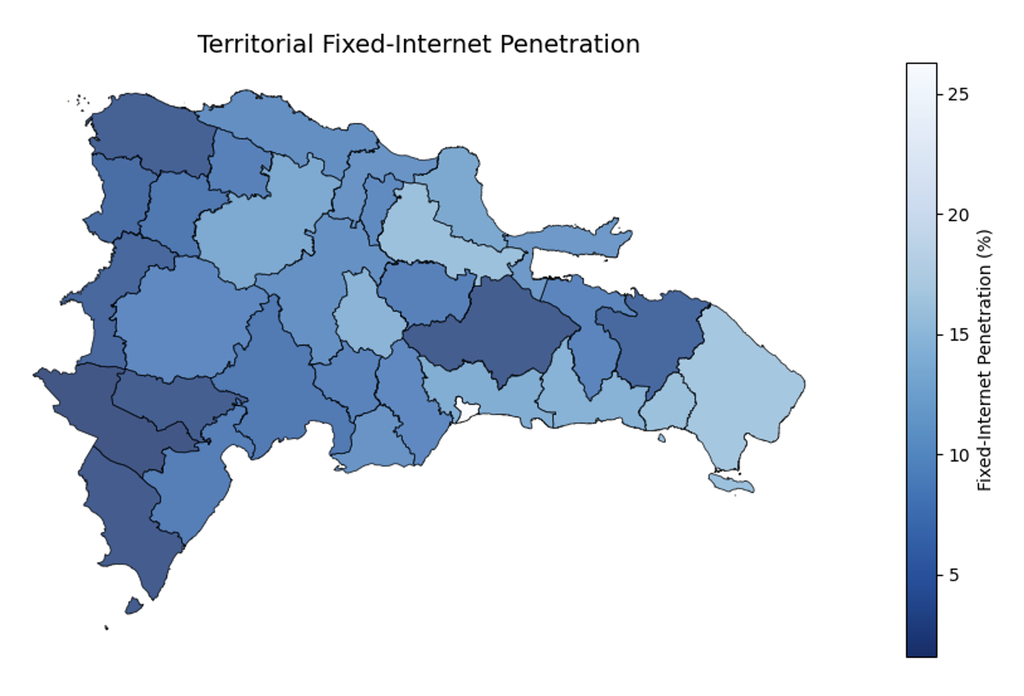
At the top of the spectrum lies the Distrito Nacional, the nation’s capital and primary economic hub, with a penetration rate of 26.2%. At the other end is Independencia, sitting at just 1.6%. In practical terms, fixed-internet penetration in the capital was roughly 16.4 times higher than that observed in Independencia, offering undeniable proof of severe territorial fragmentation.
Mapping this data reveals a distinct geographic pattern. The highest levels of internet access concentrate heavily in the Distrito Nacional and La Altagracia, a province globally renowned for its booming tourism industry. Conversely, internet density thins out significantly across the southwestern part of the country.

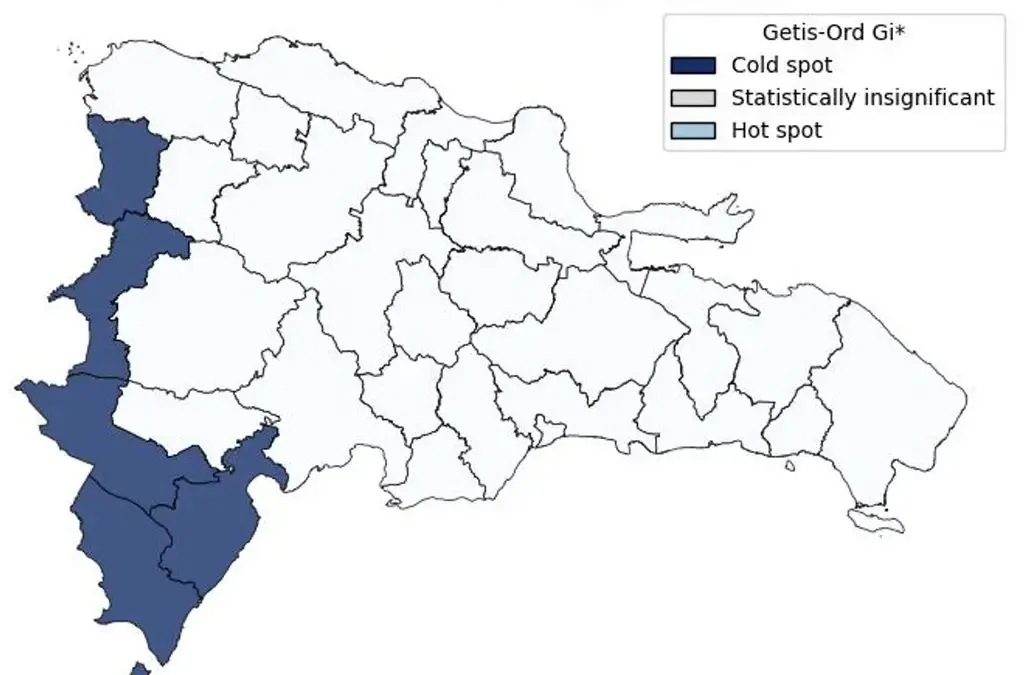
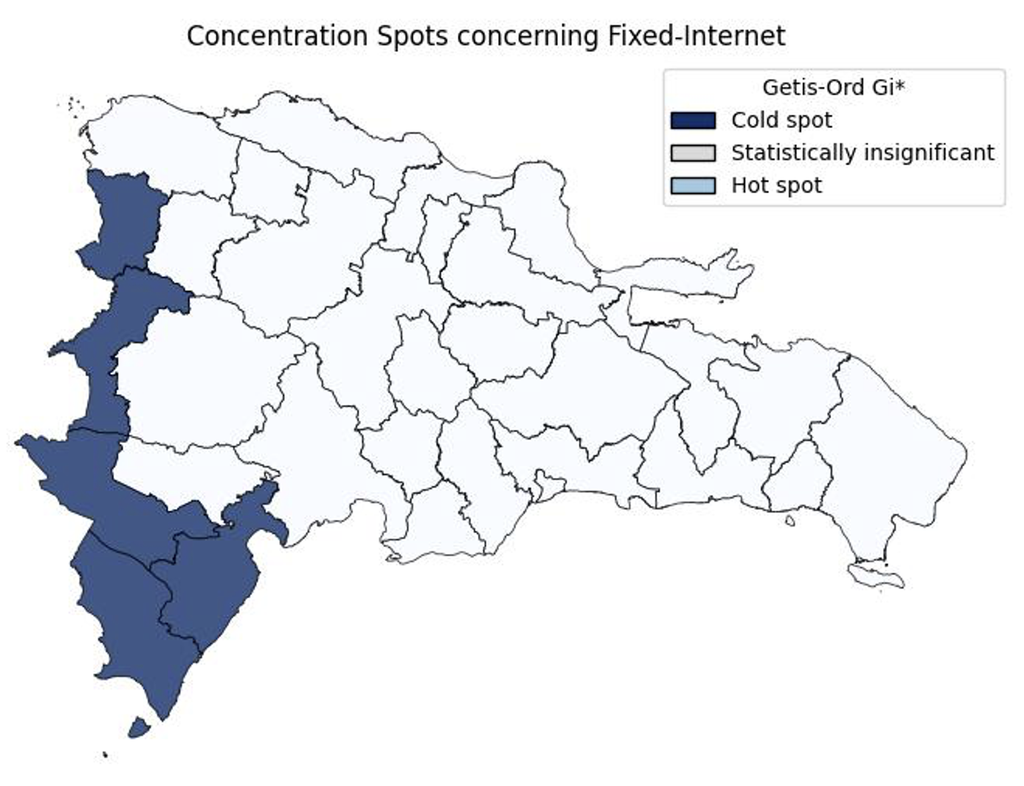
To move beyond visual cartography into statistical verification, researchers applied spatial analysis tools such as the Getis-Ord Gi* hot-spot mapping. This statistical approach confirms the existence of a pronounced low-density cluster along the southwestern corridor, where provincial penetration consistently falls below 5%.
Interestingly, the analysis found no statistically significant high-density clusters around the Distrito Nacional or La Altagracia, indicating that these high penetration levels remain relatively localized to those specific economic centers. Furthermore, the sheer population size and high penetration rates of these prosperous regions disproportionately skew national aggregate figures, effectively masking the persistent pockets of low connectivity in the southwest.
Are Territorial Inequalities Declining?
While snapshots of regional distribution provide a static view of the present, understanding the trajectory of the digital divide requires tracking how these inequalities evolve over time. Researchers employed statistical tools like the Gini coefficient and the Wolfson index to measure changes in resource distribution from 2017 to 2024.
The Gini coefficient, which summarizes the equality or inequality of a resource’s distribution across provinces, dropped from 0.365 in 2017 to 0.313 in 2024. Concurrently, the Wolfson index—which captures polarization by assessing whether a distribution is splitting into distinct high- and low-connectivity clusters—fell from 0.321 to 0.252 over the same timeframe.
Together, these indicators demonstrate that while fixed-internet access remains geographically unequal, both overall inequality and regional polarization have steadily decreased. However, a slight upward tick observed in the 2024 data signals that this progress has not followed a strictly linear or continuous path.
Beyond mere access and subscription density lies the critical question of network performance. As academic literature on IP network performance emphasizes, expanding access speeds naturally elevates user expectations regarding service quality.
To evaluate effective connectivity, the study analyzed Ookla fixed-network measurements encompassing download speeds, upload speeds, and transmission latency aggregated at the provincial level. The 2024 figures exposed vast disparities in network performance across the country. Provincial average download speeds spanned widely from 25.53 Mbps to 84.46 Mbps, while upload speeds ranged from 5.83 Mbps to 32.36 Mbps. Latency figures—representing network delay—fluctuated between 9.27 ms and 67.28 ms.
To determine whether high subscription density translates into superior technical performance, researchers ran a Pearson correlation analysis connecting provincial internet density with the three performance metrics. The results revealed a strong positive correlation between internet density and download speeds (r = 0.83), as well as upload speeds (r = 0.82). Provinces boasting higher fixed-internet penetration also tended to deliver faster connection speeds.
Conversely, latency demonstrated a strong negative correlation of r = −0.70, indicating that regions with higher penetration generally experienced lower network delay. Despite these clear statistical trends, the relationship is not absolute. High penetration does not automatically guarantee maximum speeds or minimal latency, as performance indicators measure distinct technical characteristics of the infrastructure. Consequently, relying solely on subscription counts yields an incomplete assessment of real-world connectivity.
Dr. Wilson Ramírez, a researcher and lecturer specializing in telecommunications, internet infrastructure, and data analytics whose work examines digital inclusion and connectivity development across the Dominican Republic and the Caribbean, emphasizes that aggregate numbers alone tell only part of the story.
Ultimately, the findings suggest that measuring the digital divide requires looking beyond basic subscription counts. While tracking who is connected sheds light on access, evaluating network performance reveals the actual quality of that connectivity. Examining these dimensions in tandem provides a comprehensive understanding of digital inclusion, detailing not only who manages to get connected, but the true caliber of the service they receive.