Just over a year ago, T-Mobile officially launched its home fiber internet service in the United States, a strategic move buoyed significantly by its acquisition of regional fiber provider Lumos. At the time of its initial rollout, T-Mobile’s nascent fiber service reached approximately half a million households across the country, offering competitive maximum download speeds of up to 2 Gbps. The launch marked a major evolutionary step for a company primarily known as a disruptive force in the wireless and mobile data sectors, signaling a concerted push into the lucrative and deeply entrenched fixed-line broadband market. Building upon that initial momentum, T-Mobile has returned this week to announce a major expansion of its high-speed portfolio, introducing an ultra-fast 5 Gbps tier tailored specifically for residential customers who crave even higher bandwidth capabilities for demanding digital workloads, multi-user households, and intensive data consumption.
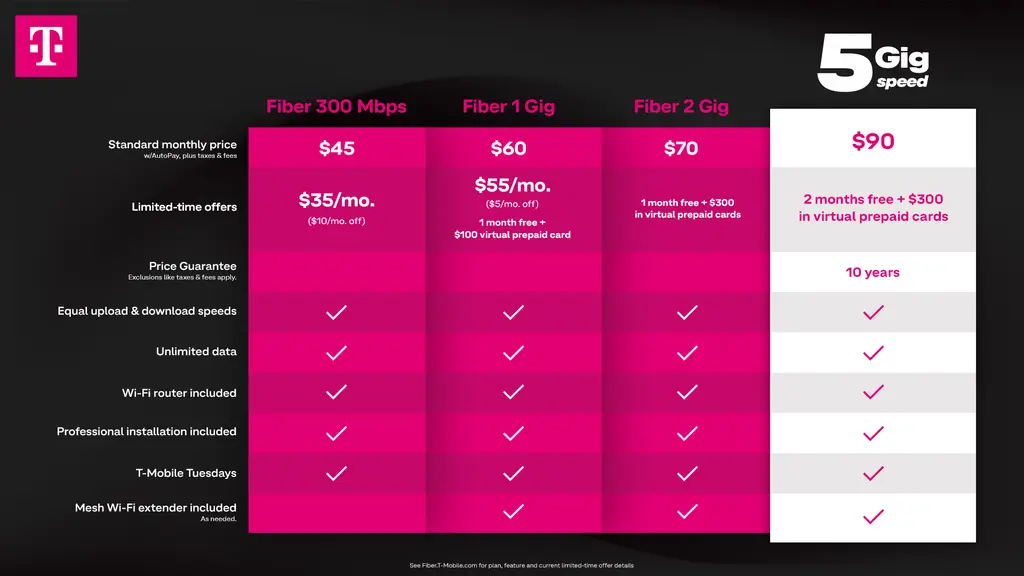
The newly introduced 5 Gbps tier is priced at $90 per month, a competitive entry point for symmetrical multi-gigabit connections in the modern telecommunications landscape. Crucially, the plan comes paired with an exceptionally rare corporate commitment: a 10-year price guarantee. In an industry where consumers have grown thoroughly accustomed to legacy cable internet providers quietly raising monthly bills, introducing hidden surcharges, or forcing subscribers to constantly negotiate retention deals or jump through complex promotional hoops just to maintain their existing service rates, a decade-long price lock represents a radical departure from traditional broadband business practices. This long-term predictability could prove extraordinarily appealing to a large segment of the population that feels fatigued by the perpetual cycle of rising utility and connectivity costs.
However, as is standard practice within the telecommunications and Internet Service Provider industry, prospective subscribers examining the fine print will find specific terms and conditions governing the seemingly straightforward $90 rate. The official offer details explicitly note that certain variables and ancillary costs are excluded from the 10-year price protection framework. Specifically, the fine print states that taxes and regulatory fees, voluntary equipment upgrades or higher-speed equipment modifications, select limited-time promotions, per-use charges, third-party services bundled onto the account, and standard network management practices are not included in the guaranteed base price. Despite these customary exclusions, the underlying promise of locking in the core monthly rate for an entire decade remains a powerful differentiator as T-Mobile attempts to capture market share from incumbent cable and telecommunications giants.
The introduction of the 5 Gbps tier underscores the rapid pace at which fiber-to-the-home infrastructure is evolving and competing for subscribers in covered markets. When T-Mobile initially entered the fiber arena a year ago by leveraging the assets and footprint acquired through Lumos, the primary objective was to establish a viable terrestrial broadband footprint to complement its immensely successful fixed wireless access home internet product. By offering robust 2 Gbps speeds out of the gate, the Un-carrier demonstrated that it could compete directly with traditional fiber-optic providers on raw performance. Now, by doubling down on infrastructure capabilities and scaling up to a 5 Gbps offering, T-Mobile is positioning itself to capture tech-forward households, remote professionals, content creators, and large families running multiple data-intensive applications simultaneously without experiencing bottlenecks or latency issues.
The broader marketplace response to T-Mobile’s ongoing fiber expansion will likely be closely monitored by legacy cable operators, who are already facing intense pressure from both fixed wireless providers and expanding fiber builders across the United States. Traditional broadband providers have long relied on multi-year promotional pricing structures that inevitably expire, often resulting in steep price hikes that catch consumers off guard. By offering a decade-long price lock on a top-tier 5 Gbps connection, T-Mobile is directly challenging this legacy pricing model, forcing competitors to rethink how they package and price high-speed internet services to retain an increasingly discerning customer base. As the rollout of this new ultra-fast tier gains traction, the company continues to solidify its dual-track home internet strategy, combining the widespread reach of its 5G wireless home internet with high-capacity, dedicated fiber connections in select markets.