When anime streaming service Funimation officially shut down its website and application in April 2024 following its full absorption into Crunchyroll, thousands of fans experienced an unexpected loss of media access. Beyond the termination of the standalone streaming platform, the closure cut off access to the digital copies that consumers had previously received as a bundled bonus when purchasing physical DVDs and Blu-ray discs. The sudden revocation of these digital licenses sparked widespread frustration across online communities, highlighting the fragile nature of digital ownership in an increasingly cloud-dependent entertainment industry.
Months after the fallout from the platform’s closure, the incident has resurfaced in a formal legal battleground. A fresh round of petitions submitted to the U.S. Copyright Office is citing the Funimation shutdown as a primary justification for a new exemption under the Digital Millennium Copyright Act (DMCA). If approved, the proposed exemption would legally permit physical media owners to bypass digital rights management and make local replacement copies of their purchased content for personal use. Rightsholders, major entertainment studios, and other opponents of the proposal now face a looming February deadline to file their formal objections against the requested rule changes.
The core of the legal hurdle stems from the DMCA’s strict anti-circumvention provisions, codified under Section 1201 of Title 17 of the United States Code. While the movies and television shows remain physically encoded on the optical discs that consumers purchased, attempting to extract or back up these files onto modern devices requires breaking the robust encryption protecting DVDs and Blu-rays. Under current U.S. copyright law, performing this decryption without a specific, approved exemption is illegal, regardless of whether the consumer legally owns the physical medium.

Every three years, the U.S. Copyright Office undertakes a comprehensive review cycle to evaluate and potentially expand the list of permitted DMCA exemptions. Last week, the agency officially opened ten proposed classes of exemptions for public comment, initiating a months-long administrative process. Among these filings, two distinct petitions directly target the vulnerabilities introduced when digital access to legally purchased media is unilaterally discontinued by distributors or streaming operators, with one explicitly highlighting the collapse of Funimation’s digital ecosystem.
The first of these petitions was submitted by Jayden Milne, who is asking the Copyright Office to grant an exemption allowing owners of DVDs, Blu-ray discs, and Ultra HD Blu-ray discs to generate a single secured, local backup copy for personal use. Crucially, this relief would apply in scenarios where the digital copy explicitly promised on the product packaging is no longer accessible or functional. Milne’s proposal addresses two distinct consumer pain points currently prevalent in the physical media market.
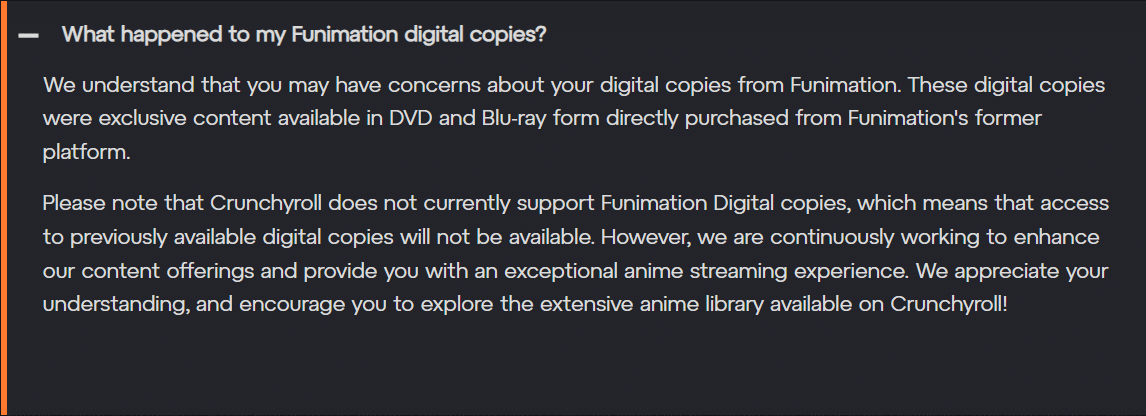
The first category involves consumers who successfully redeemed a digital copy code prior to the hosting service shutting down or terminating support, exactly as occurred when Funimation integrated its operations into Crunchyroll. Today, Crunchyroll’s official customer support documentation states that the platform does not support legacy Funimation digital copies, instead directing affected users toward Crunchyroll’s separate subscription-based streaming library.
The second category involves buyers of newly purchased physical media whose bundled digital codes have already expired before reaching the consumer. According to arguments outlined in the petition, major studios—such as Warner Bros.—enforce policies where digital redemption codes expire based on a title’s initial theatrical or home video release date rather than the actual retail purchase date. Because expired codes are routinely refused replacement by distributors, a consumer buying a legacy catalog title years after its initial release often finds that the promised digital copy is completely worthless out of the box.
Milne’s petition attempts to establish strict limitations to prevent potential abuse of the proposed exemption. Under the framework he outlines, any replacement copy extracted from a physical disc cannot exceed the quality tier originally promised by the manufacturer. If a consumer purchased a standard definition DVD or a package that explicitly advertised an HD digital copy, they would be legally barred from ripping a higher-resolution 4K version. Furthermore, the generated backup must remain strictly for personal use and must be permanently destroyed if the underlying physical disc is sold, given away, or lost.
A second, closely related petition submitted by Zakaria Zerhouane expands the scope of the debate by focusing specifically on the anime industry and the broader instability of digital distribution catalogs. Zerhouane’s filing addresses anime series and films that have been abruptly removed from authorized streaming platforms in the United States following the expiration of licensing agreements, alongside physical releases distributed by historical U.S. companies that no longer exist, such as ADV Films, Bandai Entertainment, Central Park Media, and Geneon.
While Zerhouane’s petition does not explicitly name Funimation, it underscores the systemic volatility of the modern anime market, which has faced significant consolidation under a single dominant corporate entity in recent years—an obvious reference to Sony-owned Crunchyroll. To combat the sudden disappearance of accessible media, Zerhouane’s proposal asks the Copyright Office to permit the circumvention of not only disc-based encryption, but also the digital rights management, geo-locking protocols, and session-based access controls utilized by modern streaming platforms.
The petition argues that standard consumer protections are failing because streaming providers rarely supply advance removal notices. This lack of transparency prevents dedicated fans from finishing, archiving, or preserving works before they vanish entirely behind corporate paywalls or licensing voids. Despite the broad scope of these grievances, both petitions maintain narrow boundaries regarding their intended applications. Zerhouane’s request is strictly limited to the anime medium, while Milne’s petition applies exclusively to physical media discs that were originally bundled with a promised digital copy. Both proposals emphasize that any authorized circumvention must remain strictly confined to personal, non-commercial use.
The U.S. Copyright Office has grouped these submissions alongside four other distinct replacement-focused petitions. The broader batch includes requests to permit personal backups of physical media before physical disc degradation occurs, as well as allowances for format-shifting as older playback hardware inevitably becomes obsolete. These concerns gain urgency with each passing year as legacy optical formats and specialized players continue to age out of the consumer market.
Despite the growing relevance of these preservation arguments, the Copyright Office noted in its administrative notices that the Register of Copyrights has repeatedly declined to recommend broad format-shifting exemptions during past triennial reviews. Consequently, while the proposals have secured a place on the official agenda for evaluation, their ultimate approval remains highly uncertain.
Before rendering any formal decisions, the Copyright Office is actively soliciting detailed commentary and evidentiary filings from all interested stakeholders. Regulators are demanding specific insights into the exact copy-protection mechanisms involved, whether the affected titles remain reasonably accessible through alternative legal viewing channels, and why permitting personal backups would not infringe upon existing copyright protections. Additionally, the office is asking stakeholders to submit market data addressing whether granting such exemptions would cause measurable financial harm to rightsholders and physical media sales.
Supporters and proponents of the exemptions have until December 7 to submit their initial comments to the agency. Following the public comment window, opposing rightsholders and industry trade groups will have until February 22 to file their formal objections and counter-arguments. Public hearings are scheduled to take place during the spring, where stakeholders will have the opportunity to present oral arguments before the Copyright Office determines whether the requested DMCA exemptions will be written into federal law for the upcoming cycle.