
The open-source software ecosystem is experiencing a profound transformation as generative artificial intelligence reshapes how code is authored, reviewed, and maintained. According to a landmark research report published by LF Research, the research arm of the Linux Foundation established in 2021, the rapid proliferation of AI-assisted development tools has introduced a complex double-edged sword to the global developer community. While generative AI models are demonstrably accelerating initial code creation, they are simultaneously inundating maintainers with an unprecedented wave of low-quality contributions, colloquially referred to in the industry as "AI slop," and exacerbating severe burnout across critical software projects.
The comprehensive study, titled Navigating Open Source Software Development in the Generative AI Era, draws on survey data from 234 open-source contributors and maintainers. Sponsored prominently by Red Hat, with additional collaborative contributions and support from the OpenSSF, LF AI & Data, and Futurewei, the research sheds light on the growing friction between automated productivity gains and the human-centric governance models that sustain the open-source backbone of modern technology.
The Findings
The research findings paint a stark picture of an ecosystem under strain, particularly within larger and more established codebases. Projects boasting more than 50 active contributors are bearing the heaviest brunt of the generative AI boom. Among maintainers managing these larger projects, an overwhelming 69% report a noticeable surge in incoming contributions—significantly higher than the 59% average recorded across all surveyed maintainers.
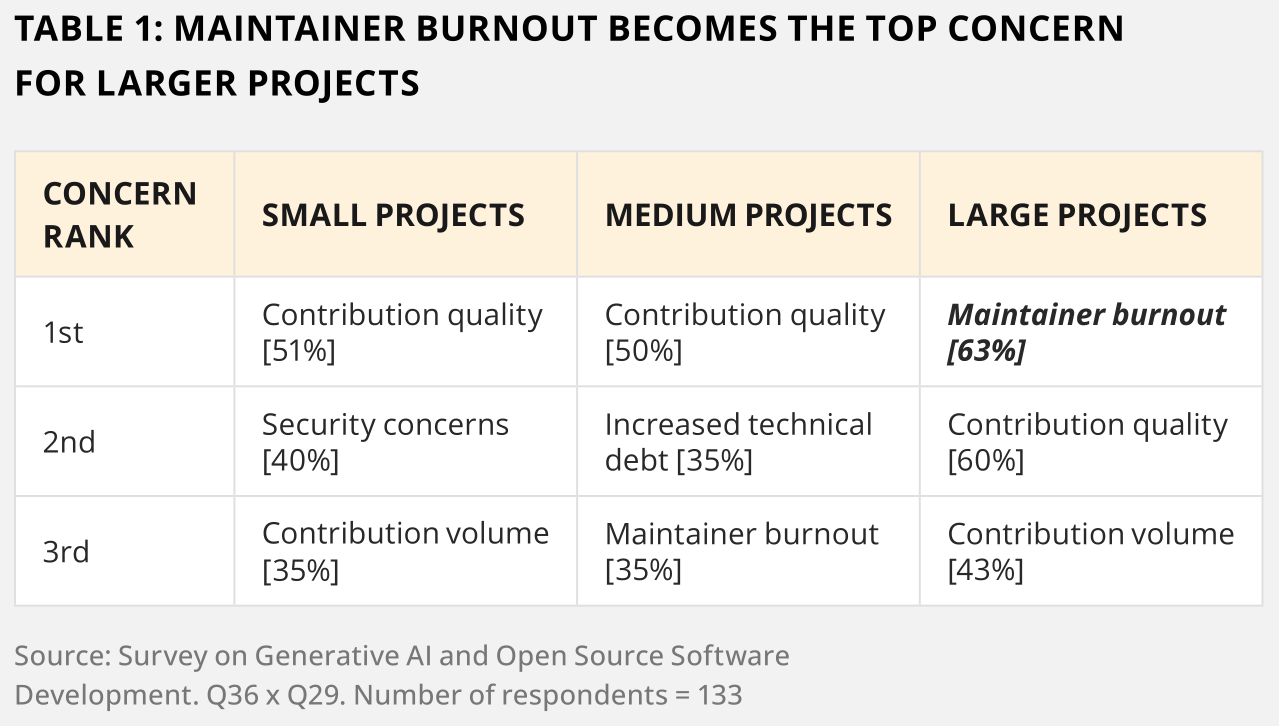
Furthermore, 64% of maintainers on large projects indicate that code reviews now take considerably longer to complete than they did prior to the widespread adoption of generative AI tools. This bottleneck is directly tied to the influx of unverified, poorly tested, or superficially generated code that requires exhaustive human scrutiny to prevent vulnerabilities from infiltrating mission-critical software. Consequently, burnout has emerged as the foremost concern for maintainers of large projects at 63%, narrowly edging out overall contribution quality, which concerns 60% of respondents.

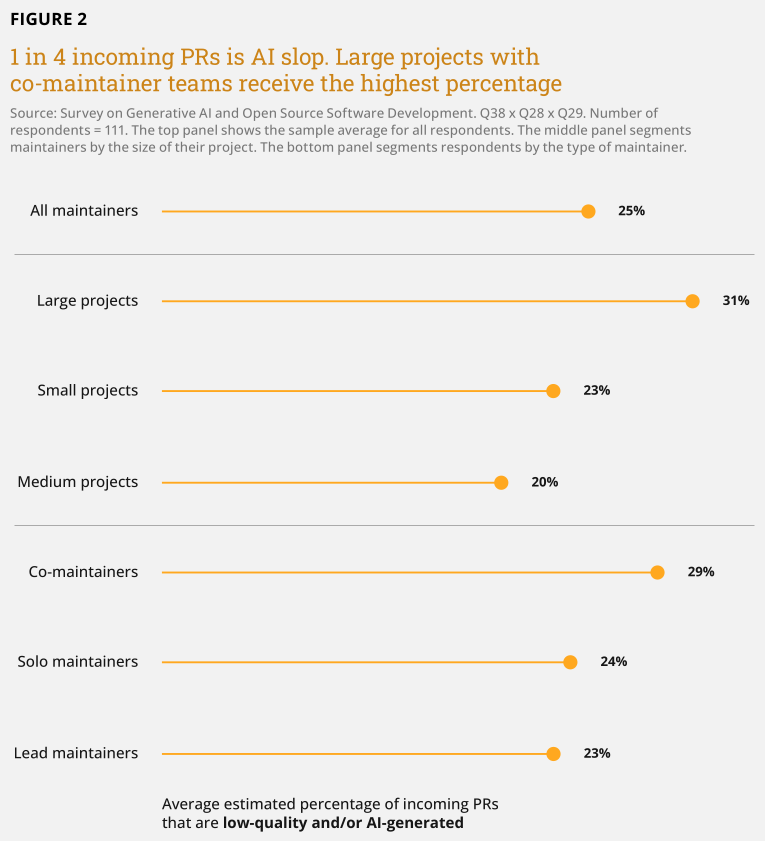
The survey attempts to quantify the scale of the problem, estimating that roughly 25% of all incoming pull requests across the ecosystem consist of low-quality AI slop. For larger projects, that estimated figure climbs even higher, reaching approximately 31%. This continuous stream of superficial contributions places an unsustainable burden on project maintainers, who often volunteer their time or rely on strained institutional funding to safeguard the integrity of public software infrastructure.
Policy Gaps and Verification Challenges
Despite the seismic shift in how code is produced, the research reveals that formal governance and organizational policies have largely failed to keep pace with the rapid advancement of AI-assisted coding and vulnerability reporting trends.
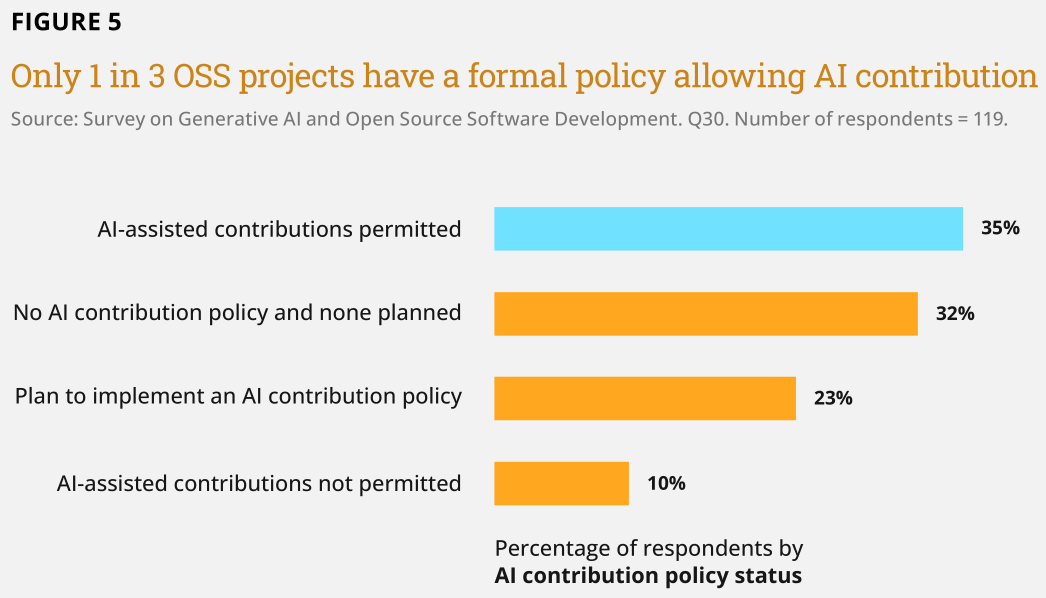
Among the 119 respondents who answered specific questions regarding internal project rules, only 35% stated that their project has established a formal policy permitting the use of artificial intelligence. Another alarming 32% reported having no policy whatsoever and no current plans to implement one, while 23% indicated that they are actively planning to write a policy in the near future. Only a small minority of 10% have chosen to ban AI-generated contributions outright.
These findings echo real-world governance debates unfolding across the software world. Prominent projects, such as LLVM, have established conditional frameworks that allow AI-generated code under specific guidelines. However, the Linux Foundation report highlights that 26% of projects currently have no mechanism or capability whatsoever to verify whether incoming contributions were assisted by artificial intelligence.
In response to these vulnerabilities, the report calls upon individual contributors to take greater personal responsibility by adhering to written project policies, transparently disclosing the use of AI tools, and investing more effort into comprehensive testing and documentation.
Productivity Gains Versus Trust Deficits
To understand the widespread adoption of these tools, the research also examined the positive impacts reported by developers. Generative AI undeniably delivers substantial time savings during the initial phase of software creation. Respondents estimate that code authoring takes an average of 52% less time when leveraging AI assistants. However, this productivity boost is not uniform across all tasks. When confronting more complex, nuanced software architecture challenges, 21% of respondents noted that the work actually took longer with AI, as developers spent valuable time debugging hallucinated code or untangling overly complex automated logic.
From a community perspective, 71% of maintainers agree that artificial intelligence makes it significantly easier for newcomers to take their first steps and start contributing to projects. By lowering the barrier to entry, AI can theoretically broaden the talent pipeline. Yet, this democratization of code creation has not translated into deeper community trust. Just over half of respondents, or 53%, state that AI has done nothing to improve community trust, while a mere 13% believe it has fostered a more trusting environment.
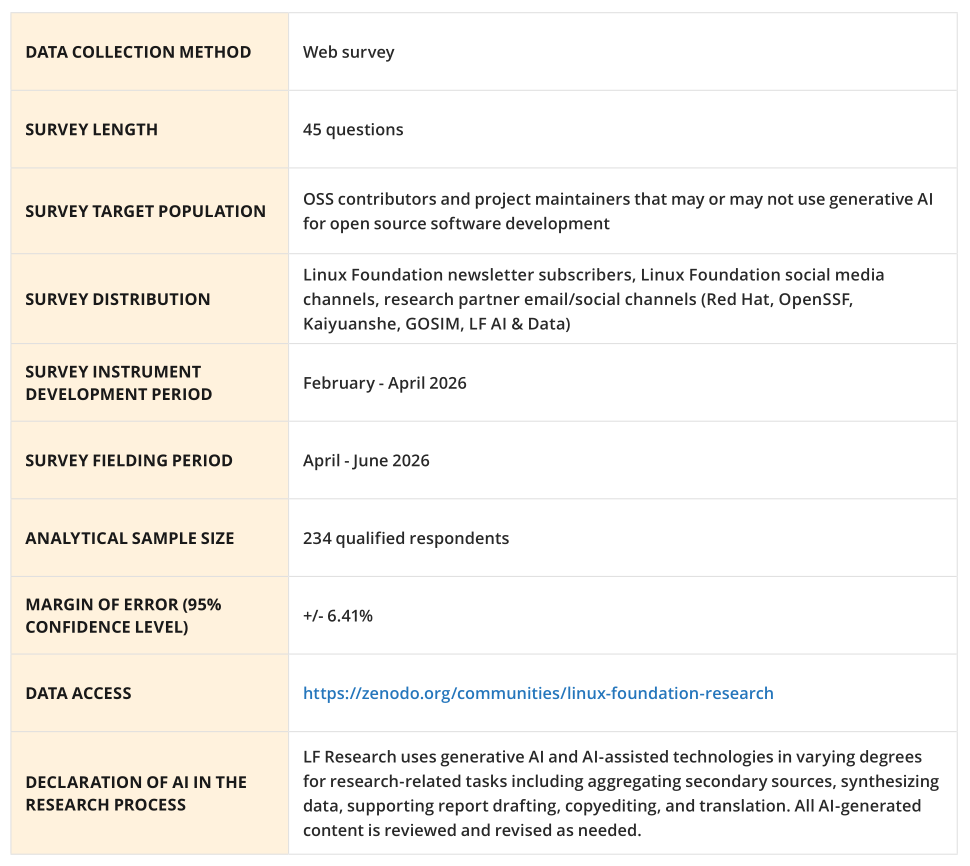
The research methodology relies on data gathered through Linux Foundation newsletters, social media channels, and partner networks, including Red Hat. Researchers note important caveats regarding the data, such as the 25% slop figure representing an estimate derived from 111 respondents rather than an exhaustive empirical count.
Ultimately, because disclosure remains largely voluntary and a quarter of projects lack verification tools, the current system relies heavily on the ethical consideration of the person submitting the code. As previous high-profile incidents within the open-source community have demonstrated—such as security strains faced by core projects like curl—the individuals generating low-quality AI output rarely take the necessary precautions, leaving human maintainers to shoulder the consequences.


Leave a Reply