
A federal magistrate judge has ordered Meta to disclose the identities of the employees and managers who authorized, approved, or participated in decisions to use BitTorrent to download copyrighted books from "shadow libraries" for the training of the company’s artificial intelligence models.
The ruling marks the latest escalation in a complex web of legal battles concerning intellectual property, AI training data, and copyright infringement. While Meta has successfully defended its use of copyrighted texts under the legal doctrine of fair use in certain contexts, its reliance on peer-to-peer torrent networks to gather datasets remains a live and contentious issue in court.
The Shrinking Scope of the Lawsuits
The legal scrutiny stems from class-action and individual lawsuits brought against Meta by authors—such as Richard Kadrey and Sarah Silverman—as well as publishers like Entrepreneur Media, the organization behind Entrepreneur magazine. Plaintiffs allege that the tech giant improperly sourced and utilized pirated literary works to train its prominent Llama family of large language models.
In earlier proceedings, the court delivered a bittersweet victory for Meta, ruling that the actual training of AI models on copyrighted books constituted fair use under United States copyright law. However, that ruling did not absolve the company of all liability. The claims regarding BitTorrent downloading and contributory infringement survived, becoming the primary battlegrounds for the remaining portions of the litigation.

Plaintiffs argue that by utilizing BitTorrent clients to acquire datasets from notoriously clandestine repositories like Library Genesis (LibGen) and Anna’s Archive, Meta did not merely download files; it actively participated in "seeding"—uploading fragments of the copyrighted works back to other users on the peer-to-peer network—thereby contributing to the widespread distribution of pirated material.
The Hunt for ‘Technical’ Decisions
To establish liability and demonstrate willfulness, Entrepreneur Media sought to uncover the chain of command behind the torrenting activity. The publisher formally requested that Meta identify every individual who "made, authorized, or approved" the decisions to acquire the shadow library datasets via BitTorrent.
Meta’s initial responses fell short of satisfying the plaintiffs. The company named several individuals involved in general data-related decisions and noted that acquiring data from Anna’s Archive underwent an internal legal review by in-house attorneys in early 2024. However, Meta maintained it could not identify anyone who "formally" made or approved decisions to acquire or use books for its first two iterations of the Llama models, asserting that those choices were typically the result of internal team consensus.
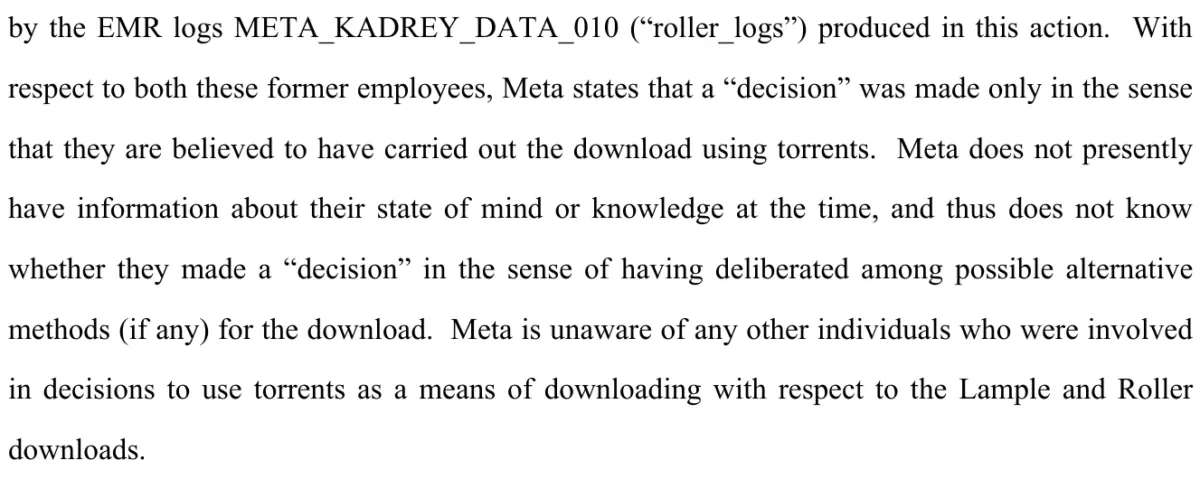
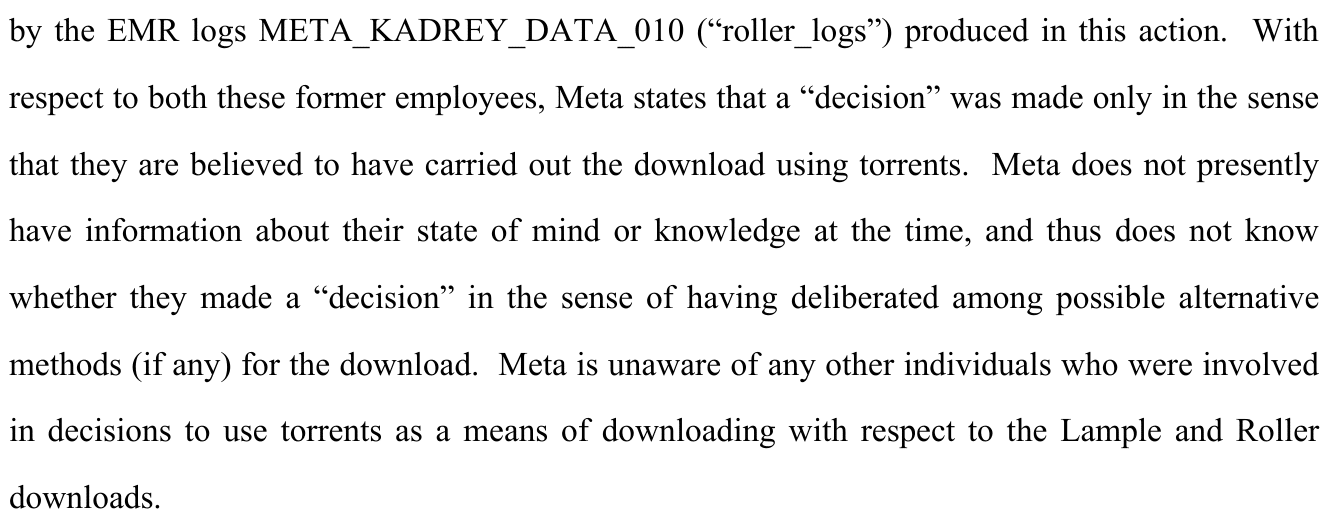
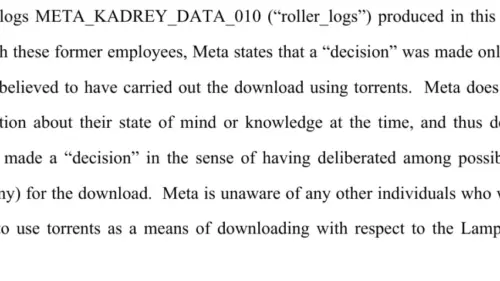
When pressed specifically on the BitTorrent mechanics, Meta categorized the actions of the employees who executed the downloads as routine technical decisions rather than executive directives. By Meta’s construction, no single individual at the company explicitly decided to use BitTorrent to distribute copyrighted works, even though the company repeatedly accessed shadow libraries using the protocol between 2022 and 2024.
This defense drew immediate skepticism from the plaintiffs. Entrepreneur Media countered that under Meta’s logic, no one at the company decided to torrent anything, yet the infrastructure engaged in the practice repeatedly over a two-year period.
Internal Warnings and ‘Legally Not Okay’
The operational reality inside Meta appeared more deliberate than the company’s legal filings suggested. Discovery efforts revealed internal communications and logbooks indicating that the legal implications of peer-to-peer file sharing were recognized by engineering teams well before the downloads took place.
Testimony from an engineer who participated in downloading LibGen data revealed that the issue of seeding was raised and actively discussed internally, prompting employees to take steps to mitigate upload activity. More damningly, an internal Meta logbook reviewed by an employee prior to executing a download from Anna’s Archive explicitly warned against utilizing the protocol.
"Decided to go with direct file uploads without using torrents for the following reasons: Using torrents would entail seeding the file such as sharing content outside. This would be legally not okay," the logbook stated, as highlighted in Entrepreneur Media’s court filings.
Despite such internal cautions, Meta ultimately utilized BitTorrent to download LibGen’s Scimag collection and data from Anna’s Archive. While the company maintained that measures were implemented to suppress seeding, the exact volume of data shared with third parties remains an open question. An expert retained by Meta previously estimated that uploads from the company’s Amazon Web Services (AWS) servers accounted for roughly 30 percent of the total data downloaded during torrent operations between April and July 2024.
Magistrate Judge Rules on the Dispute
Confronted with Meta’s resistance to naming higher-level decision-makers, Entrepreneur Media brought the matter before Magistrate Judge Thomas Hixson. Two weeks prior to the ruling, Meta informed the court that it possessed no additional information regarding the torrenting decisions to disclose.
Judge Hixson rejected Meta’s stance, issuing an order compelling the company to broaden its disclosures. The judge noted that the plaintiffs’ interrogatories were not restricted to formal executive decisions and that Meta’s previous answers focused primarily on how the data was used rather than how it was initially obtained or downloaded.
Furthermore, Judge Hixson dismissed Meta’s argument that collaborative team environments absolve it from naming responsible parties. He ruled that because the interrogatories explicitly inquired about all decision-makers, every individual involved in a group consensus must be formally identified.

Under the terms of the new order, Meta must identify the personnel who participated in internal discussions preceding the 2023 LibGen torrent download, the individuals who approved the switch to BitTorrent, and those who greenlit the April 2024 acquisition from Anna’s Archive. Crucially, the directive also extends to anyone who contributed to decisions regarding "whether or how to seed, or to mitigate seeding," during the acquisition of the shadow library datasets.
For the plaintiffs, securing these names is a vital step toward proving willfulness, which could significantly impact damages. As the litigation moves forward, the core questions of whether Meta’s torrenting operations constituted fair use and whether the company illegally distributed copyrighted books to third parties await ultimate resolution by the court.

Leave a Reply