
The global internet has successfully navigated a critical infrastructure milestone following the rolling of the Domain Name System (DNS) root Key Signing Key (KSK) on October 11, 2026. Utilizing the KSK Sentinel signal, network telemetry gathered across the first half of October indicates that the transition occurred without triggering major disruptions or widespread DNS outages, maintaining stability across validating resolvers worldwide.
This recent operational update builds upon monitoring data gathered in the months leading up to the scheduled October 11 event, following preliminary analyses published in May and early October 2026. Through an advertisement-based measurement network, researchers tracked user validation patterns during the initial two-week window of October to evaluate how individual autonomous systems and recursive resolvers handled the cryptographic handover.

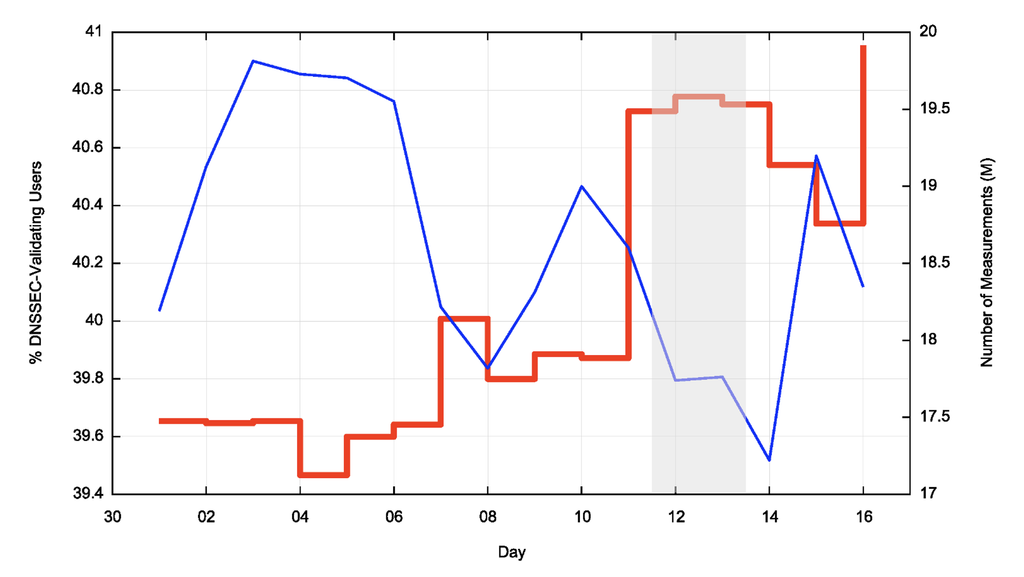
The big-picture data, collected across the first 16 days of October, illustrated consistent daily advertisement presentation rates within normal parameters of statistical variation. A closer look at the global average DNSSEC validation rate revealed a slight increase, moving from a pre-roll baseline of 39.7% to a post-roll average of 40.6%. This upward shift indicates that the KSK was rolled successfully and highlights the collaborative success of the engineering community, software vendors, and network operators who developed, standardized, and deployed robust DNSSEC validation software capable of tracking the key rollover.
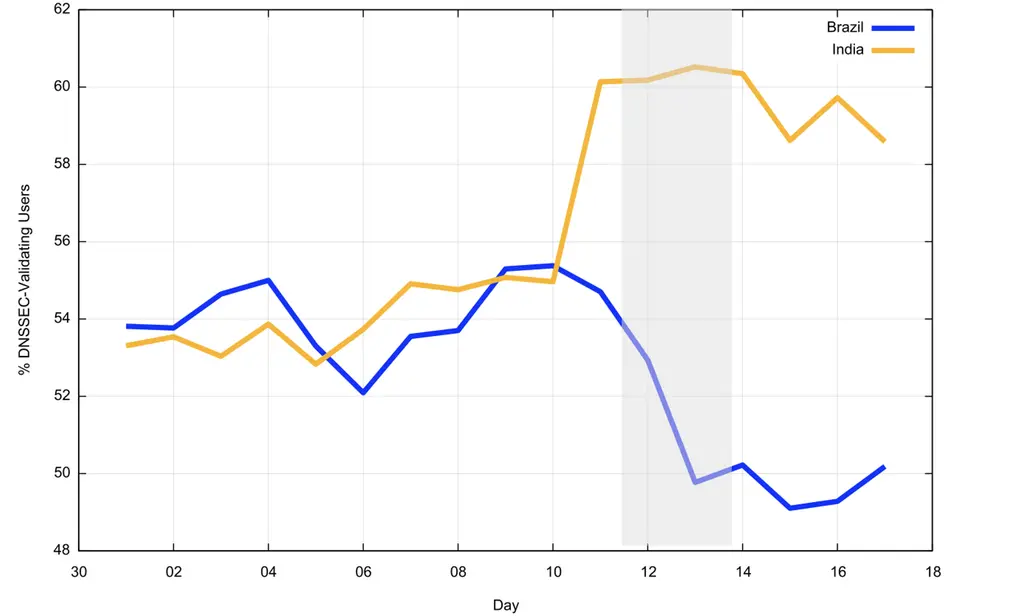
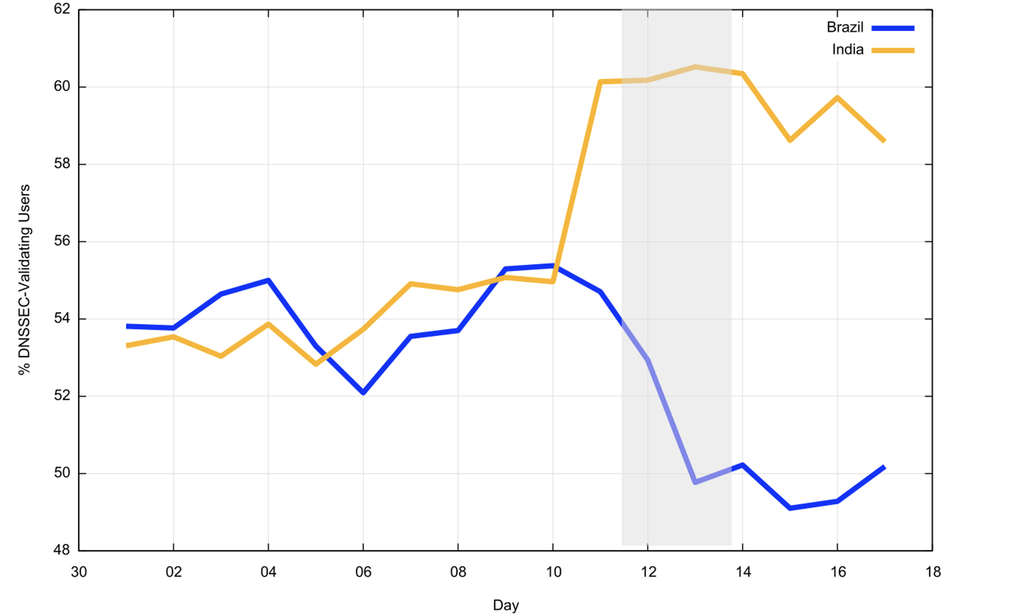
Despite the positive global average, localized behaviors frequently diverge from macro-level trends. Regional variations became evident when examining specific economies with high concentrations of DNSSEC-validating users, such as Brazil and India, where deployment is heavily driven by ISP-provisioned recursive resolvers.
Proactive intervention played a vital role in mitigating potential disruptions in certain regions. On October 9, researchers successfully contacted a major Indian internet service provider after observing KSK Sentinel signals indicating that their resolvers had failed to acquire local trust in the incoming KSK. This early notification enabled the ISP to adjust its configurations before the rollover occurred. Consequently, the measured DNSSEC validation rate among users in India rose from 55% to 59% across the transition.

In contrast, similar outreach efforts could not be successfully executed with targeted ISPs in Brazil during the same timeframe. Consequently, the regional data for Brazil showed a decline in the DNSSEC validation rate from 54% to 50% following the key roll.
Further scrutiny was applied to a cohort of 50 networks that had previously registered the lowest rates of acceptance for the incoming KSK during the week leading up to the event, despite showing technical support for the Key Sentinel mechanism in over 1,000 separate tests. Tracking these specific networks up through October 18 revealed an unexpected development: none of these systems were stranded when the root key rolled. Every single one of these networks successfully integrated the new KSK into their trusted key sets between October 7 and October 13, displaying a uniform adoption pattern that remains relatively rare in distributed network environments.
Evaluating validation outcomes across a broader scale involved analyzing networks where validation rates shifted following October 13 relative to baseline averages observed during the first ten days of the month. Out of a dataset encompassing 13,538 networks with consistent sampling before and after the event, 35 networks recorded a positive surge in validation exceeding 50%, likely stemming from configurations that trusted the incoming KSK while omitting the incumbent key. Expanding the criteria, 594 networks exhibited a positive increase of 10% or more in their DNSSEC validation rates.
Conversely, downward trends were also documented. A total of 58 networks experienced a drop in DNSSEC validation rates of 50% or more, while 660 networks registered declines of 10% or more.
Assessing the human impact of the transition relies on estimated user population metrics associated with validating resolvers. Prior to the key roll, the global population of users protected by DNSSEC-validating DNS resolvers stood at approximately 1,654,477,399 out of a total estimated user base of over 4.3 billion. Following the completion of the rollover, that validating population rose to 1,700,275,794, representing a net global increase of roughly 45.8 million DNSSEC-validating users.
At the economy level, several regions registered notable net growth in validating populations. India led the group with an estimated net increase of over 45.4 million validating users, moving from roughly 321.6 million pre-roll to 367.1 million post-roll. Other regions showing substantial net gains included Viet Nam with an increase of over 9.1 million validating users, Algeria with an addition of nearly 3.3 million, Morocco adding over 2.3 million, and Kazakhstan with a net growth of approximately 950,000 users. Slovakia, Iran, Thailand, Sri Lanka, and Lithuania also recorded positive net adjustments in their validating user populations.
Conversely, other economies experienced noticeable net contractions in validating user numbers during the same comparative window. Brazil registered the largest drop, seeing a decrease of approximately 7.7 million validating users as its total fell from 80.5 million down to 72.7 million. The Russian Federation followed with a net reduction of roughly 3.07 million validating users. Other economies observing downward adjustments included China with a net decline of approximately 1.7 million, the United States with a reduction of roughly 906,000 users, Bulgaria losing around 760,000, alongside measurable drops in Bangladesh, Japan, Uganda, Pakistan, and Egypt.
Because the Domain Name System functions as a highly distributed yet loosely coupled architecture, achieving absolute coordination of actions across every independent operator remains an inherent challenge. Variations and localized anomalies are expected during sweeping cryptographic transitions. Evaluating the broader picture against these operational realities demonstrates that the October 2026 DNS root KSK rollover achieved its core objectives successfully.


Leave a Reply