
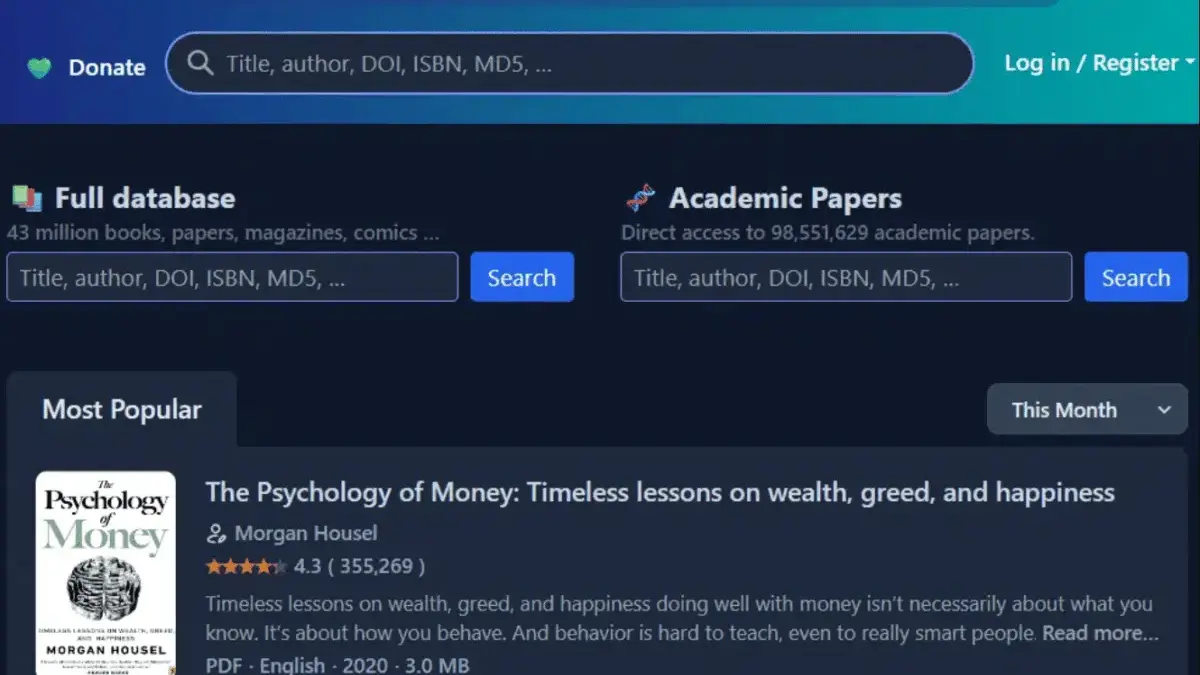
A coalition of major international book publishers has petitioned a New York federal court to enter a massive $19.5 million default judgment against WeLib, an online shadow library accused of copyright infringement on a sweeping scale. The legal action marks another aggressive step by traditional publishing houses against unlicensed digital repositories that aggregate and distribute academic texts, novels, and educational materials without authorization.
The lawsuit, which targets both the platform and its anonymous operators, highlights a growing trend in digital copyright enforcement where major stakeholders target derivative platforms that spring up in the wake of older, more established shadow libraries. Interestingly, legal documents filed by the publishers reveal a peculiar artifact of high-volume litigation: parts of the legal brief appear to have been directly copied, word-for-word, from an earlier, nearly identical lawsuit involving another prominent shadow library, complete with factual claims that do not entirely fit the specifics of the WeLib case.
The origins of the dispute date back to last year, when Anna’s Archive—itself a massive and notorious shadow library—publicly warned its own users about WeLib, describing it as a newly emerged competitor within the underground digital ecosystem. According to observations from the administrators of Anna’s Archive at the time, WeLib appeared to have essentially mirrored the majority of their vast collection while utilizing a modified fork of their underlying source code. Because WeLib’s operators were allegedly taking content and infrastructure without contributing new collections or code improvements back to the ecosystem, the Anna’s Archive team cautioned prospective users to steer clear of the site, writing in a public advisory that they recommended people avoid using the platform altogether.
In June, major book publishers arrived at a similarly critical conclusion regarding WeLib’s operations, albeit from an entirely legal perspective. Represented by specialized intellectual property law firms, major publishing houses filed a formal federal lawsuit in the United States District Court for the Southern District of New York. The complaint alleged that WeLib was deliberately established after its unidentified operators copied both the source code and the vast majority of the contents hosted by Anna’s Archive.
Despite being properly served with notice of the lawsuit and facing serious allegations of willful copyright infringement, WeLib’s anonymous operators chose not to respond, file a defense, or make any appearance in court. This complete lack of engagement prompted the plaintiffs to request a formal entry of default, which the court clerk granted in August. With the procedural hurdle cleared, the path was laid open for the publishers to move forward with a request for a final default judgment and substantial financial penalties.

$19.5 Million, Again
On Monday, the coalition of prominent publishers—including industry giants such as Penguin Random House, Elsevier, HarperCollins, Hachette Book Group, John Wiley & Sons, Macmillan Learning, McGraw Hill, Pearson Education, Simon & Schuster, and Taylor & Francis—formally asked U.S. District Judge Victor Marrero to issue a default judgment against WeLib and its unnamed administrators.
In their legal memoranda submitted to the court, the publishers did not mince words regarding the platform’s core purpose. They described WeLib as a dedicated pirate operation whose sole commercial rationale is the unauthorized reproduction and distribution of copyrighted works, directly undermining the legal rights of the plaintiffs and the broader publishing industry.
To calculate the financial penalty, the publishers requested the maximum statutory damages permitted under U.S. copyright law: $150,000 for each willful infringement. The complaint lists a total of 130 specific works, allocating ten infringed titles to each of the thirteen corporate plaintiffs. This arithmetic results in a total requested damages award of exactly $19.5 million. Notably, this figure mirrors the exact monetary judgment handed down by U.S. District Judge Jed Rakoff earlier in the separate legal proceedings against Anna’s Archive.
Under the proposed financial breakdown submitted to the court, each of the thirteen corporate entities—ranging from academic publishers like Elsevier and Taylor & Francis to trade publishers like HarperCollins and Simon & Schuster—would be awarded $1.5 million, culminating in the aggregate $19.5 million total.
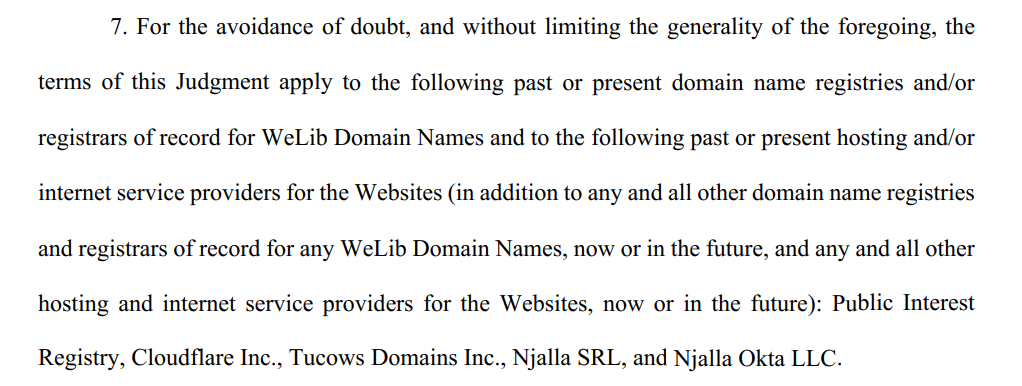
Beyond financial damages, the publishers are asking the federal court to issue a permanent injunction designed to dismantle WeLib’s digital infrastructure. If approved, the order would legally compel domain name registries and registrars to disable the domain names welib.org, welib.st, and welib-public.org, while also prohibiting the transfer of these domains to any entity other than the plaintiffs. Furthermore, web hosting providers servicing the platform would be legally required to cease supporting the sites immediately.

While the injunction would technically bind all applicable intermediaries on the internet, the proposed order specifically singles out five key entities: the Public Interest Registry, Cloudflare, Tucows, and two separate entities associated with the privacy-focused hosting provider Njalla. This target list is noticeably more concise than the one included in the Anna’s Archive judgment, which named more than twenty distinct intermediaries and technical service providers.
Borrowed From Anna’s Archive
The legal documentation submitted by the publishers also sheds light on WeLib’s monetization strategy. While the site allows users to download materials without paying an upfront fee, it actively solicits voluntary contributions or donations of up to $90 per month. According to the publishers’ legal filings, these financial requests are not genuine donations at all, but rather transactional payments extracted from users in exchange for prioritized access and faster download speeds.
However, a close examination of the legal briefs reveals curious artifacts of rapid document drafting. Because the same legal team at the firm Oppenheim + Zebrak handled the litigation against both Anna’s Archive and WeLib on behalf of the identical group of publishers, large portions of the text from the earlier Anna’s Archive brief were reused for the WeLib filing.
While legal recycling of standard arguments is commonplace in intellectual property litigation, some of the transferred text appears misaligned with the specifics of the newer case. Specifically, the publishers’ brief argues that WeLib diverts revenue from copyright holders at a scale made worse by the platform’s use of the "viral BitTorrent protocol." Yet, publicly available evidence and the text of the WeLib complaint itself do not mention the use of BitTorrent for the site’s distribution model. Instead, the cited paragraphs in the WeLib complaint describe a traditional web-server delivery system characterized by tiered download speeds, offering "slow" free downloads and paid "fast" downloads directly from the platform’s own servers.
The original Anna’s Archive complaint explicitly detailed how that specific shadow library utilized torrent files and maintained a dedicated "Torrents" page to facilitate bulk peer-to-peer sharing. The inclusion of the BitTorrent references in the WeLib brief suggests that boilerplate paragraphs from the previous litigation were carried over without adequate tailoring to match WeLib’s distinct infrastructure.

Similarly, other artifacts of rapid copy-pasting appear in the document. A paragraph discussing how WeLib’s infringement continued despite "this and several other cases against them" was pulled straight from the Anna’s Archive filings. While Anna’s Archive has faced a multitude of international lawsuits and legal actions over the years, legal observers have noted no public record of any other lawsuits targeting WeLib’s anonymous operators prior to the current federal action.
Even textual idiosyncrasies survived the transition between cases. Both the Anna’s Archive brief and the WeLib brief contain an identical typographical error, noting what happens if the court "is satified" that the statutory default standards have been successfully met. Both documents also deploy a garbled sentence featuring a double negative, arguing that the defendants "cannot establish that they have not presented any meritorious defenses."
A Paper Victory?
With the briefing concluded, the final decision now rests in the hands of Judge Marrero, who will review the motion for default judgment and determine whether to grant the requested damages and injunction.
Legal analysts point out that regardless of the judicial outcome, the publishers face significant practical hurdles when it comes to recovering the multi-million-dollar award. Because WeLib’s operators have successfully maintained their anonymity throughout the proceedings, collecting financial damages from elusive, unidentified defendants remains a near-impossible task, rendering the monetary judgment largely symbolic.
Nevertheless, the potential injunction carries tangible weight. Experiences with prior enforcement actions against similar shadow libraries suggest that domain seizures and registrar interventions can disrupt operations, force platform migrations, and diminish traffic. When Anna’s Archive was hit with prior court orders and massive financial judgments obtained by music and book industries, it lost several domain names to global takedown orders. Despite those disruptions, however, the platform managed to persist online by migrating to alternative top-level domains such as .gl, .pk, and .gd, which rely on registries and registrars located outside the jurisdiction of United States courts.
Whether a similar fate awaits WeLib remains to be seen. Even if the court grants the publishers’ request to strip the platform of its current domain names and compel internet intermediaries to sever ties, shadow libraries have repeatedly demonstrated a high degree of resilience through domain hopping and decentralized infrastructure.
Copies of the publishers’ memorandum in support of the motion for default judgment, the proposed default judgment order, the formal statement of damages, and the earlier briefs filed against Anna’s Archive have been made publicly available through court records and legal transparency archives. Representatives for the publishers’ legal counsel at Oppenheim + Zebrak were approached for comment regarding the references to BitTorrent within the filings, but no response was provided prior to publication.



Leave a Reply