

The global landscape of digital copyright enforcement has turned its attention toward a massive streaming operation that has managed to embed itself within the official distribution channels of some of the world’s most popular mobile devices. The pirate streaming application known as MovieBox has now surpassed 300 million downloads on the Palm Store, the proprietary app marketplace preinstalled on millions of smartphones across the developing world. This staggering growth has turned the application into a major thorn in the side of international rightsholders, prompting high-profile legal and regulatory complaints in Europe that could reshape how platform operators are held accountable for hosting infringing content.
The controversy surrounding MovieBox has escalated sharply following formal submissions made to the European Commission for its upcoming 2027 Counterfeit and Piracy Watch List. Both the Motion Picture Association (MPA) and the prominent French pay-TV conglomerate Canal+ have officially flagged MovieBox as a massive, industrial-scale piracy operation. While the MPA’s dossier focuses primarily on the sheer scale of the application’s unauthorized distribution and its origins in China, Canal+ has gone a step further, drawing direct and troubling connections between the operation of the pirate platform and the corporate ecosystem of major smartphone manufacturer Transsion.
From Local Nuisance to Global Platforming
The path of MovieBox has been marked by a relentless game of technological whack-a-mole. Last year, copyright watchdogs in Nigeria celebrated what appeared to be a significant victory when authorities suspended MovieBox.ng, a pirate streaming portal that was drawing tens of millions of visits on a monthly basis. Rightsholders hoped that crippling the primary web domain would effectively neutralize the threat posed by the service, which openly offered pirated cinematic releases, television series, and live sporting events to an eager audience.

However, the operators behind MovieBox demonstrated remarkable agility. As investigators quickly discovered, the site simply migrated its web presence to a new domain, transitioning to moviebox.ph to ensure continuous access for web users. More importantly, the standalone Android application—which served as the primary gateway for millions of consumers—remained entirely untouched and widely available across international markets. Rather than suffering a decline following the enforcement actions against its Nigerian web domain, the application entered a period of extraordinary, unchecked expansion.
The numbers presented to European regulators by major media companies underscore just how rapidly the platform has scaled. In its initial overview submitted to the European Commission, the MPA highlighted that MovieBox had already accumulated more than 243 million downloads through the Palm Store alone. Canal+ expanded significantly on these figures in its own regulatory filings, documenting the application’s trajectory following its domain switch in 2025. According to Canal+ data, the application not only survived the regulatory pressure but more than doubled its user acquisition rate in less than a year.
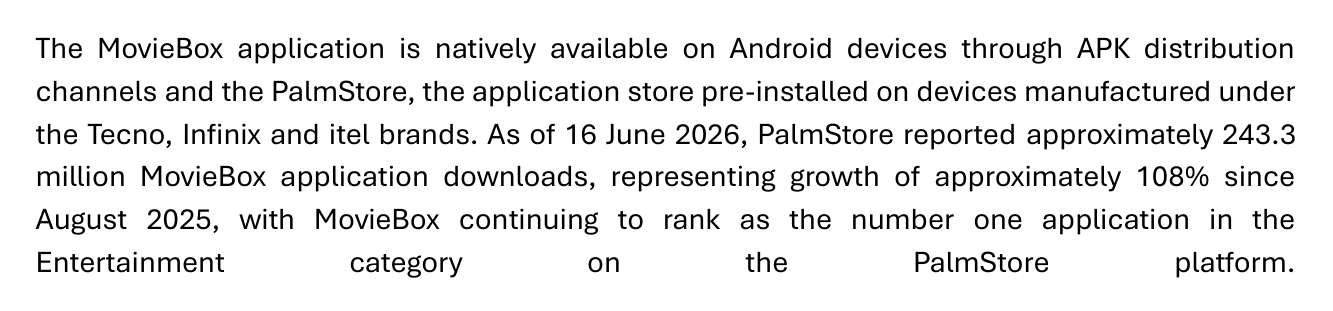
As of mid-June 2026, internal Palm Store tracking metrics cited by Canal+ indicated approximately 243.3 million downloads of the MovieBox application, marking an astonishing 108% growth surge since August 2025. Throughout this period, the software consistently maintained its position as the number one application within the Entertainment category on the Palm Store platform. Yet, even those figures quickly became outdated. By the time of the latest industry reviews, Palm Store’s official public listings recorded an eye-watering 305.6 million downloads for the app—representing an influx of more than 60 million new installs in a span of less than four months.

The promotional materials and descriptions featured on the Palm Store listing leave little ambiguity regarding the nature of the application’s contents. MovieBox explicitly markets its ability to provide free access to premium entertainment and live sports broadcasts, including direct references to Europe’s top five domestic football leagues. Furthermore, the application’s visual branding and promotional artwork have routinely utilized copyrighted imagery and famous intellectual property categories belonging to major Hollywood studios, such as Marvel and Disney, to entice prospective users.
The Transsion Connection and the Palm Store Ecosystem
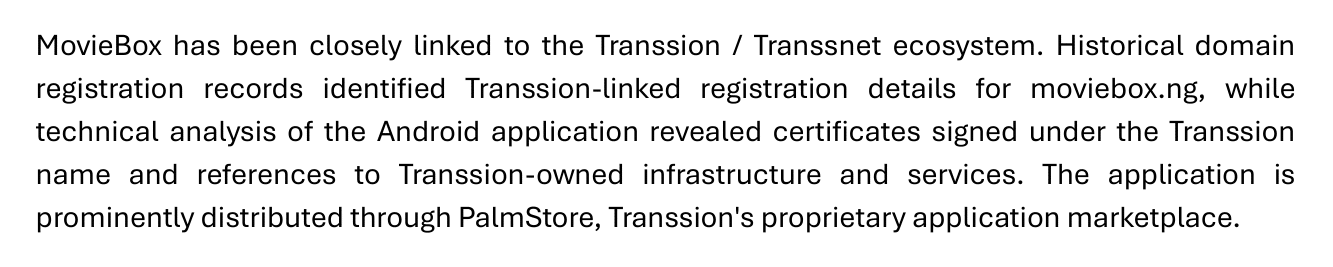
At the heart of the current international dispute is the distribution channel itself. Palm Store is not an independent third-party application marketplace operating on the open web; it is the default, preinstalled app distribution platform found on mobile devices manufactured by Tecno, Infinix, and itel. These three distinct consumer electronics brands are all subsidiaries of Transsion, a major Chinese multinational smartphone maker that dominated the African mobile market in 2024, accounting for an impressive 61.5% of all mobile phone sales across the continent according to the company’s own corporate filings.
In draft regulatory prospectuses prepared for a planned public listing in Hong Kong, Transsion explicitly describes the Palm Store as its own proprietary app distribution network. The company noted that the marketplace boasted an average of more than 180 million monthly active users throughout the previous year. Furthermore, Transsion’s financial and business documentation reveals the commercial mechanics behind the platform, noting that the company typically monetizes its app distribution network by charging third-party developers fees calculated directly according to the volume of successful software installations generated through the store. Whether such financial arrangements directly applied to the explosive growth of MovieBox remains a central question for investigators, though the commercial architecture of the marketplace itself has brought the hardware manufacturer under intense scrutiny.
While hosting a piece of software within an application marketplace does not automatically imply that the platform owner is a direct participant in the software’s underlying activities, the submissions filed by Canal+ suggest that the institutional and technical ties linking MovieBox to the broader Transsion ecosystem run significantly deeper than mere passive hosting.
In its detailed filing with the European Commission, Canal+ asserts that MovieBox shares structural DNA with the hardware manufacturer’s operational network. According to the French pay-TV group, historical domain registration records for the defunct moviebox.ng site uncovered specific registration details historically associated with Transsion. Additionally, technical audits and forensic analyses of the MovieBox Android application itself allegedly revealed software distribution certificates signed under the Transsion name, alongside distinct technical references pointing directly to Transsion-owned corporate infrastructure and backend services.
While the Canal+ submission stops short of explicitly accusing Transsion of directly owning or operating the MovieBox streaming service, the revelations point to a troubling entanglement between official mobile infrastructure and mass copyright infringement. Canal+ further pointed to Excellent Innovation Limited, a corporate entity based in Hong Kong that investigators connected to MovieBox through a web of overlapping domain registrations, Secure Sockets Layer certificates, developer attributions, and international trademark filings. Public records confirm that the Palm Store lists this exact Hong Kong-based company as the official developer of the streaming application.

In contrast, the submission filed by the Motion Picture Association does not explicitly single out Transsion by name, choosing instead to emphasize the broader geopolitical scope of the operation. The Hollywood-backed group notes in its dossier that MovieBox is widely believed by industry investigators to be coordinated and operated out of China, exploiting the fragmentation of international legal jurisdictions to evade direct accountability.
Regulatory Implications and Next Steps
The unfolding controversy also highlights broader corporate alignments within the international media sector. Canal+ maintains a direct commercial stake in the African telecommunications and broadcasting markets through its ownership ties to MultiChoice, the dominant pay-TV provider operating DStv across many of the exact same regions where Transsion devices and the Palm Store enjoy near-ubiquitous market penetration. For established broadcasters losing subscriber bases to unmonitored, free-of-charge streaming applications distributed at the hardware level, the proliferation of MovieBox represents a severe economic threat.
Despite the gravity of the allegations levied in the public submissions, neither the MPA nor Canal+ documents indicate whether formal takedown notices or removal requests have yet been formally served upon Transsion or the administrators of the Palm Store to purge the application from their distribution servers.
Under the established procedures governing the European Commission’s Counterfeit and Piracy Watch List initiative, the legal and commercial entities named in industry submissions are afforded an opportunity to present their side of the story. The Commission maintains a policy of making reasonable efforts to contact the specific service providers highlighted in regulatory complaints, formally inviting them to submit written responses addressing the allegations of facilitating or hosting copyright-infringing material.
The official Counterfeit and Piracy Watch List is anticipated to be formally published in the spring of next year. European officials have repeatedly emphasized that inclusion on the watch list does not constitute a formal legal finding of wrongdoing, nor does it serve as an official confirmation of statutory legal violations under European Union law. Instead, the mechanism is designed as a diplomatic and regulatory tool intended to encourage platform operators, technology companies, and national governments to voluntarily cooperate in taking proactive enforcement action against widespread intellectual property infringement.
As the consultation period moves toward its conclusion, representatives for both MovieBox and Transsion have yet to issue public statements or respond to inquiries regarding the explosive allegations contained in the European Commission submissions.
Leave a Reply