
Three filled notebooks sit quietly on the shelf while a fourth lies open on the desk. Somewhere within their bound pages resides a specific figure a client stated aloud on a Tuesday in March, the contact details of a plumber endorsed by a neighbor, and a structural outline drafted aboard a moving train that outshines anything written since.
The writer knows all of this information exists within the paper stack. Yet, retrieving any of it proves nearly impossible.
The traditional paper notebook frequently transforms into a write-only medium: highly efficient at the exact moment of capture, but utterly useless the instant information must be extracted. Faced with this recurring frustration, most individuals respond predictably by purchasing a more aesthetically pleasing notebook—which alters nothing—or by initiating a fifth volume, which merely compounds the clutter.
A hybrid organizational approach, drawing inspiration from Japanese notebook culture, aims to resolve this persistent retrieval failure while demanding minimal maintenance effort from the user.
Why a Notebook Fills Up and Stops Being Useful
A traditional paper notebook ultimately fails as an information retrieval tool for one fundamental structural reason: people write entries in the chronological order that events occur, whereas they invariably need that information back in the order of its relative importance.
Pages accumulate by date, while questions arrive by topic. Nothing inherent in a standard bound book bridges the gap between the two, leaving manual flipping as the sole search mechanism. Once a notebook surpasses forty or fifty pages, the process ceases to resemble active searching and transforms into amateur archaeology.
Popular remedial strategies typically attempt to solve this dilemma at the worst possible moment: during the initial capture phase. Designating a separate notebook for every individual project ensures that the correct volume is never readily available in a bag when needed. Pre-printed tabs assume an intimate knowledge of future categories months in advance, while color-coded pen systems demand micro-decisions while an interlocutor is still speaking. Meanwhile, transcribing daily notes into a digital application every evening amounts to taking on a second job—and serves as the first routine to be abandoned during a stressful week.
This breakdown is rarely a failure of personal discipline. Systems that demand sorting while active listening is underway fundamentally misunderstand how the human brain processes incoming information. Capture must remain frictionless and rapid, or it will simply not happen at all. A notebook functioning primarily as a dumping ground for a crowded mind is entirely acceptable; the true sorting process belongs elsewhere, occurring safely after the fact at the physical edge of the page.
What a Japanese Notebook Organization System Actually Is
Exploring this methodological space typically yields two distinct phenomena. The first comprises a robust market of Japanese planners and notebooks engineered around rigid structural formats. The second is an informal page-edge indexing trick that circulates widely across digital platforms without a definitive origin story. While the commercial products are easily verifiable, the folklore surrounding the indexing trick remains largely anecdotal.
Among the commercial offerings, brands like Hobonichi publish extensive planner families built entirely around a daily page format, establishing a firm commitment to a predetermined layout. Alternatively, MIDORI presents a refillable system featuring a durable leather cover designed to house rotating paper inserts, allowing the exterior housing to remain constant while the internal contents evolve. Both approaches share a common philosophy that most Western productivity systems actively avoid: the format is fixed, and the user commits to it entirely rather than endlessly redesigning their system.
The page-edge index forms the secondary pillar of this methodology. Rather than attributing this technique to a centuries-old cultural tradition, analysts view it as a practical structural overlay. It adopts the fixed-format, single-book ethos championed by Japanese stationery manufacturers while introducing a low-cost retrieval layer that requires virtually no upkeep during the busy workday.
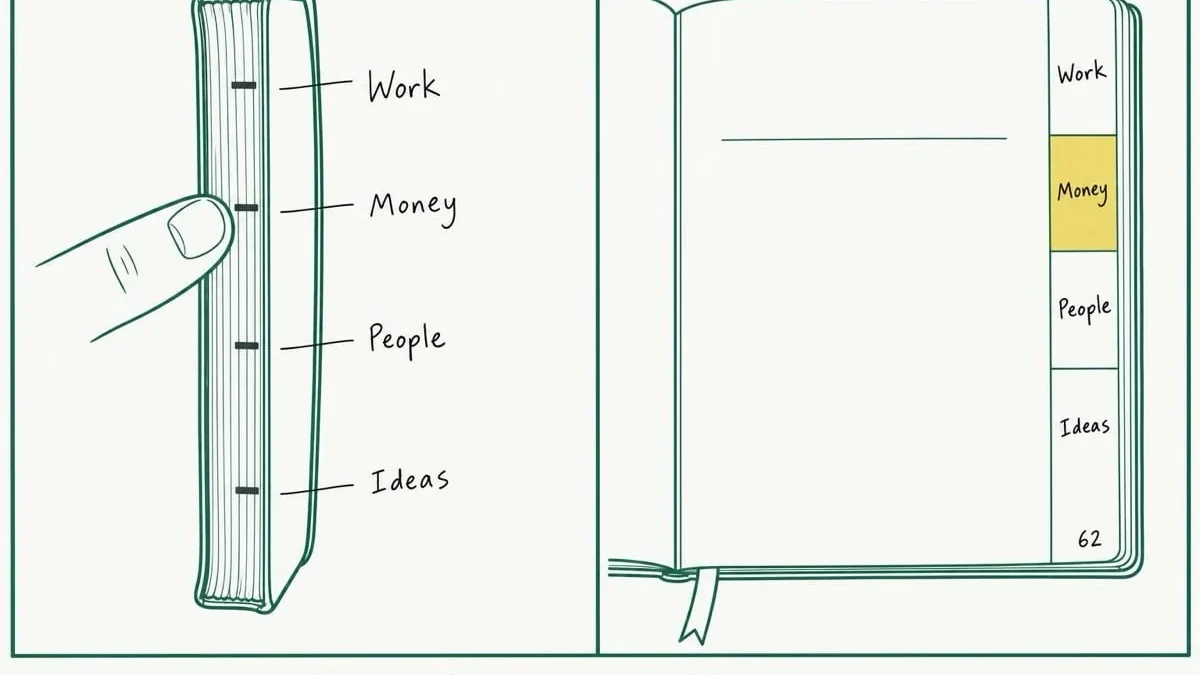
At its core, this organizational framework treats a single notebook as a continuous chronological stream while migrating all categorization duties to the outer edge of the pages and the blank sheets at the back of the volume. Nothing requires immediate classification during the act of writing. Capture remains entirely unhindered, while retrieval acquires immediate structural clarity, ensuring the two processes never compete for cognitive bandwidth.

Building the System for Daily Use
Implementing the framework requires only existing materials: an active notebook, a pen, and a single marker or highlighter. The setup deliberately avoids specialized purchases, prioritizing long-term maintenance over initial aesthetic appeal.
The foundational step involves numbering every page consecutively from front to back along the bottom outer corner. Though frequently omitted, this sequential numbering is the singular mechanical element that renders a functional index possible.
Next, users establish a limited set of overarching categories—typically four—that encompass the vast majority of their written output. Common designations include professional projects, administrative finances, interpersonal notes, and conceptual ideas. Limiting the categories to four prevents the hesitation that typically paralyzes capture time; encountering a fifth recurring subject usually indicates that the topic has outgrown the general notebook and warrants its own dedicated volume.
To execute the physical retrieval system, a narrow margin is designated down the outer edge of each page, divided vertically into distinct bands corresponding to the chosen categories. When a page is predominantly dedicated to a specific subject, the corresponding band is filled with a marker, extending the stroke right off the edge of the paper. Upon closing the book, these marks align to form a visible stripe across the page edges. Locating professional notes no longer requires opening the book at all; the user simply thumbs directly to the designated stripe.
Complementing the edge markers, the final two pages of the notebook are reserved for a chronological index. Each entry consists of a concise line detailing the date, a short descriptive summary, and the corresponding page number. Rather than deferring this task to a weekly cleanup session that risks abandonment, the entry is logged immediately upon finishing the page, taking mere seconds to complete.
Weekly maintenance is kept intentionally brief. Dedicating a short window on Friday afternoon to review the index, verify missing entries, and flag unresolved action items maintains the system’s integrity without imposing an onerous administrative burden. When the notebook is ultimately filled, photographing the index pages prior to archiving provides a searchable digital backup.
Navigating the Workflow in Practice
For professionals managing multiple overlapping projects and household administration, the system accommodates the chaotic reality of a busy schedule. Meeting notes capture attendees, decisions, and action items accompanied by small checkbox symbols to indicate unresolved tasks, while open questions are highlighted with marginal markers. The relevant edge band is colored, the index line is logged, and the task concludes in seconds.
Side projects, impromptu phone estimates from service providers, and scattered thoughts captured during transit are similarly recorded on the next available page without requiring immediate structural reorganization. The notebook preserves its natural chronological flow, which remains the only order most individuals can reliably sustain amid competing daily demands.
When past information must be recalled—such as a disputed quote from a contractor weeks later—the user consults the edge stripe to narrow the search immediately, bypassing the need to sift through irrelevant pages. For broader conceptual searches where the exact category has faded from memory, the concise back-page index provides a rapid scanning mechanism that condenses hundreds of pages of handwriting into a digestible list.
Deciding between a single bound notebook and a refillable modular system depends entirely on the nature of an individual’s workflow. Time-driven schedules characterized by daily meetings and chronological logs thrive within a standard bound volume paired with an edge index. Conversely, project-driven work that necessitates the physical regrouping of related pages often justifies a ring-bound or refillable format.
Ultimately, acquiring expensive stationery does not inherently generate an operational system; the index and marginal markings provide the necessary utility. Operating an affordable, basic notebook consistently for a sustained period yields far better results than purchasing a luxury planner and abandoning it within a few weeks.
While digital tools undeniably excel at full-text search capabilities across multi-year archives, physical paper retains a distinct advantage during the critical moments before writing commences—eliminating screen unlocks, application choices, and disruptive notifications. By balancing rapid analog capture with structured retrospective indexing, users can transform their notebooks from passive repositories of forgotten text into active, functional archives.



Leave a Reply