
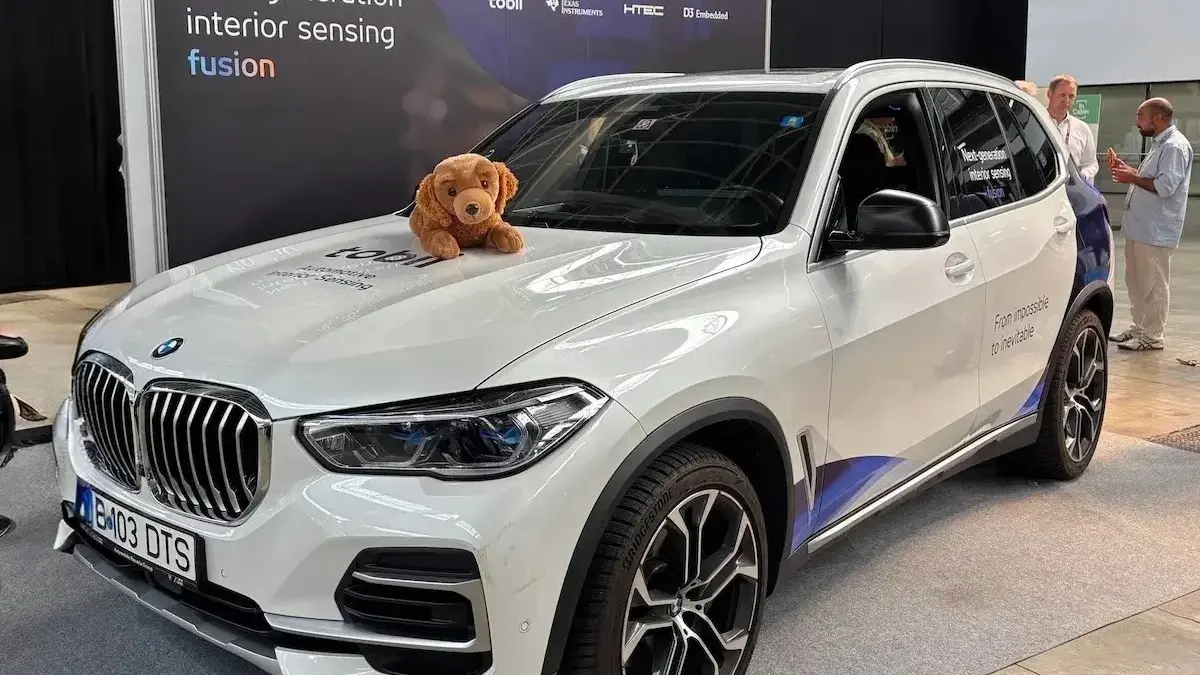
BARCELONA, Spain — More than 1,000 engineers, automotive executives, and semiconductor experts gathered in Barcelona for AutoSens and InCabin Europe 2026 to examine how evolving safety, perception, and computing requirements are actively reshaping automotive sensor design.
Original equipment manufacturers (OEMs) and Tier-1 suppliers are working closely together at the event, forging vital connections between silicon chipmakers and automotive system architects. Driving this rapid engineering evolution is a formidable wave of regulatory pressure, led most notably by Europe’s Euro NCAP 2026 protocols, which mandate that carmakers look far beyond conventional hardware parts to protect drivers and passengers alike.
Euro NCAP 2026 and In-Cabin Safety Requirements
Euro NCAP’s rigorous 2026 safety protocols place an unprecedented emphasis on comprehensive driver and occupant monitoring. Driver state monitoring (DSM) serves as a foundational pillar within the broader safe driving assessment framework. Furthermore, these updated protocols closely evaluate child presence detection and award vital additional safety points for intelligent systems capable of detecting sudden physical impairment and taking responsive measures when a driver becomes unresponsive behind the wheel.

Traditional camera-based systems frequently encounter performance hurdles when vehicle occupants or vital objects are obscured from direct sightlines—such as a sleeping infant tucked underneath a heavy blanket or resting low in a vehicle’s footwell. To effectively address these inherent optical limitations without inflating overall system costs, an increasing number of automotive suppliers are turning to multi-modal strategies that combine optical cameras with advanced radio frequency (RF) sensing technologies, including ultra-wideband (UWB) and millimeter-wave (mmWave) radar.
At AutoSens Europe 2026, Calterah showcased its Dubhe CAL1106AQ system-on-chip (SoC), which the company highlights as the industry’s first implementation of IEEE 802.15.4ab sensing integrated into a FiRa 4.0-certified 2T4R UWB chip. Equipped with a dedicated Radar Leakage Suppression module, Calterah explained that the chip possesses the sensitivity required to detect microscopic movements, such as the gentle rise and fall of an infant’s chest during breathing, entirely without the need for a separate dedicated mmWave radar unit.
Calterah further noted that its Bluetooth Low Energy-assisted, multi-millisecond system is capable of accurately measuring distances exceeding 400 meters, maintaining performance even when scanning through intervening parked cars. The company emphasized that this UWB upgrade path can fully support child presence detection by updating existing vehicle keyless entry hardware purely through software adjustments, potentially reducing or eliminating the need for dedicated 60 GHz mmWave interior radars.

Meanwhile, Infineon Technologies demonstrated its XENSIV 60 GHz radar evaluation modules, offering attendees a firsthand look at full-cabin monitoring capabilities alongside real-time radar point cloud overlays rendered directly on live video feeds.
Advanced Optical Vision
Even as advanced RF sensing technologies gain traction for their ability to detect movement through physical obstacles, optical cameras remain completely essential for capturing nuanced, high-resolution information inside the vehicle cabin.
Optical camera solutions are uniquely qualified to identify specific vehicle occupants, continuously track eye gaze vectors to detect driver distraction, and interpret micro-facial expressions to spot early signs of driver fatigue.

During the exhibition, OmniVision demonstrated its OX05C1S GS HDR sensor, which leverages advanced Nyxel near-infrared technology to achieve crisp, high-resolution imaging even in near-total darkness. By shrinking its physical packaging by 30 percent, OmniVision noted that the sensor allows for seamless, unobtrusive integration directly into rearview mirrors or structural vehicle pillars.
In parallel, Tier-1 supplier Aptiv showcased its Advanced Occupancy Classification software. Utilizing a single interior-facing camera, the software can accurately differentiate between adults, infants, children, and inanimate objects. Aptiv reported that this streamlined, camera-only methodology achieved 100 percent accuracy during testing under Federal Motor Vehicle Safety Standard 208—a prominent U.S. safety regulation—while simultaneously reducing system costs by up to 40 percent by eliminating the need for traditional in-seat pressure sensors.
Exterior Perception by Single-Exposure HDR and Imaging Radar
For exterior driver assistance and advanced autonomous driving features, engineers continue to navigate formidable environmental challenges, including harsh blinding sun glare, sudden transitions into dark tunnels, and the pesky visual flicker associated with modern LED traffic lights.

To tackle these obstacles head-on, OmniVision presented its 3-megapixel TheiaCel image sensor, which delivers an impressive 140 decibels of single-exposure high dynamic range. Unlike older multi-exposure techniques that can introduce noticeable motion blur when a vehicle travels at high speeds, the company explained that this single-exposure approach maintains exceptional image clarity across extreme highlights and deep shadows while effectively suppressing flicker.
Similarly, SmartSens Technology exhibited its 8.3-megapixel SC860AT CMOS sensor. The sensor features Lofic HDR 2.0 technology and complies fully with ISO 26262 ASIL-B and ISO 21434 cybersecurity standards. SmartSens demonstrated the sensor in tandem with Flyingchip’s M2 automotive vision-processing SoC—a subsidiary offering that integrates a neural processing unit while meeting AEC-Q100 Grade 2 automotive standards alongside ISO 26262 ASIL-B/D functional safety thresholds.
On the central computing and validation front, Samsung showcased its ISOCELL Auto 1H1 and 4AC image sensors, alongside a strategic virtual validation partnership involving Synopsys and Ansys. By incorporating precise digital twin models of Samsung image sensors directly into simulation software platforms, automakers can conduct virtual perception validation, cutting product development cycles by up to 12 months.

Different Compute Architectures
Discussions surrounding vehicular computing architectures at the event signaled a distinct industry-wide pivot away from complete architectural centralization in favor of smarter, highly optimized zonal processing frameworks. While automakers initially pursued monolithic central computers that housed all processing tasks, industry experts from NXP, Stellantis, and Bosch pointed out during AutoSens USA 2026 that this approach creates severe thermal management bottlenecks and requires cumbersome, heavy wiring harnesses. Consequently, the automotive sector is actively migrating toward zonal topologies, where localized artificial intelligence processing occurs securely at the edge, and only critical, summarized data is transmitted back to the main central processor.
Illustrating this growing edge-compute trend, STMicroelectronics highlighted its STM32N6 microcontroller. Equipped with an integrated Neural-ART neural processing unit capable of delivering 600 billion operations per second at 3 TOPS per watt, the company demonstrated the chip running real-time face recognition tasks directly on the microcontroller itself.
Simultaneously, the demand for high-speed intra-vehicle data transfer has spurred healthy technological competition among diverse networking standards. Valens Semiconductor showcased its VA7000 chipsets designed to support MIPI A-PHY, while OmniVision exhibited its 3-megapixel camera sensor featuring an integrated Automotive SerDes Alliance Motion Link serializer.

Cybersecurity and Post-Quantum Cryptography
As software-defined vehicles become more interconnected than ever before, regulatory oversight is expanding rapidly well beyond traditional automotive compliance to encompass rigorous mandates like the European Cyber Resilience Act.
This sweeping regulation establishes strict cybersecurity baselines, mandatory vulnerability patching procedures, and robust hardware secure-boot mechanisms for all digital consumer products sold within Europe. In parallel, the U.S. National Security Agency’s CNSA 2.0 guidelines mandate a systematic transition toward post-quantum cryptography to safeguard critical infrastructure against future threats posed by advanced quantum computing.
Addressing these looming security challenges at AutoSens Europe, Microchip Technology displayed its Trust Shield TS1800 and TS50x platform root of trust controllers. Utilizing an Arm Cortex-M4F processor, these controllers are engineered to execute lattice-based post-quantum cryptographic algorithms, anchoring system trust directly in physical silicon by actively monitoring flash memory in real time to prevent unauthorized firmware tampering.

Leave a Reply