
The global legal net is tightening around illicit streaming operations, but holding overseas defendants accountable continues to present major hurdles for traditional broadcasters. Ammar Towir, the alleged operator behind popular pirate IPTV services Kemo IPTV and Lemo TV, is currently facing active criminal prosecution in Dubai. However, the legal battle involving his alleged digital empire has surfaced simultaneously in a Florida federal court, where satellite broadcasting giant DISH Network just suffered a significant procedural setback in its pursuit of a massive multi-million-dollar default judgment.
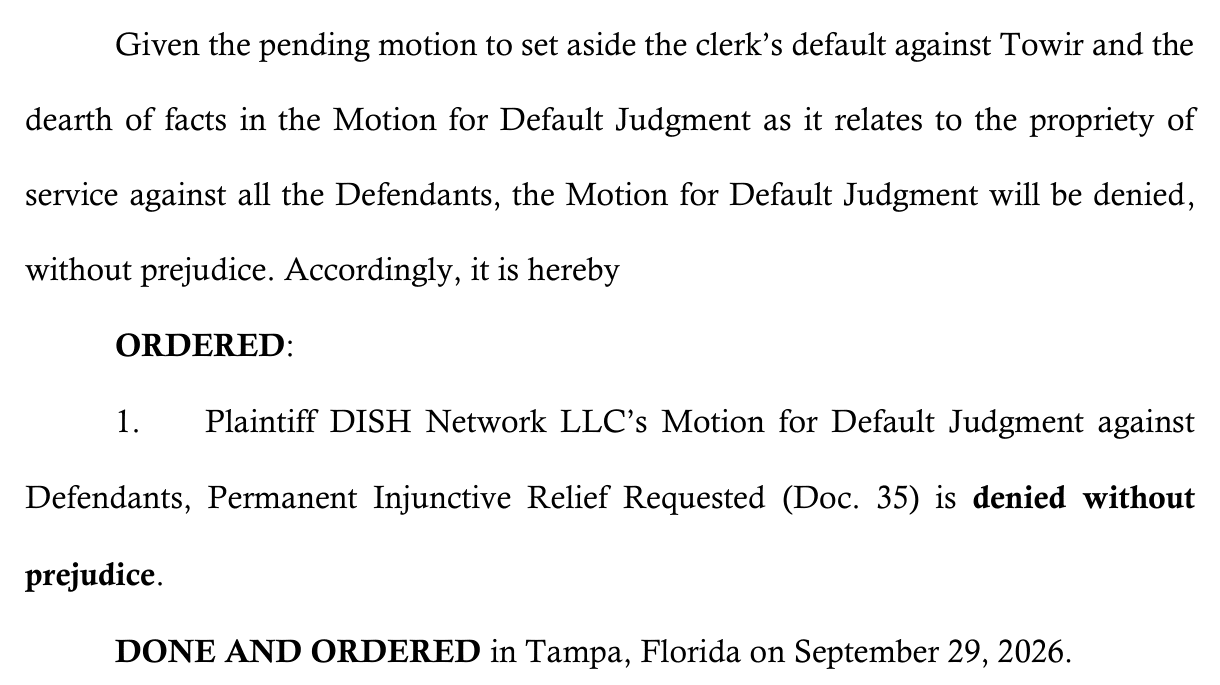
According to a recent ruling handed down by a U.S. federal judge, DISH Network’s request for a staggering $28.65 million default judgment against the defendants has been denied without prejudice. The court determined that the broadcasting company failed to adequately demonstrate that the defendants were properly served with legal notices according to applicable legal standards, introducing a fresh twist to an already convoluted international copyright infringement saga.
The Origins of the Multimillion-Dollar Lawsuit
The legal confrontation began taking shape last October when DISH Network initiated a civil lawsuit in the United States targeting the individuals believed to be orchestrating the Kemo IPTV and Lemo TV networks. Alongside the primary architects of the streaming services, the lawsuit also targeted 1 Dollar IPTV, a Florida-based reseller accused of distributing the unauthorized content to domestic consumers.
For months, the litigation moved forward with little resistance from the accused parties. Because none of the named defendants formally appeared in court or responded to the allegations within the designated legal timeframes, DISH Network moved for a default judgment in March. At that juncture, it appeared that the civil case was hurtling toward a swift and decisive conclusion in favor of the broadcaster, potentially resulting in one of the largest financial penalties ever handed down against an unauthorized IPTV operation.
That trajectory shifted dramatically in September. One of the primary defendants, Ammar Towir, formally petitioned the court to set aside the default judgment. DISH Network forcefully countered that Towir is the beneficial owner and daily operator of the underlying Kemo and Lemo domains, as well as the commercial financial accounts funneling revenue from the illegal services. Towir, however, pushed back with a fundamentally different defense, asserting that he was never validly served with the initial complaint. Specifically, he maintained that he resides in Dubai rather than at the Malaysian address listed in the court filings where the official documents were supposedly delivered.

Federal Court Denies DISH’s Request for $28.65 Million
The fate of the default judgment hung in the balance until U.S. District Judge Charlene Edwards Honeywell issued her ruling, denying DISH’s motion without prejudice. The core of the court’s decision hinged on evidentiary deficiencies regarding international service of process. According to the presiding judge, DISH’s legal filings simply asserted that the defendants had been properly served without providing the necessary factual backing or legal justification under Malaysian law to validate the claim.
As outlined in the official court order, DISH failed to set forth any concrete facts or applicable Malaysian legal authority within its motion that could definitively establish the propriety of service upon the defendants.
Despite this roadblock, the door is not entirely closed for the broadcaster. DISH Network retains the legal option to refile its $28.65 million request. Before that can happen, however, the court must definitively resolve whether the defendant was indeed served in accordance with strict international legal guidelines. That pivotal question has now been formally referred to a magistrate judge for further evaluation and a recommended ruling.
This development marks the second major setback for DISH Network’s aggressive anti-piracy campaign targeting the Kemo and Lemo infrastructure this year. Back in March, a California federal court dismissed a separate $25 million IPTV piracy lawsuit that DISH had filed against UK-based hosting provider Innetra, citing a fundamental lack of personal jurisdiction. Nevertheless, the unfolding proceedings in the Florida case have unexpectedly brought to light an entirely separate, high-stakes criminal enforcement action taking place overseas.
Criminal Probe Unfolds in Dubai
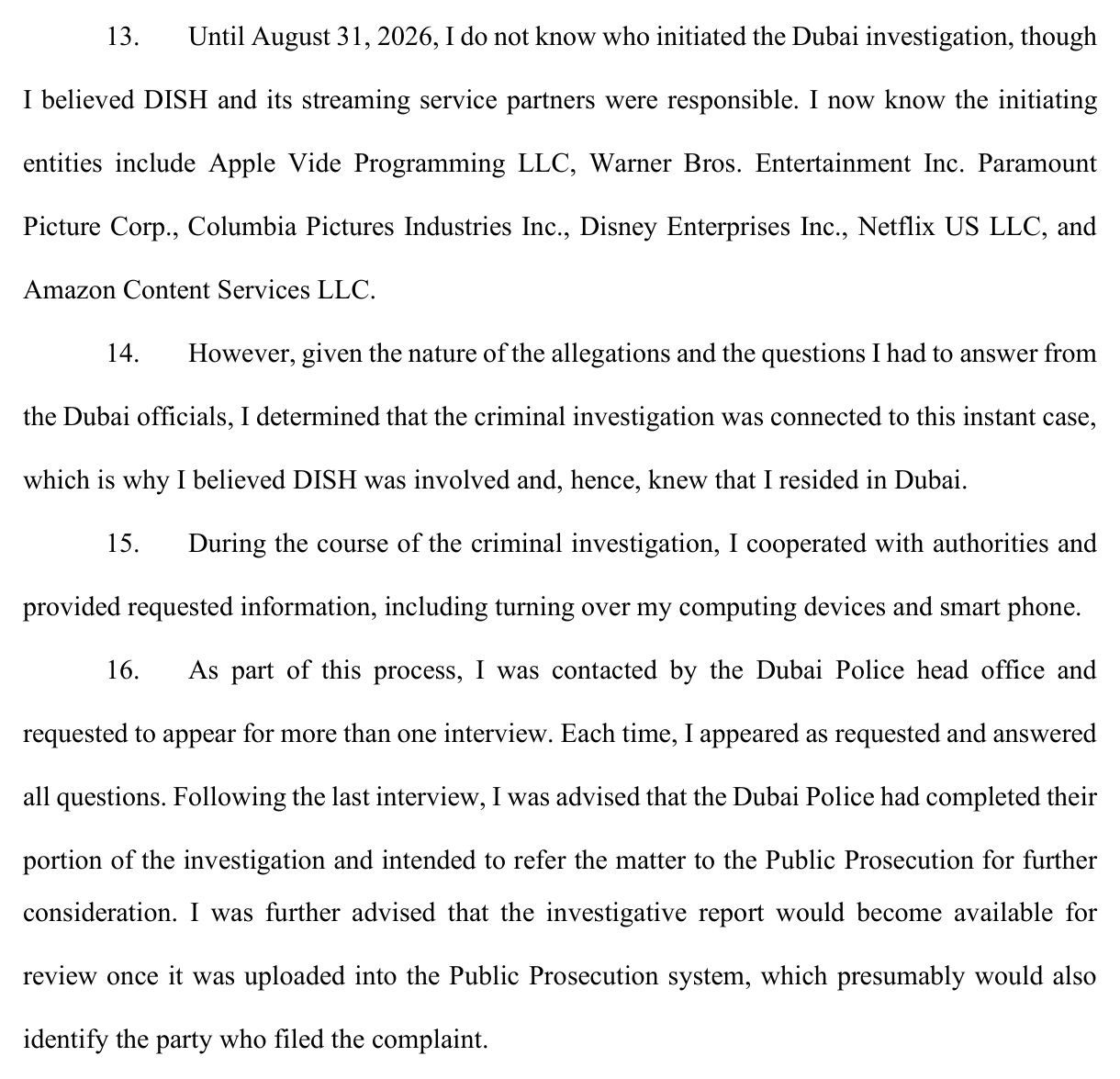
In sworn declarations submitted to the U.S. court, Towir explained his initial absence from the Florida proceedings, revealing that he was—and still is—the target of a rigorous criminal investigation in Dubai. While he initially suspected that DISH Network was orchestrating the foreign pressure, he subsequently discovered that the criminal complaint was actually initiated by a coalition of major Hollywood studios and entertainment giants, including Apple, Warner Bros., Paramount Pictures, Columbia Pictures, Disney, Netflix, and Amazon.

These entertainment powerhouses are all prominent members of the Alliance for Creativity and Entertainment (ACE), the world’s leading global anti-piracy coalition. When queried about the proceedings, ACE formally confirmed its direct involvement in the matter.
An ACE spokesperson confirmed that the coalition was indeed behind the criminal complaint filed in Dubai in late July against Ammar Towir, the alleged mastermind behind the Kemo and Lemo IPTV operations. Following the initial filing, the matter was swiftly escalated and referred to a specialized law enforcement unit within the region.
The timeline of these events indicates that ACE lodged its complaint nearly three months prior to DISH Network filing its civil lawsuit in Florida, and more than three months after DISH initiated its very first legal salvos against Lemo and Kemo in a Texas court—legal actions that likely played a crucial role in unmasking the alleged operator’s true identity.
The criminal prosecution in the United Arab Emirates is actively progressing. According to ACE, the Public Prosecutor formally referred the case to the Dubai Criminal Court, where it remains pending. While broader details of the ongoing prosecution remain tightly controlled due to active judicial proceedings, Towir’s court filings in the U.S. shed considerable light on the restrictive conditions he has faced locally.
Travel Bans and Police Interrogations
In his detailed declaration, the alleged IPTV operator recounted multiple rounds of intense questioning by Dubai Police authorities, during which he was required to surrender his personal computers, electronic devices, and smartphone for forensic examination. Furthermore, he is currently subjected to a strict travel ban preventing him from leaving the country.
Towir highlighted the compounding nature of the legal restrictions in his written testimony, noting that just as the standard travel ban automatically instituted upon the filing of a criminal complaint in Dubai was on the verge of expiring, an additional criminal complaint was lodged against him, effectively extending his legal detention within the country’s borders and further prohibiting any international travel.
Acting on local legal counsel received in Dubai, Towir chose to prioritize the foreign criminal investigation and await its outcome before mounting a defense in the parallel U.S. civil proceedings. DISH Network, however, has characterized this strategy as an intentional pretext designed solely to delay the American litigation and evade financial accountability. Settlement discussions between the two opposing sides have taken place, but to date, no formal agreement has been reached.
Competing Evidence and Ongoing Scrutiny
Within his U.S. court declarations, the defendant offers a partial admission regarding his commercial activities, acknowledging that he purchased streaming streams and services from an upstream wholesaler and subsequently reselled them to customers located outside the United States. However, he maintains stoutly that these localized resale activities had no direct connection to Kemo IPTV or Lemo TV.
DISH Network has firmly rejected this defense, pointing to a robust paper trail compiled during discovery. In opposing briefs submitted to the court, the broadcaster highlighted PayPal transaction records explicitly identifying Towir as the registered owner of commercial accounts bearing the names "KEMO IPTV" and "KEMO E MARKETING SDN. BHD." Additionally, the company presented credit card billing records matching his personal identity that were used to fund the Namecheap registrar accounts responsible for renewing the core internet domains kemoiptv.com and lemotv.com.
This documentary evidence, along with potential new findings, will likely return to the forefront of the Florida litigation once the court resolves the threshold question regarding the validity of the service of process. Meanwhile, the criminal case winding its way through the Dubai court system continues to unfold independently.
Despite the mounting international pressure, legal scrutiny, and civil litigation, digital storefronts associated with the network appear resilient. At least one Kemo IPTV front continues to actively market and sell commercial subscriptions through alternative portals such as kemoiptv.io—a domain that was explicitly targeted in DISH Network’s original asset takeover requests. Whether the defendant exercises direct operational control over this newer web address remains unverified by the courts as the multi-jurisdictional legal battle presses forward.

Leave a Reply