

Spanish professional football league LaLiga has taken an aggressive new step in its ongoing global battle against digital copyright infringement, setting its sights squarely on mainstream virtual private network (VPN) providers and widely used media streaming utilities. In a 14-page formal submission for the European Commission’s upcoming 2027 Counterfeit and Piracy Watch List, the football organization has urged European regulators to include four of the industry’s most prominent VPN services—NordVPN, ProtonVPN, ExpressVPN, and Surfshark—alongside the popular Android TV and Fire TV utility, Downloader by AFTVnews.
Every few years, the European Commission invites rightsholders, industry associations, and intellectual property stakeholders to submit evidence detailing online platforms, services, and intermediaries that allegedly facilitate copyright infringement or counterfeiting on a commercial scale. Historically, these official submissions have concentrated on traditional digital piracy vectors, including peer-to-peer torrent indexing platforms, anonymous file-hosting cyberlockers, and unauthorized Internet Protocol Television (IPTV) broadcasting networks.
Over recent editions, however, the scope of the watch list has steadily expanded to capture vital internet infrastructure intermediaries, such as content delivery networks, domain name privacy providers, and hosting companies like Cloudflare. LaLiga’s latest filing represents a significant escalation in this trajectory, attempting to bridge the gap between general-purpose technical tools and the commercial mechanisms that allegedly drive users toward unauthorized content streams.
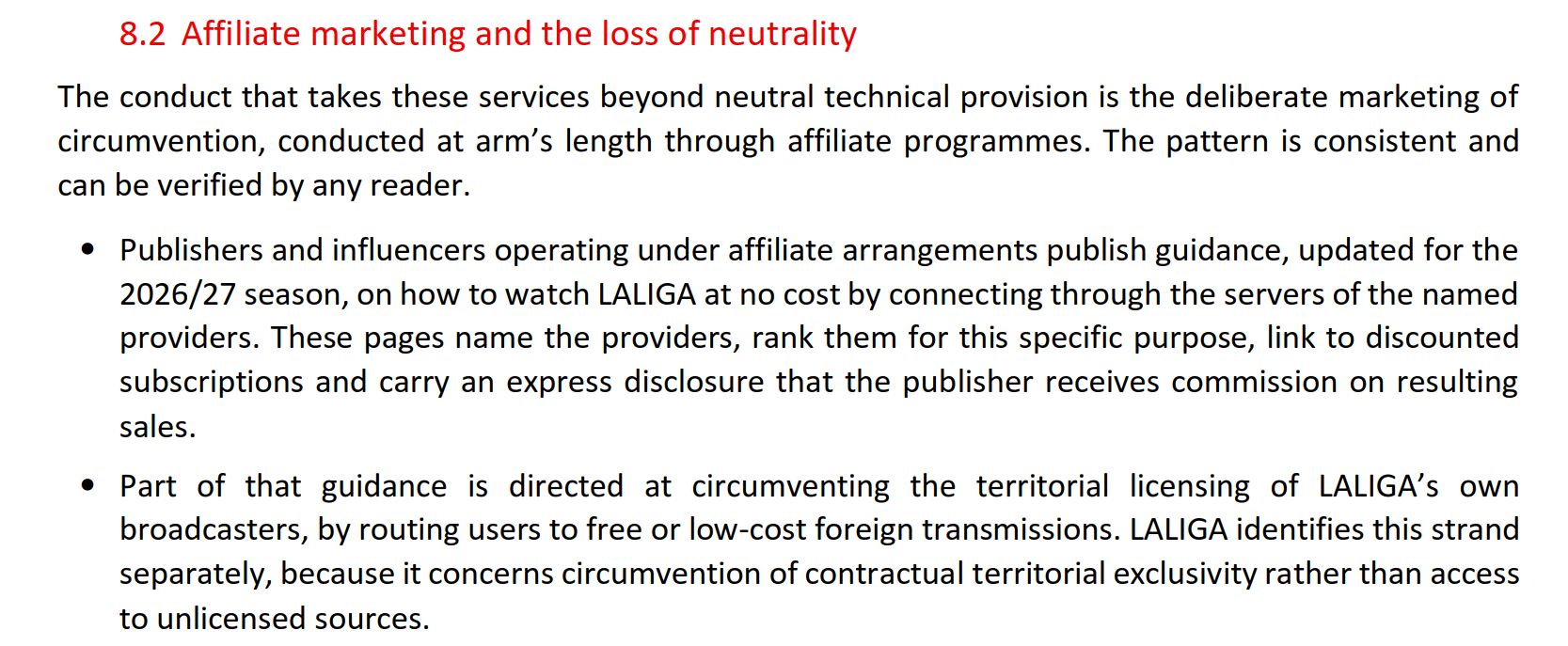
While LaLiga’s expansive submission covers a diverse array of traditional online piracy threats, its focus on the virtual private network industry represents a novel and legally contentious strategy. The football league explicitly clarifies in its introductory legal disclaimer and throughout the document that it is not launching a direct assault on the underlying encryption technology or the neutral provision of VPN services themselves. Instead, the legal grievance hinges upon the downstream commercial practices, promotional campaigns, and affiliate marketing ecosystems that surround these consumer privacy products.
According to LaLiga, the conduct that pushes these services across the line from neutral technical providers into active participants in the digital piracy ecosystem is the deliberate marketing of geoblocking circumvention. This marketing, the league argues, is frequently conducted at arm’s length through lucrative affiliate marketing programs managed by third-party publishers, review aggregators, and online influencers.

Geo-Unblocking Free Football Broadcasts and Territorial Exclusivity
At the heart of LaLiga’s argument regarding VPNs is the commercial exploitation of territorial licensing boundaries. The football league points out that digital publishers, bloggers, and online influencers maintain specialized guides—frequently updated for the current football season—detailing how consumers can utilize consumer VPN services to watch live matches for free or at drastically reduced subscription rates by connecting to foreign server locations.
These specialized guides typically rank various VPN providers, evaluate their connection speeds and server availability, and embed direct referral links that reward the publishers with financial commissions for every resulting paid subscription. Some of these published tutorials explicitly instruct sports fans on how to bypass geo-restrictions to access free-to-air or inexpensive television broadcasts originating in other countries where broadcasting rights are structured differently.
While LaLiga acknowledges that these specific tutorials may not always point directly to illicit, unlicensed pirate streaming websites, the league argues that the practice severely undermines the foundational economic model of modern sports broadcasting: territorial exclusivity. Broadcasters pay immense sums of money to acquire exclusive regional viewing rights, and the ability of domestic fans to effortlessly circumvent those geographical barriers using commercial VPN services diminishes the commercial value of those media rights.
LaLiga notes that these commercial recommendations are routinely published by independent affiliates rather than authored directly by the VPN providers themselves. Nevertheless, the league’s official submission maintains that the major VPN providers are fully aware of these promotional practices and actively profit from the influx of new subscribers driven by content focused on circumventing regional broadcasting restrictions.
Circumventing Pirate Site Blockades and Corporate Affiliations

Beyond the issue of geo-blocking legitimate or foreign broadcasts, LaLiga’s European Commission submission raises what it considers an even more alarming phenomenon: affiliate marketing pages that explicitly name illicit pirate streaming websites and IPTV services, while instructing users on how a VPN can be deployed to bypass court-ordered site-blocking measures implemented by national internet service providers.
The football league asserts that this widespread affiliate marketing activity is easily verifiable by regulators, though the 14-page document refrains from citing or linking to any specific web pages, articles, or individual influencers crossing the legal boundary.
Furthermore, the submission attempts to connect certain high-profile VPN review and ranking portals directly to the corporate ownership groups controlling the VPN products themselves. Specifically, LaLiga draws a corporate link between the popular vpnMentor review publication and Kape Technologies, a major cybersecurity holding group that owns several prominent consumer VPN brands. The league argues that these commercial review sites lack true editorial independence because they recommend and rank products under the same corporate umbrella—a financial relationship that the publications generally disclose to their readership.
This regulatory filing mirrors arguments that have begun playing out in European courtrooms. In February, a Spanish court in Córdoba issued an ex parte site-blocking injunction targeting ProtonVPN and NordVPN. Without formally hearing arguments from the VPN providers prior to issuing the ruling, the court concluded that both companies actively promoted their capability to bypass geo-restrictions by timing marketing materials and social media campaigns around live football match schedules, effectively labeling them as participants in the digital piracy supply chain.
The legal battle remains intensely contested. In May, the same Córdoba court declined to impose financial penalties on NordVPN for failing to comply with the initial blocking order, acknowledging the technical reality that the targeted internet protocol addresses associated with pirate video streams change dynamically and continuously. The broader, substantive legal proceedings in Spain remain ongoing.
LaLiga’s submission emphasizes that its request for the European Commission to blacklist NordVPN, ProtonVPN, ExpressVPN, and Surfshark rests entirely on their alleged facilitation of unauthorized access to blocked piracy networks through aggressive promotional strategies. Whether this rationale will persuade European regulators remains uncertain, particularly given that lawmakers across various jurisdictions continue to debate whether privacy-enhancing tools like VPNs should ever be legally compelled to enforce court-ordered network blocking mandates.
Targeting AFTVnews Downloader Short Codes
Virtual private networks are not the only general-purpose software tools caught in LaLiga’s regulatory crosshairs. The league’s submission to the European Commission also targets Downloader by AFTVnews, an immensely popular file-management and web-browsing application designed for Android TV and Amazon Fire TV devices, which boasts a user base exceeding 100 million people.
The application allows users to download files and navigate the web by inputting a standard URL or a compact numeric short code. LaLiga claims in its filing that it catalogued 341 distinct short codes through the app, of which 262 allegedly direct users to applications or platforms offering unauthorized pirate streams. The football league characterizes these numeric short codes as a curated catalogue operating under the exclusive editorial control of the application’s creator.
"The ease and simplicity with which applications can be discovered and installed through this catalogue is itself demonstrative of its nature as an editorially-curated platform, distinct from the underlying distribution infrastructure," LaLiga stated in its regulatory filing.
This is not the first time the Downloader application has faced legal scrutiny or platform bans. In 2023, Google temporarily removed the application from its official Play Store following complaints filed by Israeli television companies, and subsequently removed it again following a Digital Millennium Copyright Act (DMCA) takedown notice submitted by anti-piracy firm Markscan. The application was ultimately reinstated on the platform after subsequent reviews.
Elias Saba, the creator of AFTVnews and developer of the Downloader application, strongly rejected LaLiga’s characterization of his software in a public response following the publication of the submission.

"LaLiga’s description of the AFTVnews URL Shortener as a ‘curated catalogue’ is incorrect," Saba stated. "My Downloader app is a general-purpose web browser and file downloader; short codes simply save users from typing full URLs. Anyone can submit a URL, and the service automatically generates an active short code and short URL without editorial review or approval. Neither Downloader nor the URL Shortener offers code directories, code recommendations, or a way to search or browse codes."
Saba emphasized that he does not condone copyright infringement and actively cooperates with rightsholders by processing valid copyright takedown requests, disabling flagged short codes promptly, and permanently blocking reported destination URLs from being shortened in the future. He confirmed plans to contact LaLiga directly to obtain the specific list of codes referenced in the regulatory filing so that they can be addressed immediately, as well as submitting a formal correction to the European Commission regarding the technical operation of his services.
Whether the European Commission will choose to incorporate the targeted VPN providers or the Downloader application into its official 2027 Counterfeit and Piracy Watch List remains to be seen. The most recent iteration of the watch list, published in May 2025, ultimately omitted all consumer VPN services while highlighting various foreign hosting providers, the InterPlanetary File System (IPFS), and the domain privacy service Njalla.

Leave a Reply