
BARCELONA, Spain — As global automotive safety regulators roll out increasingly stringent passenger-monitoring guidelines, automotive engineers find themselves grappling with a complex design dilemma. Modern vehicle interiors are becoming densely populated with an array of single-purpose hardware, ranging from optical cameras and infrared detectors to ultrasonic transducers. While these distinct devices are critical for fulfilling upcoming safety mandates, the continuous addition of hardware introduces severe engineering hurdles. It jacks up manufacturing costs, tangles electrical wiring harnesses, and exacerbates spatial limitations inside increasingly connected vehicle cabins.
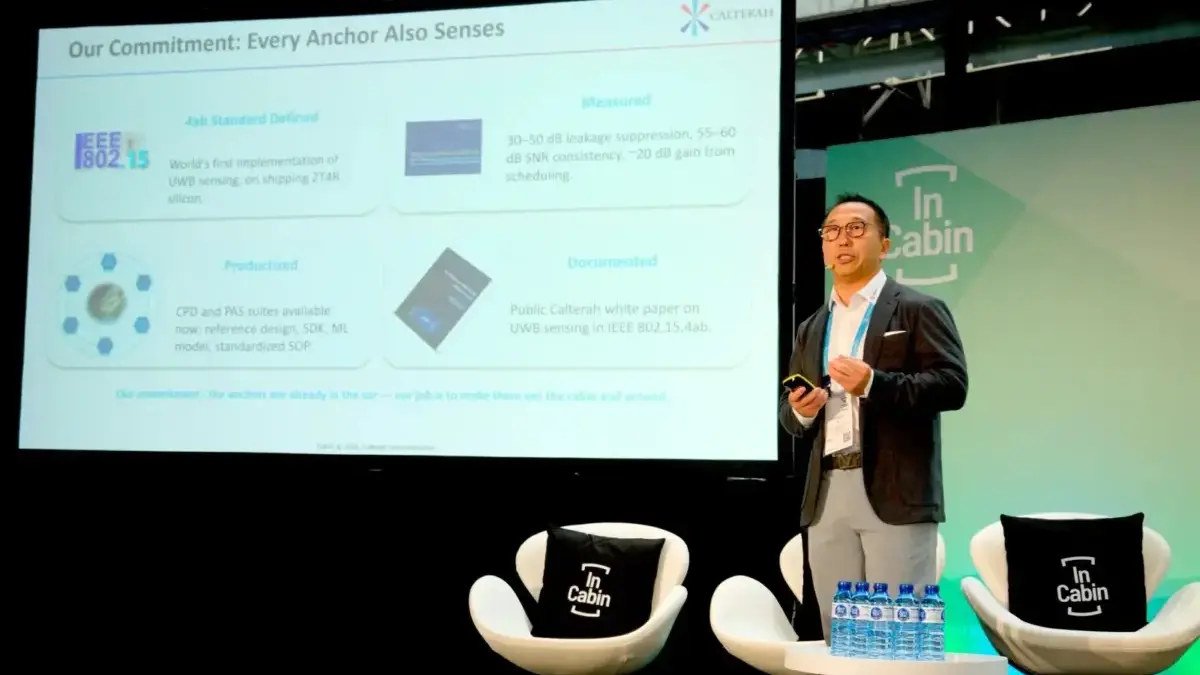
Speaking at the InCabin Europe 2026 conference in Barcelona, Yaohui Liu, EMEA FAE and marketing manager at Calterah Semiconductor, presented an alternative architecture centered on standardized wireless communication. Rather than burdening crowded car interiors with another dedicated layer of hardware, Calterah proposes repurposing existing ultra-wideband (UWB) digital key systems, turning them into a unified, synchronized radar sensing network.
"We want to leverage the fact that more and more digital keys are occupying even basic models of cars, and we give them a new purpose, which is sensing," Liu explained during his presentation. Supported by the emerging IEEE 802.15.4ab standard, synchronized UWB sensing is rapidly positioning itself as a viable, multi-purpose feature for next-generation vehicle production lines worldwide.
Regulatory Push for In-Cabin Sensing
Stricter safety regulations and consumer vehicle assessment programs remain the primary catalysts behind the automotive industry’s rapid adoption of advanced in-cabin monitoring technologies. The Euro NCAP 2026 standards, for instance, mandate higher overall baseline safety levels. Under these updated guidelines, top safety ratings are awarded primarily to vehicles equipped with robust child presence detection (CPD) systems capable of discerning minute physiological movements, such as a sleeping infant’s breathing patterns.
Concurrently, the rapid proliferation of consumer electronics is accelerating the commercialization and deployment of UWB technology. Billions of UWB-enabled devices—including smartphones, smart tags, and advanced digital key fobs—are already deeply embedded in global electronics supply chains.
According to Liu, Calterah Semiconductor, established in Shanghai in 2014, has already shipped more than 30 million millimeter-wave radar chips to automakers globally. Building directly on this deep experience in automotive-grade radar, the company asserts that its latest generation of UWB chips can fully satisfy modern passenger safety and monitoring requirements without demanding additional physical sensor housings or custom enclosures.

Current regulatory frameworks mandate a broad suite of interior monitoring capabilities, including tracking driver alertness, monitoring seat occupancy states, verifying seatbelt compliance, and reliably detecting unattended children left behind in the back rows. Liu noted that deploying isolated, single-purpose sensors for every individual monitoring task makes it exceptionally difficult for interior designers to package everything neatly within the cabin. By transforming existing UWB keyless entry anchors into a seamlessly connected sensing network, automakers can establish a comprehensive, multi-functional system that provides total coverage across all seating rows.
Overcoming the Geometric Traps of Radar
Despite their utility, single-anchor radar systems deployed inside confined automotive cabins face inherent physical limitations. During his conference talk, Liu emphasized that achieving reliable interior monitoring is fundamentally a challenge of geometry rather than simply applying raw computing power or running larger artificial intelligence models.
"One thing I want to say is that it’s not really that a bigger AI model can solve everything, because we don’t want to burn our batteries just doing calculations," Liu remarked. "What this UWB multi-static network gives you is really the geometry."
Furthermore, standalone single-anchor radar nodes often suffer from internal signal leakage, a phenomenon where overpowering transmitted signals can saturate the receiver and temporarily block it from detecting nearby objects. Introducing additional, uncoordinated transceivers into the cabin only worsens this issue, as their asynchronous signals generate mutual interference and elevate the overall background noise floor.
"Synchronized multi-static UWB systems solve these geometry problems by placing sensors in different spots inside the car," Liu said. "By putting transceivers in places like the rearview mirror, overhead console, and rear pillars, the system can see the cabin from several angles. If a baby in the third row is blocked from the front sensor, sensors in the rear pillars can still see them."
Coordinated Communication Sensing Network
Unlike traditional radar architectures that broadcast asynchronous, uncoordinated signals, UWB operates fundamentally as a standardized wireless communication protocol.

"The IEEE 802.15.4ab standard sets up a protocol that turns UWB radar into a network where devices can work together," Liu explained. "In this system, each UWB transceiver has a specific role, such as controller, transmitter, receiver, or requester."
The standard relies on a sophisticated time-slotted media access control (MAC) layer organized systematically into blocks, rounds, and individual time slots. This precise scheduling ensures that secure digital key ranging functions and continuous radar sensing operations can run simultaneously on the exact same underlying hardware without causing signal interference. When scheduled by the protocol, a designated anchor broadcasts a signal while adjacent anchors listen actively and measure the resulting channel response.
The IEEE 802.15.4ab standard also incorporates advanced frequency stitching across distinct operational bands, such as Channels 9 and 10. Utilizing multiple frequency bands substantially increases available bandwidth, improves spatial resolution, and mitigates the severe signal fading typically caused by metallic surfaces and structural frames inside modern vehicles.
Following his session, Liu elaborated on these concepts in an interview with EE Times, stressing that system-level network coordination offers far greater value than simply stacking more hardware sensors into a vehicle.
"It’s not like the more sensors the better, because there is a balance of feature scope, accuracy, and cost," Liu noted. "It is not necessarily that more is better, but that the technology can enable a network and coordinate—that gives you a big advantage."
Eliminating Sensor Clutter and Lowering Cost
Automotive original equipment manufacturers select sensing technologies based on rigid economic and engineering metrics, including unit cost, power consumption, and design flexibility. Comparing UWB against optical cameras and ultrasonic transducers highlights distinct operational tradeoffs across these critical categories.

"While camera suites excel at two-dimensional image capture, computer vision algorithms struggle to extract accurate vertical height and depth information from flat images," Liu told EE Times. "Camera systems capture flat images well, but computer vision struggles to measure height and depth from them. Cameras also use a lot of power and do not work well in the dark or bright sunlight."
Similarly, conventional ultrasonic sensors, which are widely utilized in parking assistance systems, exhibit limited angular accuracy and necessitate cutting physical holes directly into vehicle bumpers, which can negatively impact the car’s exterior aesthetics. Conversely, robust 3D spatial resolution allows vehicles to accurately assess obstacle dimensions. As Liu illustrated, "You can measure exactly if the bumper is high enough that there is a curb you can drive over, or if you have to really stop before that."
Emphasizing the financial and logistical benefits of reducing overall sensor counts, Liu added, "Every sensor you add to the system, you have to qualify. The automotive qualification process is long, tedious, and costly. When you have one type of sensor qualified, you can use it for multi-purpose use—this is the ultimate dream come true."
Silicon Rollout and Roadmap
Production-ready silicon hardware is making synchronized UWB sensing a commercially viable reality for mass-market vehicle production. Calterah’s Dubhe UWB platform utilizes a flexible 2T4R transceiver configuration for anchor nodes, enabling versatile antenna arrangements for both transmission and reception duties. For smartphones and portable key fobs, where distance measurement remains the primary requirement, a simplified 1T4R architecture reduces component costs while maintaining full system interoperability.
During the same interview, Kamal Yanhansal, sales manager at Calterah, underscored the importance of advanced signal processing in satisfying rigorous regulatory demands. "With our 2T4R chip, we can enable 3D angle-of-arrival where we see the benefit and we can enable the concept of virtual antennas," Yanhansal said. "We can achieve solid performance for advanced features like child presence detection and intrusion detection, showing the technology is capable of meeting standard requirements."
The unified UWB anchor infrastructure is capable of supporting a diverse software stack of vehicle functions. Secure vehicle access and precision ranging operate seamlessly under IEEE 802.15.4z-2020 and Car Connectivity Consortium (CCC) standards. Liu argued that these exact same physical transceivers can execute IEEE 802.15.4ab bi-static and multi-static sensing algorithms to simultaneously handle in-cabin child presence detection, occupant posture recognition, and exterior parking assistance.

According to Calterah representatives, the industry-wide transition toward UWB sensing aligns directly with the broader movement toward software-defined vehicles. Because standardized transceivers are already being integrated into modern vehicle architectures for digital keyless entry, automakers gain the flexibility to introduce new safety, comfort, and monitoring capabilities later through remote software updates.
"Today, the basic infrastructure is ready for the industry to deploy because the important thing is interoperability," Liu concluded. "OEMs are not locked into one vendor. This is not a proprietary solution; it’s a standard-supported solution." He added that this hardware foundation significantly streamlines future vehicle upgrades: "You have the hardware already in the car supporting 802.15.4ab, and the rest is a software-defined vehicle where you add features on top of it—that is the journey for how OEMs and the industry adapt this technology."
Leave a Reply