
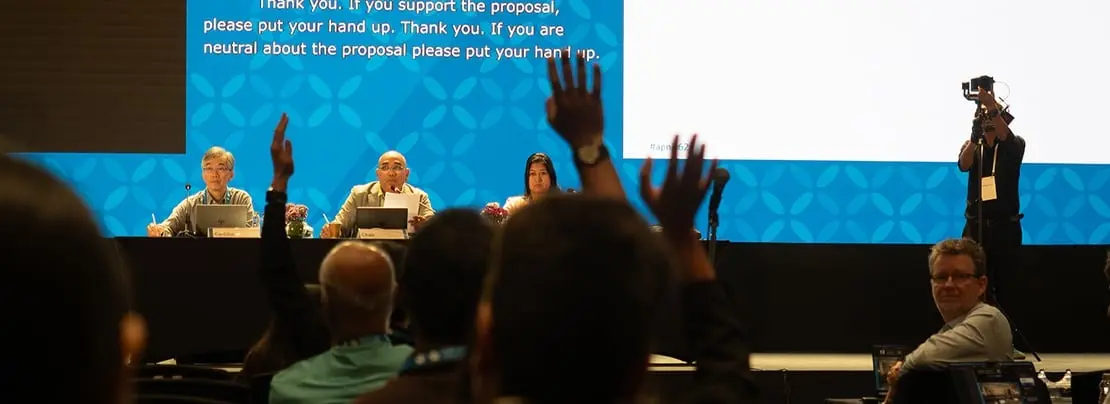
The recent APNIC 62 Open Policy Meeting (OPM) delivered hours of lively discussion, deep technical analysis, and strong opinions as internet community members gathered to debate the future of internet resource management. Spanning multiple sessions, the Policy Special Interest Group (SIG) tackled a diverse agenda featuring seven critical policy proposals. These measures addressed some of the most pressing challenges facing network operators today, including IPv4 address exhaustion, IPv6 usability, network planning, and IP abuse contact accountability.
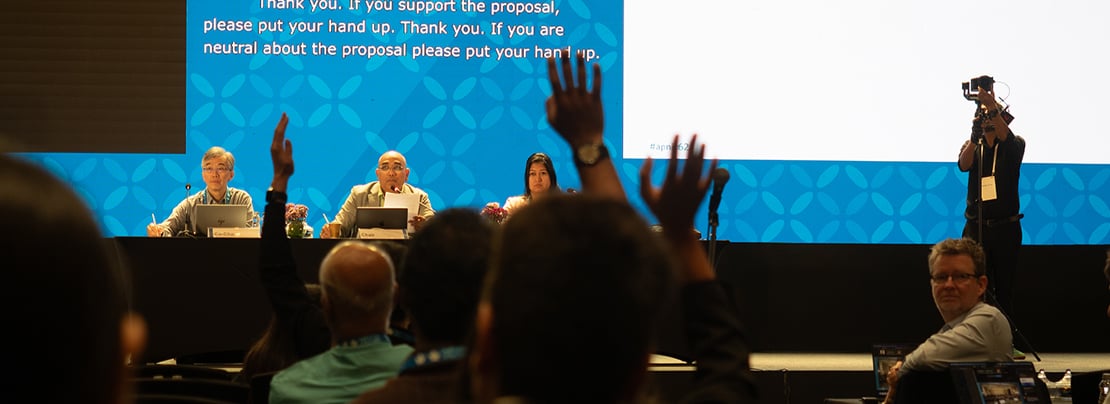
The Policy SIG considered the seven proposals across OPM 1 and OPM 2, reflecting a vibrant ecosystem striving to balance operational pragmatism with long-term resource conservation. By the conclusion of the meetings, two proposals successfully achieved consensus and are now set to progress through the formal APNIC Policy Development Process (PDP). Meanwhile, three proposals were returned to the community mailing lists for further refinement and discussion, and two exploratory items remained under active consideration without a formal consensus call.
Prop-164: Allocations of IPv6 resources longer than a /32 with a nibble boundary alignment
Among the proposals generating significant technical debate was Prop-164, which sought to permit APNIC to issue IPv6 address allocations smaller than the traditional minimum threshold of a /32, extending down to a /40 while strictly maintaining nibble-boundary alignment.
Supporters of the proposal argued that lowering the minimum allocation size would better align resource distribution with actual operational requirements, significantly reduce over-allocation of precious address space, and enable more precise and accurate registration of delegated resources. However, despite broad acknowledgment of these potential benefits, several complex issues remained unresolved during the floor discussions. Participants debated whether the proposal addressed a sufficiently widespread operational need across the region, how the policy shift would impact internal APNIC operational processes and registry systems, and whether offering different allocation sizes might inadvertently influence member decision-making regarding network design.
Faced with these lingering questions, the Policy SIG Chairs determined that absolute consensus had not been reached. Consequently, the proposal was officially returned to the community mailing list to allow stakeholders more time to refine the text and address outstanding concerns.
Prop-165: Provision of IPv4 address space to IPv6-only networks for transitional purpose
Addressing the ongoing hurdles of migrating modern network architectures, Prop-165 proposed a mechanism to provide a limited amount of IPv4 address space to IPv6-only networks specifically for transitional purposes. Under the terms of the proposal, organizations that successfully qualify for an IPv6 allocation would be permitted to request a single IPv4 /24 address block. This space would be strictly designated to support transitional infrastructure and essential operational requirements, such as running DNS resolvers, mail gateways, monitoring systems, logging infrastructure, and maintaining access to legacy IPv4-only services across the internet.
Proponents emphasized that the measure would effectively remove practical, day-to-day barriers hindering organizations from deploying fully native IPv6-only networks, all while adhering to strict IPv4 conservation principles. Despite the clear operational motivation, the timing and complexity of the proposal introduced procedural hurdles. A revised version of the text had been submitted shortly before the conference began, leaving insufficient time for a comprehensive review by the broader community. Given the need for additional analysis on validation workflows, usage monitoring, and long-term enforcement, the Policy SIG Chairs opted not to make a formal consensus call, leaving the item open for continued evaluation.
Prop-168: Increase to maximum IPv4 delegations
The growing scarcity of legacy internet resources took center stage with Prop-168, which aimed to increase the maximum amount of IPv4 address space obtainable from APNIC’s rapidly dwindling remaining IPv4 pool from a /23 to a /22. The proposal also incorporated provisions for creating a dedicated reserved pool intended to support new market entrants deploying essential IPv6 transition technologies, such as NAT64 and DNS64.
Proponents of the change argued that smaller and expanding operators continue to face legitimate, unavoidable requirements for additional IPv4 resources as dual-stack deployment slowly progresses. They contended that raising the maximum delegation ceiling would alleviate dependency on secondary market transfers and complex leasing arrangements. Conversely, critics raised serious concerns that larger individual delegations would drastically accelerate the depletion and shorten the operational lifespan of APNIC’s final IPv4 reserves. Debate centered heavily on striking a delicate, equitable balance between immediate operator requirements and the overarching, long-term necessity of IPv4 conservation. Ultimately, the Chairs concluded that consensus had eluded the room, returning Prop-168 to the mailing list for further structural development.
Prop-169: Aligning IPv4 LIR needs assessment with current IPv4 delegation policy
In contrast to the more contentious debate over pool exhaustion, Prop-169 achieved a smoother path to agreement by seeking to update formal policy language to accurately reflect current operational realities. The proposal addressed a persistent discrepancy between existing policy text—which historically referred to justification requirements for a /23 block—and actual APNIC practices, which already permitted the assessment and issuance of smaller delegations.
Supporters noted that formalizing this alignment would improve regulatory clarity and synchronize official policy wording with existing operational workflows without altering foundational allocation principles or membership eligibility requirements. The proposal was met with widespread approval from meeting participants, leading the Chairs to confirm that formal consensus had been achieved.
Prop-170: Nibble-boundary alignment for IPv6 allocations
Another successful measure, Prop-170, introduced an optional mechanism enabling eligible applicants to request IPv6 allocations explicitly aligned to nibble boundaries, provided they could demonstrate a valid, demonstrable operational need.
Proponents underscored a wide array of operational advantages associated with the change, including improved reverse DNS management, streamlined network planning, enhanced automation, cleaner route aggregation, efficient troubleshooting, and robust support for future network expansion. Crucially, the proposal left APNIC’s existing minimum allocation sizes and needs-based assessment models intact, merely offering applicants an additional structural option when justified by network architecture. Although a few participants questioned whether existing policies already afforded sufficient flexibility, the overwhelming sentiment reflected strong support for the practical benefits of the measure, prompting the Chairs to declare that consensus had been reached.
Prop-171: Operational accountability for abuse contacts in sub-allocated address space
Addressing the administrative and security challenges of network misuse, Prop-171 sought to enhance the real-world effectiveness of abuse reporting. The proposal was designed to ensure that officially registered abuse contacts reliably connect incoming reports to the specific downstream organization actually capable of investigating and mitigating the relevant network issues.
The discussion stemmed from widespread concerns that abuse reports frequently terminate at upstream resource holders without being effectively relayed to the downstream operators running the compromised or offending networks. Rather than imposing a rigid, mandatory implementation framework, the proposal concentrated on guaranteeing a functional operational path for handling abuse notifications. While many attendees strongly supported the underlying goal of improving abuse management, significant differences remained regarding the operational overhead, validation requirements, and implementation complexity involved. As a result, consensus was not reached, and the proposal was returned to the mailing list for refinement.
Prop-172: Defining Internet abuse through IP addresses
Rounding out the policy agenda, Prop-172 initiated a broader exploratory discussion on whether APNIC should establish and adopt a formal, standardized definition of internet abuse specifically in relation to internet number resources. The dialogue aimed to build a shared foundation regarding what constitutes abuse involving IP address blocks and to clarify the exact responsibilities incumbent upon resource holders.
Participants engaged in a wide-ranging exchange covering technical evidence requirements, complex jurisdictional variations, the appropriate boundaries of registry policy, and the practical role of a Regional Internet Registry in managing abuse-related disputes. While attendees expressed considerable interest in continuing the dialogue, opinions varied significantly concerning both the ideal definition and the proper scope of APNIC’s mandate. Given the exploratory and preliminary nature of the topic, the Chairs made no consensus call.
As the APNIC 62 Open Policy Meeting concluded, the outcomes underscored the continuous commitment of the regional internet community to carefully balance technical operational needs, resource stewardship, and administrative accountability. With proposals 169 and 170 successfully moving forward through the PDP, and several other critical discussions returning to community mailing lists, attention now turns toward the upcoming APRICOT 2027 and APNIC 63 conferences, where the ongoing evolution of internet policy will continue to take shape.


Leave a Reply