The convergence of Post-Quantum Cryptography (PQC) and the Domain Name System Security Extensions (DNSSEC) has drawn intense interest and concern from internet engineers in recent months. The looming prospect of quantum computing threatens conventional cryptographic practices across the digital landscape. Specifically, a sufficiently powerful quantum computer—widely referred to as a "cryptographically relevant quantum computer," or CRQC—could theoretically derive a private key from exposed public information, including public keys and encrypted text. In the context of DNSSEC, the core risk lies in the possibility that a CRQC could calculate a private key well within the operational lifetime of an active DNSSEC key pair, undermining the integrity of domain name resolution worldwide.
Recent years have seen considerable intellectual and financial investment in developing quantum computers. These systems exploit quantum mechanical phenomena where fundamental units of information are not classical bits with discrete values of one or zero, but qubits capable of existing in a superposition of both basic states simultaneously. While there is broad optimism that quantum hardware will eventually mature to solve complex computational challenges, current quantum systems remain in their technological infancy. They represent an equivalent form of massively parallel processing operating on an exponential scale.
The engineering challenges associated with building stable, error-corrected quantum computers remain formidable, meaning progress has been slow and exceptionally expensive. Nonetheless, research projects persist because a sufficiently large quantum machine could solve computational problems entirely beyond the reach of binary computers. Long before these engineering hurdles can be fully cleared, theoretical research has highlighted how quantum algorithms could outpace classical computers by orders of magnitude. In 1994, Peter Shor published a foundational algorithm for finding the prime factors of an integer. This mathematical breakthrough holds profound implications for cryptography, as the exponential speedup over classical algorithms threatens to render widely used systems like RSA and ECC vulnerable once quantum computers achieve the necessary scale and reliability.
When such a machine becomes reality, it will meet the definition of a CRQC. While predicting an exact timeline remains difficult, increased funding has accelerated research and development. The year 2030 is frequently cited as an optimistic yet plausible milestone. Because this timeframe falls well within standard multi-decade security horizons, organizations seeking to protect sensitive information for the next twenty years must prudently assume that quantum adversaries could attempt decryption within that window.
Consequently, even though capable quantum systems are not yet fully operational, security architects must evaluate quantum-resistant cryptographic algorithms today, particularly where long-term data integrity is critical. A prominent current danger involves attackers performing mass data interception—a tactic known as "Harvest Now, Decrypt Later" (HNDL)—in anticipation of processing captured ciphertext later with a CRQC. Cryptography is equally vital for digital signatures, which establish the authenticity of signed messages and the identity of their authors. A compromised key pair allows an attacker to impersonate the author, meaning vulnerability periods directly correlate with the active lifespan of the signature keys.
DNSSEC Key Lifecycles and Mitigation Strategies
DNSSEC key lifetimes for Top-Level Domains (TLDs) were examined thoroughly in a 2022 publication by the Internet Corporation for Assigned Names and Numbers (ICANN) authored by Ed Lewis, titled Observing DNSSEC Key Lifecycles. While key management practices vary widely, the study reported that a zone’s Key-Signing Key (KSK) is typically maintained for one or more years, while its Zone Signing Key (ZSK) remains active for periods ranging from weeks to months.
A standard first-line defense against potential CRQC risks involves more frequent key rotation, introducing a new ZSK every month and a new KSK every year or even semi-annually. While more frequent than historical norms observed in ICANN data, these adjustments do not represent a radical departure from current administrative workflows. However, if quantum computing progress accelerates, shorter key lifetimes alone will prove insufficient, necessitating a full migration to Post-Quantum Cryptography within DNSSEC configurations.

Transitioning to post-quantum DNSSEC introduces significant technical hurdles, primarily due to the physical characteristics of PQC algorithms. A common trait among these quantum-resistant alternatives is that they require drastically larger key and signature sizes compared to pre-quantum public key algorithms. For instance, comparing traditional DNSSEC algorithm 13, which utilizes ECDSA P-256 with SHA-256, against draft post-quantum algorithm 18, known as ML-DSA-44, reveals a stark contrast. While an ECDSA P-256 public key requires 32 bytes and its signature spans 65 bytes, an ML-DSA-44 public key demands 1,312 bytes, its private key requires 2,560 bytes, and its resulting signature reaches 2,420 bytes.
When a PQC-generated DNSSEC signature is attached to a standard DNS response, the total payload swells dramatically. When a stub resolver queries a recursive resolver for a record signed with ECDSA P-256 and requests the signature by setting the DNSSEC OK bit in the query, the resulting response fits comfortably within a single, unfragmented User Datagram Protocol packet at 191 bytes. Repeating the identical query for a name signed with the post-quantum ML-DSA-44 algorithm yields a response measuring 2,551 bytes.
This massive payload expansion causes recursive resolvers to receive truncated responses over UDP, forcing stub resolvers to establish a Transmission Control Protocol session to complete the query. Instead of a straightforward two-packet query-and-response exchange over UDP, the transaction balloons into a multi-step sequence involving truncation flags, TCP handshakes, and session completion packets.
Transport Challenges for Large DNS Payloads
To bypass TCP overhead, administrators might consider relying on conventional IP packet fragmentation while retaining UDP transport. The maximum size of an IP packet reaches 65,536 bytes, which would theoretically accommodate ML-DSA-44 and other candidate PQC signature algorithms by allowing the network layer to fragment large packets and reassemble them at the destination.
However, internet measurements have repeatedly demonstrated that IP packet fragmentation is inherently unreliable and introduces security risks. The broad consensus across the DNS engineering community is that the unreliability of IP fragmentation across both IPv4 and IPv6 networks outweighs any structural convenience of managing large payloads at the network layer.
The original DNS specification addressed this limitation by restricting UDP payloads to 512 octets. This was later modified by Extension Mechanisms for DNS, known as EDNS, which allowed requestors to specify a preferred UDP payload size corresponding to the capacity of their local network stack. Until roughly 2019, operational guidance encouraged a compromise EDNS maximum payload size of 4,096 octets.
Subsequent measurements regarding IP fragmentation performance, particularly over IPv6, raised serious doubts about its robustness. Initiatives like DNS Flag Day 2020 explicitly warned that IP fragmentation is unreliable on the modern internet, causing transmission failures and potential security vulnerabilities where fragmented messages could be spoofed. Consequently, industry initiatives recommended adopting an EDNS UDP buffer size of 1,232 bytes to avoid IP fragmentation across nearly all active networks.

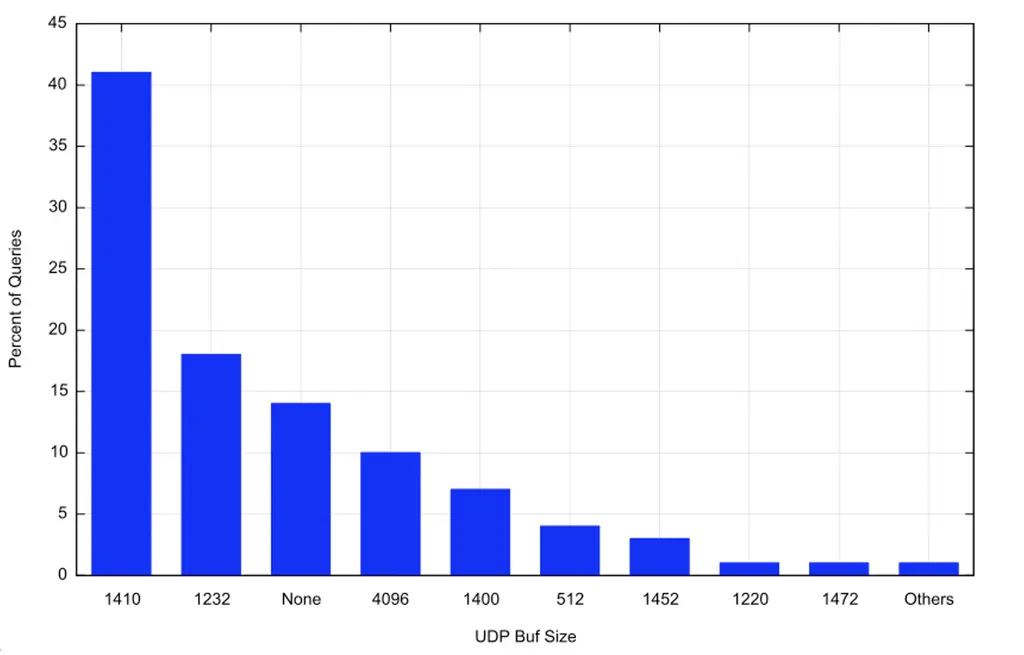
Data gathered by the APNIC Labs measurement platform reveals how recursive resolvers utilize these buffer sizes in practice. Across billions of queries collected from millions of end users, the majority of queries utilize a UDP buffer size of 1,410 bytes, fitting neatly inside standard 1,500-byte IP packets alongside transport and network headers. Approximately three-quarters of queries employ buffer sizes likely to avoid IP fragmentation, while a minority continue to use legacy settings or larger buffers. Because authoritative servers apply their own conservative buffer size limits, large responses routinely trigger truncation flags, safely steering traffic toward TCP.
The Role of the DNSSEC OK Bit
A recursive resolver signals to an authoritative server—just as a stub resolver signals to a recursive resolver—that it desires DNSSEC signature records by setting the DNSSEC OK, or DO, bit within the query. If the zone is signed, the response includes the corresponding RRSIG resource record set.
RFC 4035 mandates that a security-aware resolver must include an EDNS option with the DO bit set when issuing queries. Even if an initial client query omits the DO bit, a security-aware recursive resolver will frequently issue upstream queries with the DO bit enabled to populate its cache efficiently, stripping the cryptographic signatures before returning data to clients that do not require validation.
Measurement data indicates that approximately 60 percent of all unique queries across the global internet feature the DO bit set. Meanwhile, independent measurements show that roughly 40 percent of users sit behind resolvers actively performing strict DNSSEC validation, with an additional segment utilizing resolvers that attempt validation before falling back upon failure. This disparity highlights that a portion of resolvers enable the DO bit gratuitously without performing full validation, raising questions about unnecessary network overhead.
This dynamic leads directly to architectural debates within the Internet Engineering Task Force. An active internet draft titled "No DO for you" explores whether non-validating resolvers should clear the DO bit in their queries to reduce the volume of TCP connections handled by authoritative servers, balanced against the added operational complexity of cache management. While some engineers view minor protocol adjustments as a way to streamline traffic, others worry that compounding tweaks risks making the DNS ecosystem increasingly fragile. As researchers continue to weigh these protocol trade-offs, the eventual widespread adoption of post-quantum cryptography will force the internet community to confront the tangible network costs of securing domain name infrastructure for the quantum era.