

Starting over after a divorce at 50 can make an ordinary Tuesday feel strangely unfamiliar. The mortgage login has changed, dinner is suddenly for one, and friends often hesitate, unsure whether to invite both parties or how to navigate the shift. Meanwhile, a career still expects the same competent version of you, even as sleep, personal finances, housing, family dynamics, and identity all demand immediate decisions.
The pressure to "make a fresh start" arrives quickly from all directions. Well-meaning acquaintances talk about a new apartment, a new body, a new social life, and perhaps a completely new career. While it sounds hopeful at first, the endless list of expectations quickly becomes just another overwhelming demand.
Experts and those who have lived through midlife transitions emphasize a fundamental truth: you do not need to reinvent everything while the floor beneath you is still moving.
A steadier order is entirely possible. The approach begins with protecting the practical floor, rebuilding a reliable weekly routine, and then testing who you want to become through small, reversible choices. Grief can run alongside that work; it does not have to be completely resolved before you pay a bill, ask for help, or take a walk outside.
For individuals facing immediate danger, local emergency services remain the primary resource. When a partner or former partner frightens, monitors, threatens, or controls you, the National Domestic Violence Hotline offers confidential safety planning by phone, chat, or text. Professionals caution against announcing an exit plan or attempting couples counseling when safety is uncertain. For mental health, suicide, or substance use crises in the United States, calling or texting 988 connects individuals to the 988 Lifeline, though neither service replaces local legal advice.
Starting Over at 50 Means Rebuilding in Layers
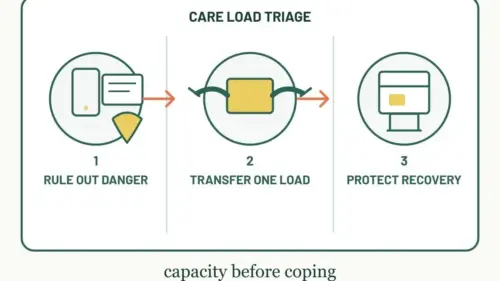
Navigating life after a marital dissolution at 50 works far better as a layered rebuild than as one dramatic, sweeping reinvention. The first priority is securing the floor: personal safety, stable housing, cash access, legal deadlines, health insurance, necessary prescriptions, and reliable sleep. Only after those elements are secure does it make sense to rebuild a workable week with a few dependable anchors. Larger identity choices regarding work, home, friendship, love, and personal purpose should only be tested after stabilization has taken root.
Stabilization is not a form of surrender; rather, it creates the necessary psychological and practical room for better decision-making.
This phased approach applies core life frameworks to health, family, work, money, purpose, and leisure while deliberately protecting the time, energy, and decision-making capacity required to rebuild them. Treating life change as a rebuild from an existing foundation rather than a blank slate significantly reduces risk. By organizing necessary actions into a predictable sequence, individuals can explore what truly fits their lives before making permanent commitments.
Why Trying to Reinvent Everything at Once Backfires
All-at-once reinvention asks a stressed mind to make the largest possible number of high-stakes choices simultaneously. While popular culture romanticizes the idea of a complete life overhaul, research suggests that acute stress and overwhelming transitions can disrupt executive control, depending on the task and timing. Smaller, manageable decisions serve as a crucial safeguard rather than a verdict on a person’s capability or resilience.
Uncertain decisions constantly compete for limited attention. This is where the fantasy of a clean break becomes costly. A new city, a new relationship, or a new job might ultimately be the right choice, but each variable changes multiple aspects of life at once while the practical foundation is still unsteady.
To avoid burnout, individuals are advised to handle urgent administrative and safety items first. Using reversible tests allows people to gather information without locking themselves into irreversible paths. Identity-level decisions require adequate advice, sleep, and emotional distance to transform into actual choices rather than impulsive exits from pain.
Securing the Practical Floor
Protecting the floor means locking down the parts of life where delay can create lasting, tangible harm: personal safety, stable housing, access to money and official documents, legal deadlines, health coverage, prescriptions, joint debts, and reliable sleep. This phase is tactical triage, not a complete financial or legal master plan.

Money demands sober, realistic attention during this transition. A longitudinal study of divorce occurring at age 50 or older in the United States found average declines in the standard of living of roughly 45 percent for women and 21 percent for men, as measured by the income-to-needs ratio, while overall household wealth fell by about half for both groups. While these figures represent model-based averages rather than a universal forecast, they illustrate why financial matters belong near the front of the recovery sequence.
Legal realities also require careful handling. A divorce decree does not automatically end a person’s responsibility to a creditor on a joint account, and removing a name from a property title does not automatically release a borrower from a mortgage or auto loan, according to the Consumer Financial Protection Bureau. For those starting over with limited cash, focusing strictly on safety, document access, legal deadlines, and basic monthly budgeting is essential. Civil legal aid organizations, family-law professionals, tax experts, and financial advisers can help untangle individual circumstances.
Rebuilding a Week You Can Trust
A trustworthy week does not require a flawless routine. Instead, it relies on a few fundamental anchors: one dedicated block of time for divorce and household administration, one action that protects physical health, one reliable person you can contact honestly, and one period where recovery is allowed to be entirely unproductive.
Placing each anchor at a specific time stops necessary tasks from arriving as a constant stream of fresh, exhausting decisions. Research into implementation intentions—often framed as "if-then" plans—shows that associating a specific time and cue with a necessary task significantly improves goal attainment.
When it comes to emotional and social support, designating a trusted friend or family member for specific, bounded tasks—such as listening for twenty minutes, joining an appointment, or reviewing housing options—prevents isolation. Recognizing the value of support without feeling the immediate need to reciprocate helps dismantle the people-pleasing habits that often turn asking for help into a perceived emotional debt.
Testing the Person You Are Becoming
Identity after divorce is far better tested than declared. Rather than deciding who the "new you" must be, experts recommend running small, reversible experiments for a limited period, such as 30 days. This might involve taking a class, rearranging a single room, reconnecting with an estranged friend, volunteering, or spending a Saturday in a new environment.
Keeping these experiments small ensures that a disappointing result simply becomes useful information rather than a personal collapse. Longitudinal studies observing divorcing adults indicate that self-compassion—acknowledging that the process is difficult and that clumsy choices do not equal character flaws—correlates with lower emotional intrusion over time.
Allowing preferences to emerge naturally through trial and error gives individuals the space to discover what fits their lives without demanding an immediate, permanent reinvention of their entire identity.
Managing the Timeline and Moving Forward
There is no verified clock or universal timeline for emotional and financial recovery following a divorce. Long-term studies of individuals separating later in life reveal a wide variety of adjustment patterns, ranging from rapid resilience to prolonged difficulty, depending on individual circumstances, resources, and local laws.
When progress feels slower than expected, comparing one’s current state to an arbitrary milestone only adds unnecessary pressure. Affection for a former partner can sometimes linger even when a relationship was fundamentally unworkable, unsafe, or beyond repair, but missing someone does not require ongoing contact or immediate decisions.
Taking one floor-protecting action—whether downloading a financial statement, noting a legal deadline, refilling a prescription, or asking a qualified professional a precise question—is enough for any single day. Starting over at 50 does not require a performance of relentless courage; it simply requires making one safer decision, followed by another, when the facts are clear.


Leave a Reply