
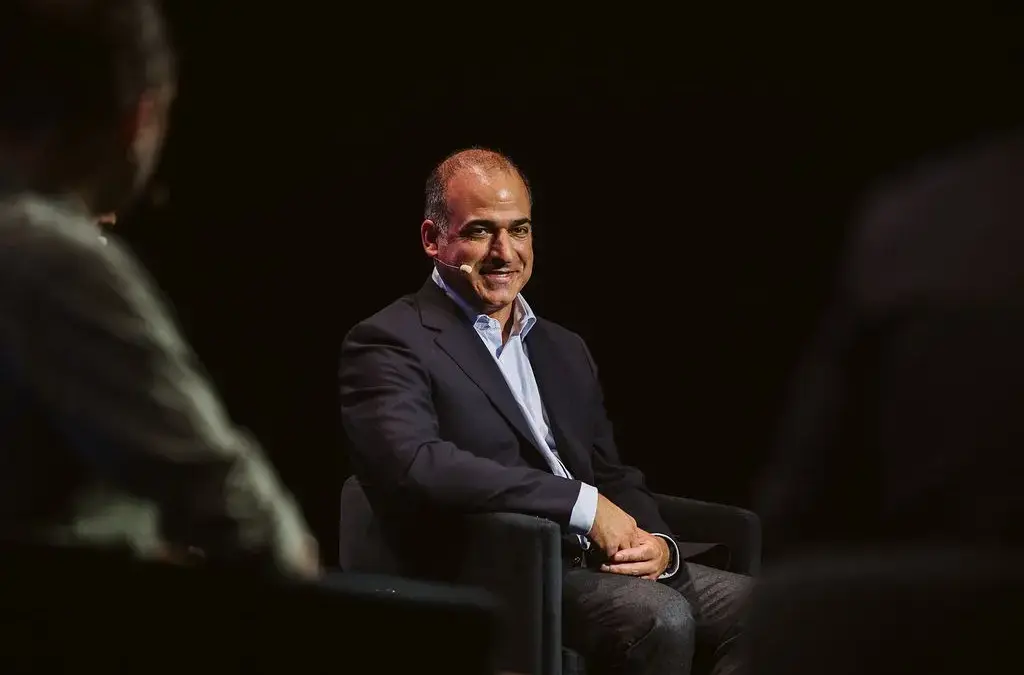
This week, moderating a panel on world models at the All In conference provided a rare, front-row seat to one of the most enigmatic and heavily funded corners of the artificial intelligence ecosystem. The cutting edge of this emerging field is currently dominated by two heavy-hitting entities: Yann LeCun’s AMI Labs and Fei-Fei Li’s World Labs. Yet, while both organizations have successfully commanded massive amounts of buzz, talent, and early-stage capital, they share a distinct characteristic that sets them apart from the broader tech landscape: they currently rank remarkably low on the traditional scale of trying to commercialize and make money.
At their core, world models represent a major leap forward in automating spatial intelligence. Because of this foundational capability, the field holds the potential to branch out into an extraordinary variety of lucrative and impactful directions. Experts believe the technology could eventually transform industries ranging from advanced robotics and interactive video generation to more complex, highly adaptable autonomous driving systems.
However, when pressed on where the technology will actually see its first major commercial deployments, the horizon quickly becomes foggy. The closest thing to an authoritative voice on the matter at the conference was Michael Rabbat, a co-founder of AMI Labs and the company’s vice president of world models, who joined the panel discussion. When questioned directly about the specific products and use cases AMI is currently developing, Rabbat remained notably cagey. "We’ll talk about it when we’re ready to talk about it," he told the audience. Later, in an email clarification, he added that the organization remains deeply embedded in a research and building phase, making public discussion of product timelines or concrete plans premature.
To be entirely fair, AMI Labs is less than a year old, meaning a tight-lipped approach to early development is standard operating procedure in the fast-paced and cutthroat AI sector. But this air of secrecy extends far beyond a single startup, permeating the entire world-modeling space. World Labs’ Marble platform stands out as perhaps the most fully developed product currently visible in the market. Its public demonstrations showcase everything from straightforward media creation and the building of explorable, three-dimensional environments for video games to advanced CGI effects. While there are certainly underlying robotics use cases embedded within the platform, the overall presentation feels deliberately crafted to showcase raw technical capabilities rather than a fixed commercial product meant for a specific consumer or enterprise market.
That pervasive secrecy even reaches the supply chain partners supplying the raw ingredients for these models. On the sidelines of the same conference, Alex de Vigan, the CEO of data supplier Physicl, shared his perspective on working with the burgeoning world model business. He noted that he is confident Physicl’s data has proven valuable for whatever these stealthy labs are building, but he remains completely in the dark regarding the final destination or exact nature of the work. "I wish they would tell us more. We could build more useful data if we knew what they were working on," de Vigan explained.
Part of the persistent mystery stems from the inherent versatility of world models as a concept. In its simplest iteration, a world model functions as a navigable, predictive map of physical reality, sharing a philosophical lineage with the AI architectures that currently power self-driving cars. Yet the exact same underlying modeling approach that helps an autonomous vehicle weave safely through chaotic urban traffic could theoretically help a humanoid robot maneuver through a warehouse to carry boxes, or translate a few minutes of flat video footage into a fully interactive, explorable virtual environment.
AMI Labs has already dipped its corporate toes into an astonishing array of distinct verticals, including manufacturing, biomedicine, robotics, and even specialized AI software for doctors through its partnership with Nabia. It is statistically certain that the organization will not pursue all of those ambitious avenues simultaneously, but the sheer breadth of exploration raises questions about which specific applications are ultimately rising to the top.
Despite the ambiguity, few observers doubt that there are numerous highly viable, multi-billion-dollar businesses waiting to be built on top of world model technology. As long as venture capital and strategic funding remain relatively easy to secure, there is little immediate pressure for these labs to narrow their focus to a single, revenue-generating product. In fact, there is arguably good strategic reason to maintain a broad and undefined posture. If a major player like AMI were to announce tomorrow that they had successfully built a commercial humanoid robot framework or a next-generation Hollywood rendering suite, dozens of rival labs would instantly pivot their resources to capture that exact market. Within moments, the lab would find itself facing intense potential competition not just from peer world-model startups and newly formed neolabs, but from industry giants like OpenAI and Anthropic.
In many ways, this dynamic represents the flip side of the current fundraising boom. The massive pools of capital that allow early-stage researchers to build ambitious models under the radar are also actively funding a multitude of potential rivals who are simply waiting for a clear path to market to emerge. Even if that ultimate wave of intense competition is entirely inevitable, conventional business logic dictates that delaying it for as long as possible is the optimal strategy. For these pioneering labs, keeping quiet about the specifics of their engineering efforts is the most effective defense mechanism available.
Fans of speculative science fiction, particularly the works of author Cixin Liu, will readily recognize this dynamic as a classic dark forest scenario: when you are operating in a vast, unknown frontier and you do not yet know who else might be lurking in the woods, the safest and most rational move is to avoid attracting any unnecessary attention whatsoever.


Leave a Reply