
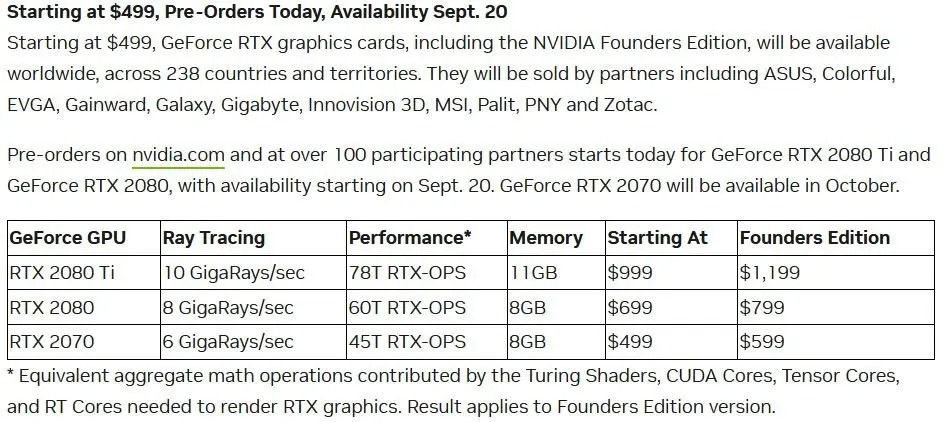
Eight years ago today, Nvidia’s Turing GPU architecture officially landed in the hands of PC enthusiasts and gamers around the world, marking a monumental shift in computer graphics. This release was far more than just another standard generational performance bump or an incremental architectural evolution. According to Nvidia, the GeForce 20-series represented the culmination of two decades of research and development, introducing a capability that had long been considered the holy grail of computer graphics: real-time ray tracing combined with rasterization in a hybrid rendering pipeline.
Nvidia chose to introduce this revolutionary technology at the very top of the market, debuting the new architecture through the high-end GeForce RTX 2080 and the flagship RTX 2080 Ti Founders Edition graphics cards. These powerhouse components gave early adopters their first taste of hardware-accelerated ray tracing and deep learning super sampling, commonly known as DLSS. Meanwhile, gamers looking for a slightly more accessible entry point into the new generation would have to wait a little longer, as the more mainstream GeForce RTX 2070 was scheduled to hit the market the following month in October.
The journey toward this monumental launch had been heavily hyped by Nvidia leadership in the weeks leading up to the retail release. In a corporate blog post published exactly a month ahead of the launch day, Nvidia Chief Executive Officer Jensen Huang did not hold back when heralding the arrival of the Turing architecture for the personal computer gaming ecosystem. He boldly proclaimed that Turing had effectively opened up a brand-new golden age of video game graphics, characterized by a level of visual realism that many industry experts and consumers previously believed was still a decade away from practical implementation in consumer-grade hardware.
Huang’s enthusiasm for the visual fidelity afforded by the new technology was absolute, famously telling the gaming community that once a player experienced a video game running with RTX effects enabled, it would be impossible to go back to traditional rendering methods. This bold claim set the tone for an industry-wide transition. The introduction of dedicated RT cores for ray tracing and Tensor cores for artificial intelligence processing fundamentally altered how graphics cards were designed, manufactured, and evaluated by reviewers and consumers alike.
The release of the Turing architecture set off a multi-year transformation across the entire video game industry. Developers suddenly had access to hardware capable of simulating the physical behavior of light in real time, calculating accurate reflections, shadows, and global illumination that previously could only be rendered offline in Hollywood animation studios over the course of hours or days. At the same time, the inclusion of Tensor cores introduced machine learning capabilities to gaming hardware, paving the way for AI-driven upscaling techniques that would eventually become an essential feature for maintaining high frame rates at demanding resolutions.
Reflecting on the launch of the GeForce RTX 2080, RTX 2080 Ti, and the broader Turing family eight years later, the graphics card market has unquestionably been reshaped by the technological roadmap Nvidia laid out on that September day. What began as an expensive, bleeding-edge enthusiast feature pioneered by high-end silicon has since matured into an industry standard expected by gamers across every tier of hardware.

Leave a Reply