
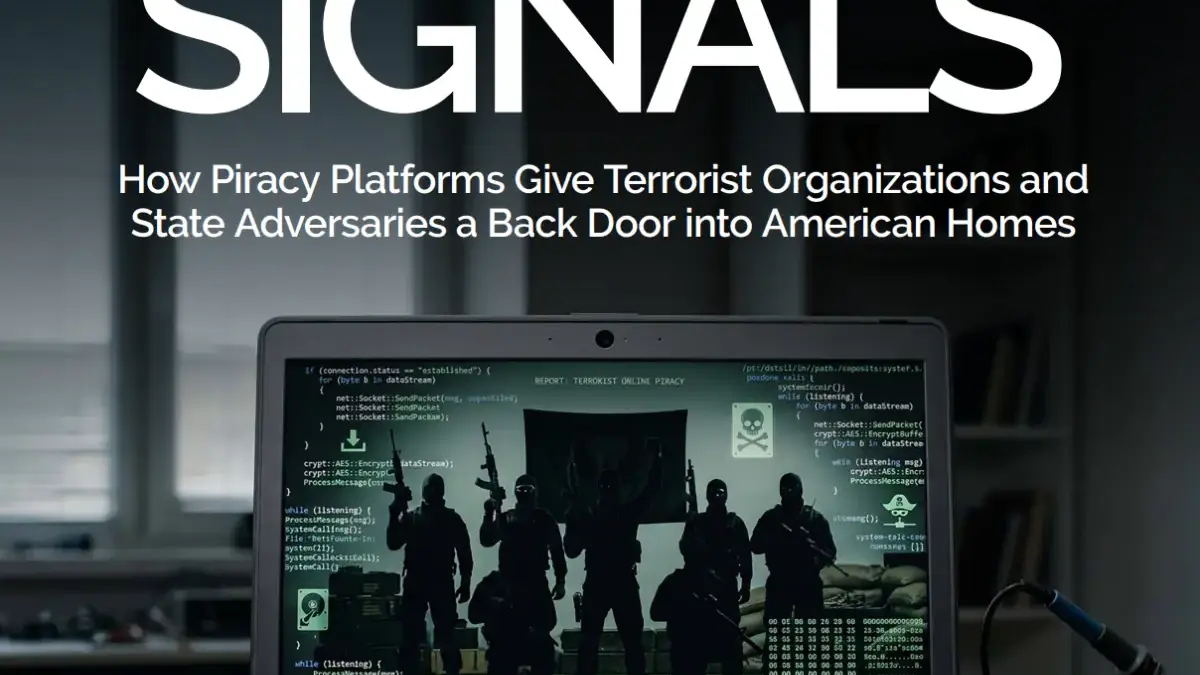
Rightsholders have linked digital piracy to terrorism and organized crime for several decades, attempting to frame copyright infringement not merely as an economic concern for creative industries, but as a broader national security threat. This strategic messaging first emerged in the late 1990s, when the International Federation of the Phonographic Industry (IFPI) raised concerns regarding international criminal networks smuggling pirated compact discs across national borders.
The terrorism angle was subsequently introduced in 2003 during a U.S. House of Representatives hearing examining piracy’s links to organized crime and terrorism. Around the same period, Interpol Secretary General Ronald Noble testified before Congress, stating that intellectual property crime had evolved into a preferred method of funding for several terrorist groups.
The most widely cited connection materialized in 2009, driven by a movie industry-funded RAND Corporation report that linked film piracy, organized crime, and terrorism. Although critics noted that this study heavily blurred the lines between physical counterfeiting and digital piracy, its conclusions have been continuously referenced by rightsholders and advocacy groups ever since.
"Never Forget"
More recently, the Digital Citizens Alliance, operating with support from creative industries, has kept this rhetorical tradition alive. In 2017, the Washington-based group bundled digital piracy alongside ISIS recruiting videos, malware distribution, and fake news campaigns. More recently, in May of this year, the organization published a report linking pirate IPTV services directly to illicit drugs, weapons trafficking, and traditional organized crime.

Yesterday, the Digital Citizens Alliance expanded its terrorism-focused narrative with a new release titled Hostile Signals. The report argues that contemporary digital piracy does not merely provide financial income for illicit actors; it can also function as an alternative, sanction-circumventing broadcasting channel capable of bypassing national security filters.
To add rhetorical weight, the report highlights that the 25th anniversary of the September 11 terrorist attacks is rapidly approaching, concluding its introductory remarks with the phrase "Never Forget." Given that the press release was issued yesterday, the timing of the publication is notable.
Pirate IPTV Services Carry Terrorist Channels
To substantiate these claims, researchers from Atlanta-based cybersecurity firm risk3sixty subscribed to 25 commercial pirate IPTV services using standard U.S. internet connections between May and August. According to their findings, 17 of these evaluated platforms carried at least one television channel directly tied to a designated terrorist organization or a state broadcaster operating under international sanctions.
The findings showed that Al-Manar, the television station operated by Hezbollah—an organization designated as a terrorist group by the United States with a history of attacks resulting in hundreds of American deaths—was available on all 17 of the identified piracy platforms. Furthermore, the Houthi-run Al-Masirah channel appeared on nine services, Iran’s state-backed Al-Alam channel was found on seven, and Hamas-affiliated Al-Aqsa TV was accessible on two.

"Al-Manar, the broadcast outlet of Hezbollah, which has a long history of attacking American targets and is responsible for at least 291 U.S. deaths over decades, is carried by all 17 piracy platforms identified to allowing carriage," the report states.
The research names several allegedly problematic IPTV services, including Lion OTT, Sansat VIP, OTTOcean, Belitvision, and Wish IPTV, all of which were accessible to consumers utilizing U.S. broadband connections.
The U.S. government officially banned Al-Manar’s satellite transmission feed back in 2004. Several years later, a Brooklyn resident was sentenced to 69 months in federal prison for providing material support to a terrorist organization after reselling the channel’s broadcasts to customers in New York. Despite these historical enforcement actions and regulatory crackdowns, modern pirate IPTV services have seemingly established a technological back door.
"A piracy subscription has restored what two decades of federal action removed," the report concludes.

Concerns and Nuance
The conclusions presented in the Hostile Signals report are alarming, suggesting that commercial pirate IPTV services could potentially be leveraged to facilitate radicalization among domestic populations.
"National security officials, policymakers and citizens alike should be concerned," the report warns, adding that "piracy platforms have created a new avenue for terrorist organizations and state adversaries to distribute recruitment messaging to U.S. audiences, including content intended to inspire acts of violence."
At the same time, however, the report acknowledges vital nuances regarding actual viewership patterns. The findings do not provide data concerning how many subscribers actually watch these specific foreign-language channels. Furthermore, the broadcasts are primarily delivered in Arabic, frequently lack subtitles or translations, and represent a tiny fraction of a massive programming catalog that typically includes thousands of mainstream entertainment and sports channels.
Additionally, many of these program streams—including those of Hezbollah—remain freely accessible to anyone through the broadcasters’ official websites over the open internet. This includes Al-Manar’s primary digital presence.

While the U.S. Department of Justice seized 13 Hezbollah-linked domain names in 2023, including seven that explicitly carried the channel’s name, the station’s main operational site continues to operate under Lebanon’s native .lb country-code top-level domain. Because this domain falls entirely outside U.S. legal jurisdiction, it continues to stream content to international visitors, including users in the United States.
Although the broad availability of these streams on the open web may diminish the exclusive impact of the report’s IPTV findings, it serves to lay the groundwork for the policy solutions advocated by the authors.
Solution: Site-Blocking
The Digital Citizens Alliance report does not restrict itself to identifying security vulnerabilities; it also proposes a definitive policy remedy. The organization argues that systemic site-blocking measures, which rightsholders have long advocated for combating traditional copyright infringement, can and should be deployed to block terrorist content and sanctioned state broadcasts.
"These findings reinforce the need for the United States to adopt measures to prevent overseas piracy networks from operating in the country," the report notes.

The timing of this policy recommendation aligns closely with ongoing legislative debates in Washington, where U.S. site-blocking bills have returned to the political agenda. Representative Darrell Issa’s American Copyright Protection Act and Representative Zoe Lofgren’s Foreign Anti-Digital Piracy Act are both under active consideration, and Rep. Issa has recently indicated that a bipartisan, bicameral legislative compromise may be imminent.
In August, Motion Picture Association Chairman Charles Rivkin alongside leadership from the National Intellectual Property Rights Coordination Center utilized high-profile World Cup domain seizures to reiterate demands for domestic site-blocking legislation.
As site-blocking discussions continue in Congress, content owners and allied advocacy groups are expected to leverage the Hostile Signals report as fresh evidence that aggressive measures against digital piracy could yield broader national security benefits.
"‘Never Forget’ became the enduring rallying cry for those who experienced the 9/11 attacks. It’s also a reminder to never let the terrorists back in, in any form," the report concludes.

Leave a Reply