
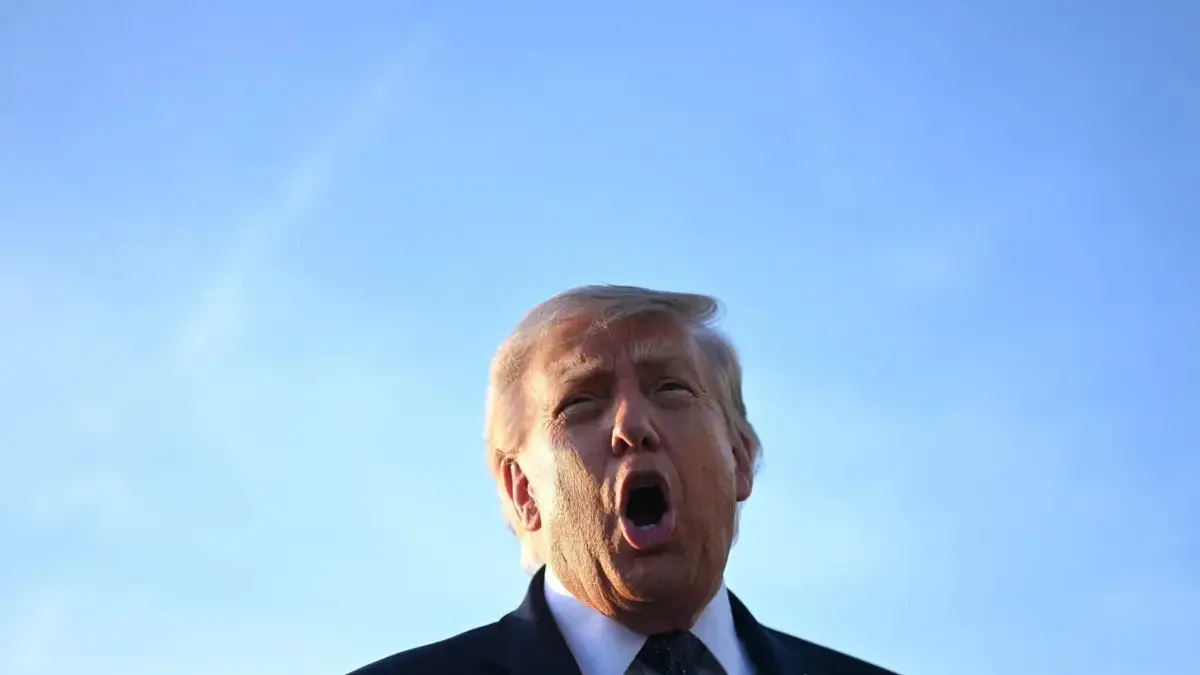
President Donald Trump has responded in characteristic fashion to the intense national and international debate surrounding artificial intelligence safety, declaring that the growing concerns are simply part of a long line of hoaxes generated by what he termed the "Radical Left Dumocrats" for the explicit purpose of destroying the country.
The remarks mark the latest intervention by the president into a rapidly shifting technological landscape, where policymakers, industry leaders, and researchers are increasingly at odds over how to regulate or pace the development of advanced artificial intelligence systems. Rather than engaging directly with the technical complexities of machine learning models or safety research, Trump took to his social network, Truth Social, over the weekend to share his broader grievances and outline plans for federal oversight.
Trump began his musings on Saturday by arguing that the very term "Artificial Intelligence" is inaccurate and ineloquent. To address this perceived linguistic shortcoming, he posted an online poll inviting his followers to vote on an alternative name for the technology, offering options such as "Superior Intelligence," "Extreme Intelligence," or "Supreme Intelligence." The poll remained active as publication time approached, drawing widespread attention from his online base.
Just a couple of hours later, the president followed up with a much sharper political post. In it, he claimed that ongoing attempts aimed at the "decimation, or destruction, of AI" represent just one of many orchestrated Democratic hoaxes. He explicitly compared the current anxiety over artificial intelligence to a laundry list of past controversies and political battles, citing what he called "RUSSIA, RUSSIA, RUSSIA, UKRAINE, UKRAINE, UKRAINE, Global Warming, Impeachment Hoax #1, Impeachment Hoax #2, Men in Women’s Sports, [and] Transgender for Everyone."
Insisting that he "will not stand by and let this happen," Trump argued that the narrative around AI safety is merely the latest phase of a coordinated campaign against technological and industrial progress. In his telling, the movement began with attacks on massive data centers before communities realized how wealthy and prestigious those facilities were for the local economies where they were built. According to the president, once the "crazed Data Center attack has largely failed," critics and opponents simply pivoted and decided to go "straight at AI."
Trump did not offer any factual evidence to back up his assertion that widespread public suspicion of AI and the massive data centers powering it is entirely inoraganic and insincere. In reality, unease over the technology and its infrastructure has transcended traditional partisan lines, drawing sharp scrutiny from both Republicans and Democrats alike. The physical footprint, immense power consumption, and environmental demands of data centers have sparked local pushback across the United States. This growing tension recently culminated in New York, which became the first state in the country to officially halt permits for large-scale data center projects while officials study their long-term impact.
The president’s weekend social media posts echo similar sentiments he expressed during a golf tournament the previous weekend. At that time, he indicated that he might be open to certain "guardrails" for the industry, but quickly pivoted to argue that a lot of negative forces are bringing up concerns that should not be raised at all.
Despite his complaints about critics, Trump made it clear that he views the technology as a vital national asset. On Saturday, he promised that he would "cherish [the industry,] help it, and watch over it, as it grows." However, true to his approach to federal governance and national security from his first term—during which he established the United States Space Force—Trump announced plans to create a dedicated federal entity specifically for the sector, which he is calling the "AI Force."
"To that end, I will be announcing, in the near future, the AI ‘Czar’ — Only High I.Q. individuals need apply!" he added in his post.
The president did not provide specific details regarding what the duties, authority, or size of the new AI Force and the corresponding AI czar position will actually entail. The announcement comes at a time of administrative transition for the White House’s technology advisory apparatus. Venture capitalist David Sacks stepped down from his role as Trump’s official AI and crypto czar earlier this year, subsequently transitioning to co-chair the President’s Council of Advisors on Science and Technology.
The national and global debate over AI safety has intensified dramatically in recent weeks. The friction reached a new pitch when a prominent AI researcher announced his resignation from Anthropic, one of the industry’s leading frontier labs. The researcher voiced profound concerns that the companies driving the artificial intelligence boom earnestly believe their cutting-edge models could potentially kill everyone by the end of the decade, accusing top developers of "gambling with our lives" in a reckless race for dominance.
In response to mounting internal and public pressure regarding existential risks, Anthropic CEO Dario Amodei subsequently released a formal plan to "pace the frontier" of AI development safely. That strategic framework appeared to win endorsements from other major industry figures, including OpenAI CEO Sam Altman and SpaceX and xAI CEO Elon Musk. At the same time, a vocal faction of critics and technology analysts has argued that an exclusive focus on science-fiction-style existential threats serves primarily as a distraction from the much more immediate, tangible harms that AI systems are already inflicting on society, labor markets, and information ecosystems.
Industry titans, meanwhile, have found common cause with the administration’s skepticism of regulatory slowdowns. Nvidia CEO Jensen Huang addressed the controversy directly when Trump called him up on stage during the All-In Summit, an event co-hosted by David Sacks. During the appearance, Huang publicly agreed with the president’s characterization of the AI backlash as a "hoax" and insisted to the assembled crowd that the industry and its supporters "are not going to let" a regulatory or developmental slowdown happen.

Leave a Reply