
The current tabletop landscape in 2026 feels remarkably like an HD remake of the late 1990s and early 2000s. Nostalgia trends have brought back retro fashion, classic cinematic franchises are dominating box offices, and contemporary nerd conventions are playing host to direct, highly visible showdowns between several competing collectible card games.
At PAX West in Seattle, much of that competitive battle unfolded inside Summit, the newer of the two buildings comprising the Washington State Convention Center. The bustling tabletop floor featured official, heavily funded booths for prominent contenders such as Riftbound, OverPower, Rush of Ikorr, and the Gundam Card Game. In previous years, the collectible card game space at major conventions like PAX was almost entirely dominated by Magic: The Gathering. Today, however, a diverse array of ambitious challengers are visibly gunning for its throne, signaling a vibrant, highly competitive era for physical card gaming.
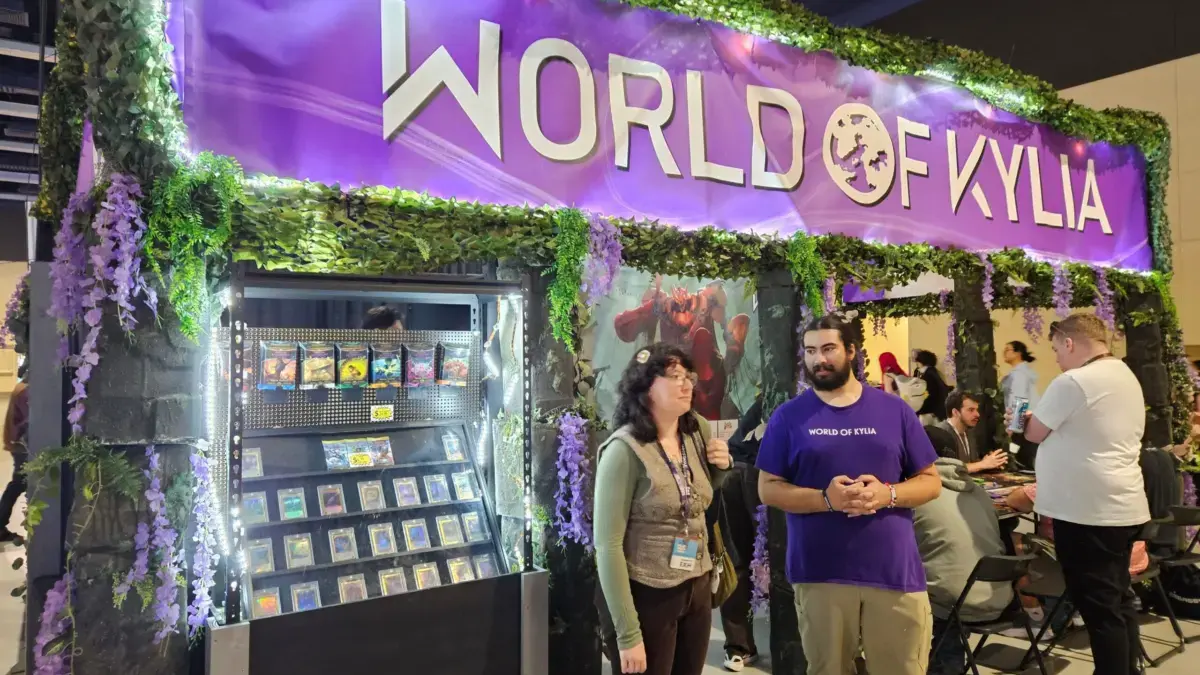
Yet, one of the most interesting and unconventional challengers at the convention was tucked away a few blocks away. The World of Kylia booth maintained a more modest presence, hidden somewhat in the Arch building’s expansive expo hall. Here, the Washington-based independent company iQ Pictures was showcasing Ascendant, a competitive card game that has quietly celebrated its second anniversary.
According to its creator, Chase Lambert-Crittenden, the expansive universe of Kylia originally began as a creative side project while he was pursuing an animation degree in California. Within the fictional continuity, Kylia is an inhabitable planet located in a distant galaxy, a celestial body rich with a valuable, plasma-like substance known as Genki. In the contemporary setting of the property, Kylia serves as a melting pot for multiple native and alien species, who coexist and conflict across seven distinct, fully realized nations.

The initial long-term vision for Kylia was to establish a multimedia franchise anchored by a series of animated cartoons, or potentially even a full-length feature film. While that overarching transmedia plan has not been abandoned by its creators, the card game was developed first, successfully funded and sustained by the steady animation production work of iQ Pictures.
Battling to Ascend
Ascendant is designed to be versatile, supporting various competitive formats including traditional one-versus-one matches, two-versus-two team play, and chaotic battle royale configurations. For players who have experience with other modern deckbuilders or trading card games, the foundational concepts will feel immediately familiar, though Ascendant introduces several distinct mechanical rules that require a period of adjustment.
The most prominent mechanical departure is how the game handles resource management. Unlike traditional card games that rely on dedicated land or energy cards drawn from a deck, the cost indicated on each Ascendant card directly represents the exact number of copies of that specific card a player needs to possess in order to successfully deploy it into play. If a card displays a cost of two in its upper right-hand corner, the player must have two identical copies; if the cost is eight, eight copies are required. This approach shares a conceptual kinship with certain automated battle games, emphasizing deck-building discipline and tactical redundancy.
Fortunately, the game’s economy is balanced by forgiving hand management rules. Hands in Ascendant feature no upper limit, and every participant draws a card at the very beginning of every turn. Consequently, even if a player does not specifically optimize their deck for rapid card-draw mechanics, they still cycle through their available arsenal at a brisk, engaging pace.

Certain cards also necessitate the generation of an entirely separate resource, which is accomplished through the use of designated Generator cards. These assets can be tapped during a player’s turn to produce Genki, a vital energy currency that can be spent to fuel the advanced abilities of various powerful cards.
Alternatively, it is entirely viable to construct a competitive deck that bypasses Genki generation altogether. During a demonstration at PAX West, players could experience setups like the pre-made deck used against creator Lambert-Crittenden, which was constructed entirely around physical equipment, industrial machinery, and a pair of steampunk energy revolvers. Devoid of complicated magical spells or mystical generators, the playstyle leaned heavily into mundane hardware, proving that players could navigate a universe filled with cosmic wizards, summoned monsters, and alien warlords using straightforward, tactile tactics.
Winning games often comes down to a blend of calculated strategy and sheer, unpredictable fortune. Ascendant utilizes 20-sided dice to resolve all combat interactions, introducing an inherent layer of tabletop role-playing game uncertainty into the collectible card game format.
When one player initiates an attack against another in Ascendant, both opponents roll a standard 20-sided die, with the higher numerical result claiming victory. If the attacker proves successful, their intended target suffers damage equal to the exact numerical difference between the two rolls. For instance, if an attacker rolls an 18 and the defender rolls a 10, the target absorbs eight points of damage. Since all participants begin a match with a generous pool of 70 life points, the last player standing emerges victorious.
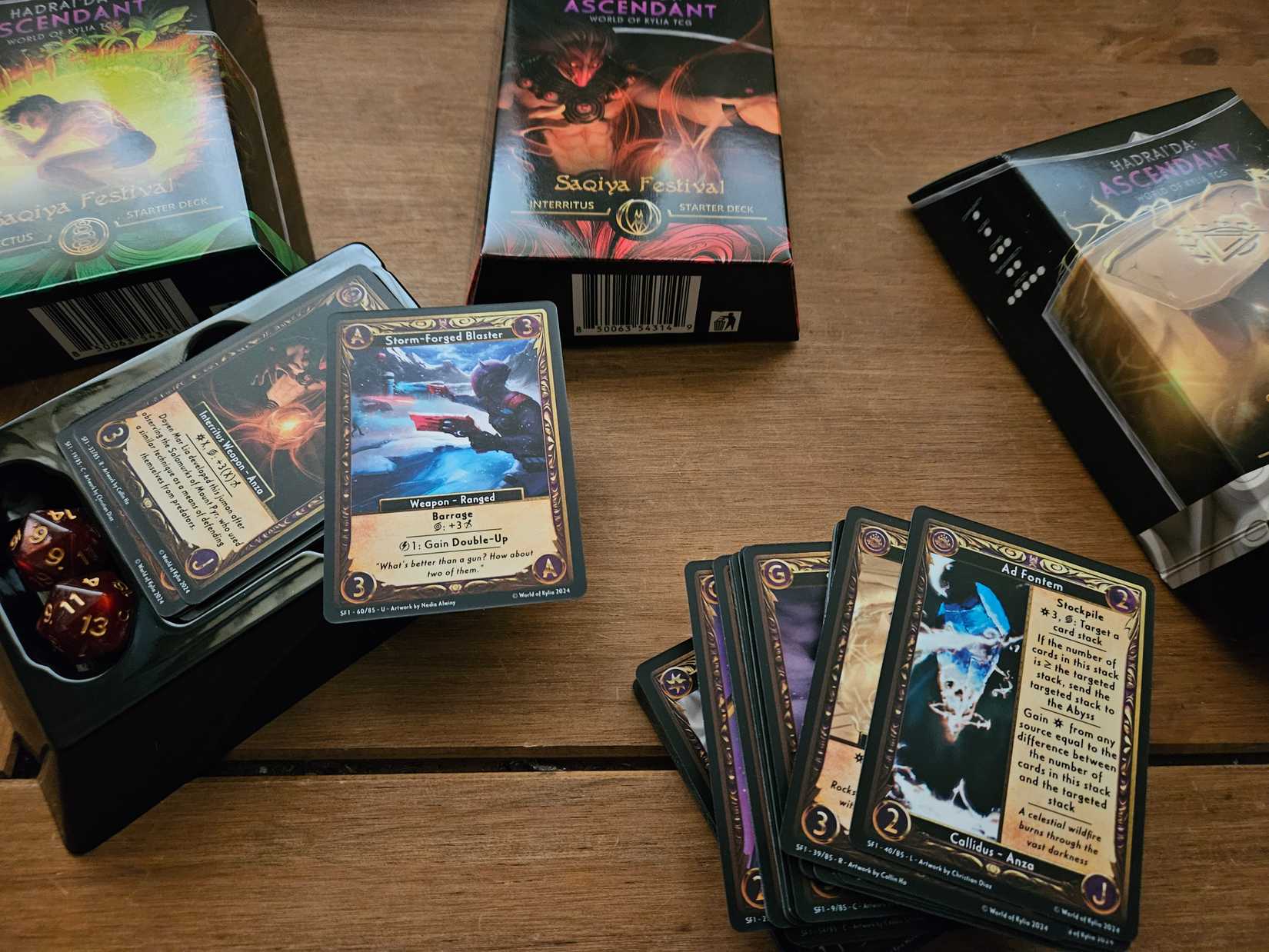
The true tactical depth emerges from the myriad ways participants can actively modify those die rolls. While players do not require a specific creature or card archetype simply to declare an attack, every single card active on the battlefield typically provides passive or activated ways to add or subtract modifiers from the final roll, turning every combat phase into a delicate mathematical puzzle.
The late game is where Ascendant truly blossoms in complexity. Players must carefully weigh their options—tapping one card, sacrificing another, activating critical passive abilities, and finally rolling their die with every possible bonus stacked in their favor before hoping for the best. While a pool of 70 life points can feel like an insurmountable barrier during the early opening turns, endgame creatures and coordinated combos enable players to unleash devastating single-turn offensive surges capable of inflicting 20 or more points of damage in a single exchange.
Like many independent tabletop projects, Ascendant features certain mechanics that can feel slightly under-explained at first glance, such as the nuances governing Speed. New players should expect to spend their initial matches frequently referencing the rulebook. Fortunately, access is streamlined through a handy PDF linked directly via a QR code printed on the back of every boxed set of cards. The property also boasts an extensive lore database, though narrative world-building currently outpaces a formalized standalone story campaign.
Even with its learning curve, the game is remarkably easy to pick up, maintains a brisk pace, and ensures that the random nature of its dice-driven combat leaves plenty of room for newcomers to secure surprising victories. For enthusiasts seeking a fresh alternative in an increasingly crowded TCG market, Ascendant offers a solid, mechanically distinct entry into the hobby.


Leave a Reply