You packed the shoes. They came home clean.
That is the usual shape of travel workouts. The intention gets packed, the session never happens, and a four-night trip quietly becomes the thing that ended a program you had running for two months. Not because a hotel room is a bad place to train. Because at 6:40 a.m. in a city you did not choose, with a client breakfast at eight and a body clock that thinks it is the middle of the night, nobody designs a workout from scratch.
What actually survives a trip is a decision you already made before leaving home. Instead of hoping for the best, expert travel fitness strategies suggest packing just two pre-written sessions: one that takes 20 minutes and one that takes eight. Combined with a single rule for deciding which one to run each morning, this approach ensures the choice is never open for debate in a room with blackout curtains and an early start time.
Why "I’ll Find a Gym There" Keeps Failing
The plan to find a local gym on the road almost always fails on logistics rather than willpower. The typical hotel fitness room turns out to be two adjustable dumbbells, a treadmill with a dead display, and one bench currently occupied by someone else. Meanwhile, a real gym nearby demands a day pass and a 15-minute walk you did not budget for in your schedule. By the time you check both options, your available window has vanished, and your first morning meeting has started without you.
What you reliably have instead is a floor, a wall, a chair, a door, and a suitcase. That list does not change between Cleveland and Frankfurt, which is precisely why it is worth building a session around it. If you want a bit more range, a resistance band weighs nothing and folds neatly into a shoe.
Sleep is the other casualty of travel. A survey of 2,242 business-class travelers in Japan and the United States found worse self-reported jet lag among people with sleep disorders and milder jet lag among those who were more physically active. While that is based on questionnaire data rather than a detailed physiological mechanism, it accurately describes the environment you will be training in: short sleep, a disrupted biological clock, and a schedule written by someone else.
The Trip Is Not Where You Lose It. The Week After Is.
Four nights away costs you very little physically. A short break is not long enough to undo months of hard work, and fearing that it is usually drives two unhelpful responses: cramming an impossibly hard session into an already exhausting week, or writing the entire week off because a partial routine feels pointless. Neither is the real threat. What a trip actually risks is the thread—the simple fact of having a session booked when you land.
In a small trial involving 20 resistance-trained men who trained for four weeks, stopped for two, and then resumed, leg-press strength did not drop across the break. While 20 young men and one lift do not constitute a universal law, it provides a reassuring answer to the anxious questions people ask in airport security lines.
The real danger happens when you return home with nothing booked, a vague sense of being behind, and the idea that you should start over "properly" on Monday. Monday is where the damage is done. The session you skipped on Wednesday in a hotel room cost you almost nothing, but the elaborate restart it forces can cost you a full month.
Therefore, the primary purpose of travel workouts is not to make dramatic progress. It is to land at your home airport still mid-program. That inverts conventional fitness advice, which typically hands travelers a denser, harder session to make up for a missed gym—asking more of you during the week you have the least to give. The better strategy is to shrink the session until the trip cannot defeat it, leaving the full version for when your normal morning routine returns.
Structuring the 20-Minute Session and the 8-Minute Floor
Travelers should pack just two routine options and nothing else. The full session consists of five movements performed across three rounds, taking about 20 minutes. The floor version uses the exact same five movements for just a single round, taking about eight minutes. On a trip, the floor routine becomes the default and the full session is a bonus—the exact reverse of how you would run them at home.
Every movement utilizes a wall, a chair, a door, or your suitcase, meaning nothing depends on what the hotel provides. For the split squat, place your back foot on the floor a long stride behind you, using the desk chair’s fingertips for balance, performing three sets of eight to ten per leg in the full session or one set of eight for the floor. For a hip hinge, use a single-leg deadlift by standing on one leg and reaching toward the floor.
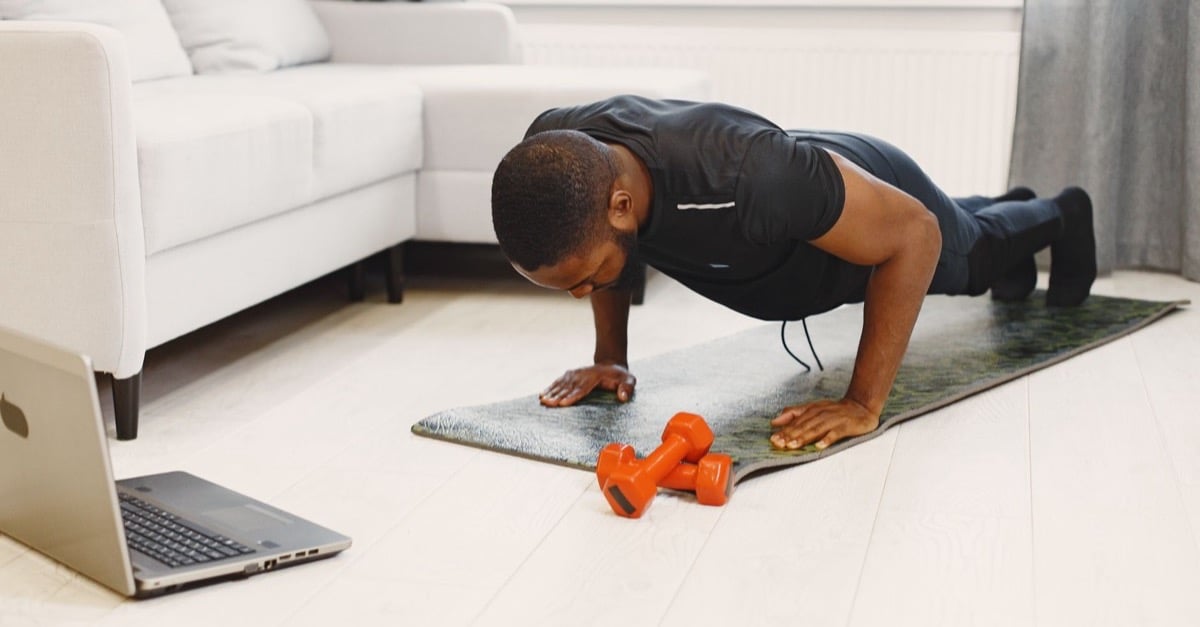
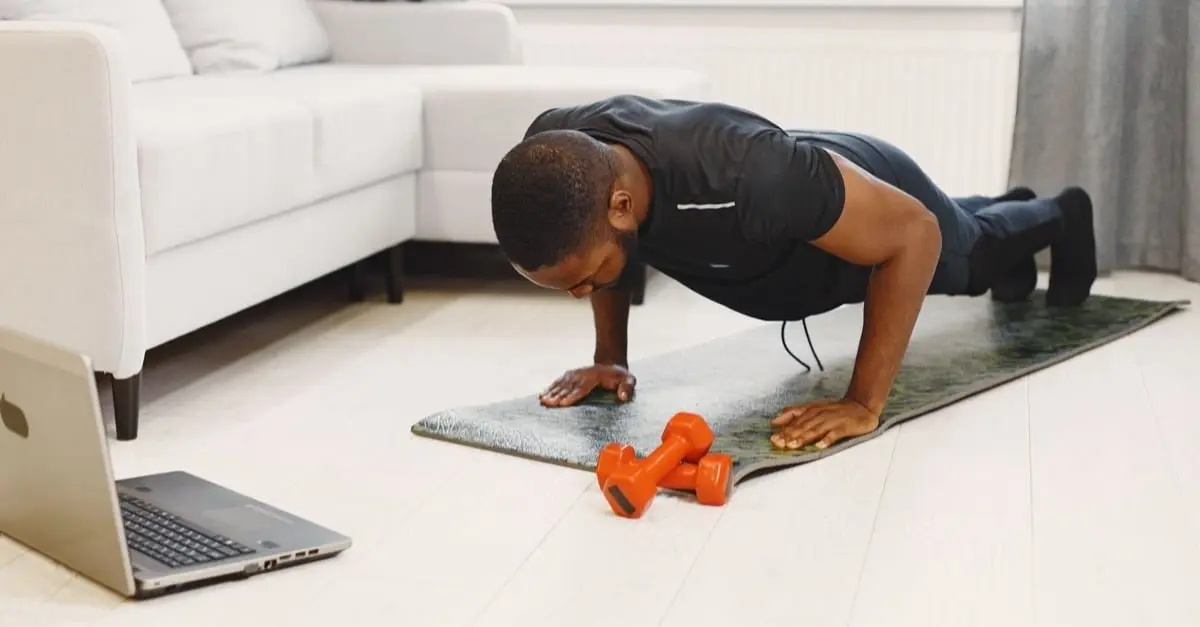
Push-ups can be performed with hands on the desk, chair seat, bed frame, or floor, targeting eight to twelve reps. Rows can be done by looping a towel around a sturdy door handle and leaning back, or by performing a bent-over row while holding your packed suitcase. Finally, a suitcase carry—holding the bag in one hand down the corridor and back before switching sides—completes the circuit.
When utilizing a door for towel rows, safety is paramount. Always pick a door that latches and opens away from you so that pulling on it presses the door firmly into its frame rather than swinging it open. Test it with a light lean before putting your full weight into it. If the room has a sliding door, a loose handle, or a door opening inward, substitute the suitcase row instead.
These five movements mirror the foundation of standard at-home weight training plans. You are not switching programs for a week; you are running a stripped-down version of the one you already own, which is why returning home does not feel like starting from scratch.
Research into maintenance training indicates that younger adults can maintain strength and muscle size for up to 32 weeks on just one session per week and a single set per exercise, provided the relative intensity remains high, while older adults may require two sessions and multiple sets. This highlights that the variable to protect on the road is not how many sets you fit in, but how hard the final set feels. Running the three sets as a circuit—going through all five movements once before repeating—maintains high effort and moves much faster than completing traditional straight sets.
Making Hotel Room Workouts Challenging Without Weights
A bodyweight set works when it is difficult at the very end, not when it takes a long time. In a hotel room, you can manipulate intensity through angles and speed: lower your hands, slow your descent, train one leg at a time, or pause at the bottom of a movement. When a set stops feeling challenging by the last two repetitions, make the movement mechanically harder rather than chasing endless high-rep counts. Counting out 40 casual push-ups is an entirely different physical activity than true training.
Evidence supports that progressive calisthenics constitute legitimate training. In a four-week trial of 23 moderately trained men comparing progressive push-up variations to bench presses, both groups improved their bench press one-rep max and push-up progression, with neither showing significant differences in measured muscle thickness. While this does not prove unloaded movements perfectly match loaded ones, it confirms that increasingly difficult push-ups represent a valid training variable.
If a movement causes discomfort, scale back the difficulty rather than pushing through pain. A smaller range of motion or a folded towel under the knee is always a smarter choice than forcing a compromised set.
A Realistic Four-Night Business Trip
A realistic four-night work trip involves four mornings, with one likely written off entirely by an extremely early airport departure. A successful trip might feature one full session, two floor sessions, and one morning where the 5:40 a.m. car wins out. That represents a successful, intact training week rather than a compromised one. You left with a program and returned with the same program, having trained three times during a week you might have otherwise abandoned.
Managing timing strategically helps hedge against sleep deprivation. A meta-analysis of 69 studies covering 959 participants found that acute sleep loss was associated with a mean drop in physical performance tests, with evening tests consistently performing worse and morning tests remaining largely unaffected. Scheduling hotel workouts for the morning hours thus helps mitigate the physical toll of disrupted travel schedules.
Meanwhile, accumulating high step counts through walking city streets offers cardiovascular and general health benefits, even if it does not replace the specific strength demands of resistance training. Walking the city is valuable, but it serves a different purpose than maintaining your lifting numbers.
Ultimately, travel workouts are not about achieving personal records while away from home. They are about maintaining momentum so that a brief work trip does not inadvertently trigger a month-long absence from your fitness routine. By packing your decisions alongside your clothes and locking in a minimalist routine before you fly, you ensure that your fitness program survives the journey intact.