The recurring cycle of impulse buying often persists long after a consumer resolves to curb their expenditures, largely because broad financial resolutions typically clash with highly specific, frictionless purchasing environments. Observers of modern consumer behavior note that a general decision to spend less must continually combat micro-moments of temptation—such as an app already logged in, a credit card securely saved on file, and a prominent banner warning that a price will expire by midnight. In this dynamic, a general resolution must triumph over convenience every single time it arises, yet it only needs to falter once a week to completely unravel a month of financial discipline.
Individuals caught in this cycle are rarely careless with their money. Many actively monitor their balances, consult popular self-help literature, and implement traditional waiting periods before making purchases. Yet, spending habits frequently resurface within identical contexts: the same retail application, the exact same evening hour, and the familiar contours of a stressful week. Analysts suggest that while a single unplanned purchase might appear to be a momentary lapse in judgment, multiple transactions sharing the same distinct behavioral fingerprints form a reliable pattern—one that can be modified without requiring a fundamental shift in personality.
Examining the mechanics of financial rules reveals a fundamental disconnect between the environment where a resolution is conceived and the environment where a purchase is executed. A budgeting rule formulated at a kitchen table on a Sunday morning must somehow travel to a Thursday night transaction completed at eleven o’clock. Along the way, it encounters checkouts designed for completion in as few as three taps, urgent countdown timers, and the cumulative fatigue of a long day. Most traditional rules fail to make this journey because they lack any tangible presence at the point of sale.
The retail landscape is intentionally engineered to accelerate this process. Saved payment credentials, one-tap checkouts, free return policies, and expiring promotion banners all serve a singular purpose: to shorten the psychological gap between desiring an item and owning it. On platforms equipped with saved-card checkouts, completing a purchase frequently requires fewer taps than pausing to evaluate whether the acquisition is genuinely necessary.

Consequently, much of the conventional advice regarding impulse buying—such as avoiding shopping malls, drafting strict lists, waiting 24 hours, or transitioning exclusively to cash—often proves ineffective because it targets the wrong triggers. While these recommendations are not inherently flawed, they are typically generalized solutions that fail to address the specific vulnerabilities of individual consumers.
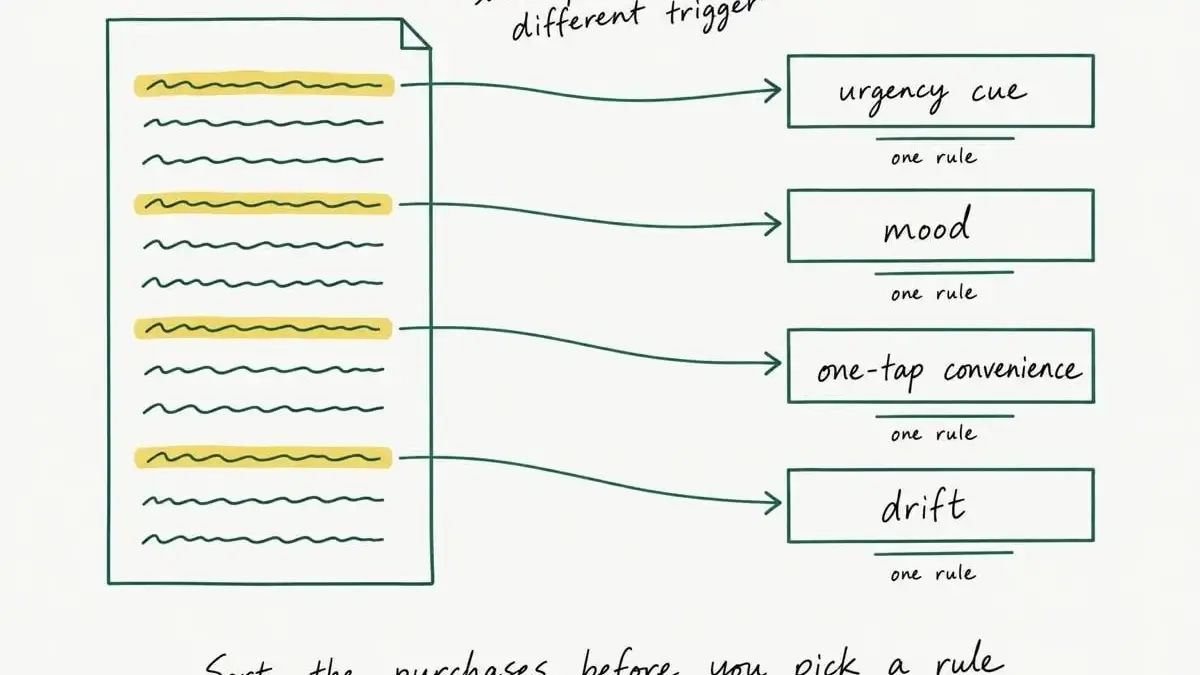
Rather than relying on universal prohibitions, behavioral researchers and consumer advocates suggest analyzing actual spending records to uncover repeating triggers. Reviewing card statements from the past thirty days often reveals whether unplanned purchases cluster around specific situations. Research into financial self-control interventions highlights the value of tracking and diagnostic reflection in understanding spending behavior, even if standard waiting periods and payment methods lack definitive empirical backing as standalone deterrents. Instead, current insights point directly toward two primary catalysts: the urgency cues embedded within modern storefront interfaces and the emotional state of the buyer during the hour of the transaction.
Addressing these behaviors effectively involves identifying specific purchasing patterns and establishing targeted interventions rather than relying on generalized willpower. Financial analysts recommend auditing recent transaction histories to pinpoint precisely where and when unplanned spending occurs, categorizing entries by specific triggers such as urgency cues, emotional states, one-tap convenience, or aimless digital browsing. By replacing broad resolutions with specific, context-aware boundaries—such as removing saved payment methods from frequently visited apps or establishing replacement routines for vulnerable emotional hours—consumers can systematically disrupt the automated loops that drive impulse acquisitions. When these targeted adjustments fail, recognizing the underlying patterns or distinguishing between ordinary financial habits and persistent compulsive behaviors ensures that individuals can seek appropriate guidance when necessary.