
The modern struggle with impulse buying often feels like an uneven match between a fleeting intention and an engineered environment. When individuals resolve to spend less money, they are typically relying on a general decree—a vague commitment to practice financial restraint. Yet, the purchase that dismantles this resolution arrives as a finely calibrated, eleven-second interaction on a couch: the retail application is already logged in, the credit card details are securely saved, and a prominent banner warns that a favorable price will expire by midnight. A general resolution is forced to win that psychological moment every single time, whereas it only has to lose once a week to completely undo the progress of an entire month.
Many consumers who grapple with this cycle are far from careless with their personal finances. They monitor their account balances, read through financial advice columns, and have frequently attempted standard remedies, such as instituting a mandatory waiting period before making a purchase. While such tactics may hold firm for a brief period—often around nine days—the spending invariably returns. Moreover, it tends to reappear in the exact same environments: the same retail application, the same late hour of the evening, and the same stressful kind of week. Behavioral experts note that when a purchase recurs with identical patterns, it ceases to be a mere isolated lapse in judgment. Instead, it forms a recognizable pattern, and patterns can be systematically addressed without requiring a fundamental overhaul of one’s personality.
The friction between personal resolve and retail architecture becomes apparent when examining where spending rules are typically formulated versus where transactions actually occur. Financial resolutions are often drafted under calm conditions, such as sitting at a kitchen table on a Sunday morning. The purchases themselves, however, frequently take place under entirely different circumstances, such as late at night during a demanding week. A spending rule must somehow bridge that gap, traveling through a digital checkout process designed to be completed in as few as three taps, complete with countdown timers and emotional fatigue. Because traditional advice rarely anchors itself directly at the point of sale, most rules fail to survive the journey.
The retail industry’s digital design is intentionally frictionless. Saved credit credentials, one-tap checkouts, free return policies, and expiring promotional banners are all engineered to shorten the psychological distance between the desire for an item and its acquisition. Retailers arrange digital interfaces to ensure that completing a purchase requires fewer taps than taking a moment to evaluate whether the item is truly needed.
Consequently, conventional advice on curbing impulse spending often proves ineffective precisely where it matters most. Recommendations to avoid shopping malls, compile strict shopping lists, wait twenty-four hours, or switch exclusively to cash transactions are not inherently incorrect, but they tend to address generic habits rather than specific behavioral triggers.
To understand why spending habits persist, researchers suggest looking past broad resolutions and examining actual transaction records. A review of a thirty-card statement typically reveals whether unplanned purchases cluster around specific repeating situations. A rule can only function effectively when it directly targets one of these specific scenarios. Furthermore, an examination of standard financial advice reveals a notable lack of empirical backing for certain widely recommended practices. Academic literature exploring mandatory twenty-four or forty-eight-hour waiting periods often lacks rigorous trials measuring subsequent purchase rates or buyer regret. Similarly, research comparing cash versus card spending remains inconclusive regarding precise psychological impacts. While these simple rules are harmless to test, relying on them as primary mechanisms can be misleading.
Instead, scientific literature increasingly points toward two primary drivers behind unplanned purchases: immediate urgency cues embedded within the storefront and the buyer’s emotional state during the hour of the transaction. Identifying these specific triggers allows individuals to implement targeted measures designed to block them, moving away from ineffective blanket restrictions.

Analyzing spending habits through a structured review of past statements offers a diagnostic approach rather than a rigid instruction manual. By examining the last thirty days of transaction history across primary shopping applications, consumers can identify the precise volume and financial total of unplanned acquisitions. Recording details such as the purchase amount, date, time, location, and the emotional context prior to the transaction helps reveal distinct behavioral clusters. For instance, data may show that a significant portion of unplanned spending occurs within a single application late at night, aligning closely with the known effects of decision fatigue. Field experiments published in financial and economic journals indicate that comprehensive self-control interventions—combining tracking, budgeting, and reflective practices—can successfully reduce online borrowing and discretionary entertainment spending, reinforcing the value of monitoring financial behavior as a diagnostic tool.
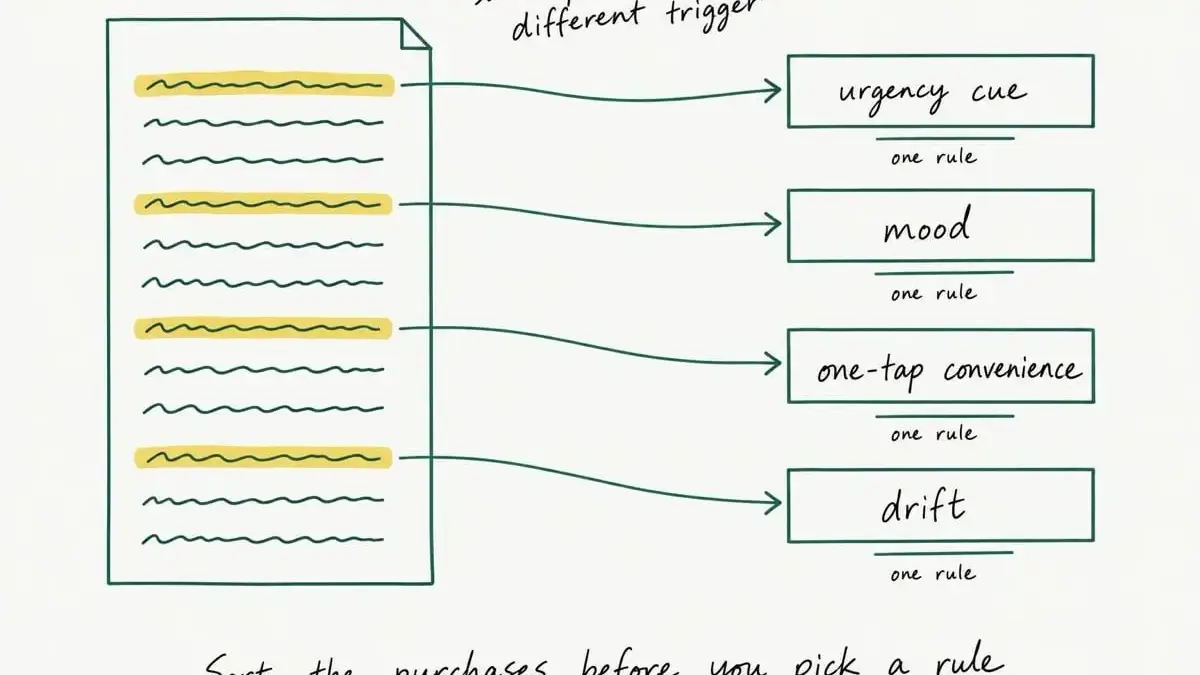
Once purchasing data is gathered, sorting transactions by specific triggers clarifies the underlying mechanisms driving the behavior. Behavioral classifications generally divide these triggers into four categories: urgency cues, such as countdown timers or low-stock alerts; negative moods, particularly specific periods of emotional distress; one-tap convenience enabled by saved payment methods; and drift, which occurs when a consumer enters a store or app without a clear purchasing target.
Research into urgency cues highlights how limited-time and limited-quantity scarcity appeals significantly influence impulse-buying intentions, largely driven by a fear of missing out and modulated by anticipated regret. Similarly, psychological studies focusing on emotional states demonstrate that negative moods, particularly sadness, can systematically alter economic behavior, leading individuals to place higher valuations on items during choice tasks. While stress and boredom are frequently cited by consumers as catalysts for spending, structured tracking allows individuals to recognize their personal emotional patterns without relying on generalized assumptions.
Addressing these behaviors effectively involves replacing broad decrees with specific, contextual rules tailored to the most costly triggers. Rather than attempting to overhaul all spending habits at once, focusing on the primary triggers responsible for the majority of unplanned expenditures yields more sustainable results. For urgency-driven purchases, strategies often involve eliminating exposure to promotional emails and implementing friction, such as recording item details and closing the browser tab rather than buying immediately. For convenience-driven spending, removing saved card information from frequently used applications and logging out of accounts introduces necessary deliberation. For mood-driven purchases, establishing pre-planned replacement activities during vulnerable hours addresses the underlying emotional state directly.
Maintaining specificity in these rules is essential for accountability. Vague commitments like spending less on clothing are difficult to evaluate, whereas explicit boundaries—such as prohibiting clothing purchases without a mandatory waiting period and the removal of saved payment details—provide clear benchmarks. Establishing periodic check-ins allows individuals to assess the effectiveness of their rules. If a specific boundary fails repeatedly, it indicates that the rule may be too restrictive or misaligned with the actual trigger, necessitating an adjustment rather than an escalation of complexity.
While most unplanned spending can be managed through behavioral awareness and environmental adjustments, persistent shopping behaviors that cause significant personal distress or financial strain require professional attention. Clinical literature distinguishes occasional impulse buying from compulsive shopping disorders, which involve excessive preoccupation with purchasing and are often associated with underlying psychological distress. For individuals experiencing severe difficulty in controlling spending habits, seeking guidance from qualified health professionals remains a critical step.
Ultimately, addressing impulse buying begins with examining historical purchasing patterns without immediate pressure to change. Reviewing past statements to identify specific situational clusters allows individuals to understand where their financial resources are being directed, paving the way for practical, evidence-based adjustments that align with their personal financial goals.



Leave a Reply