Impulse buying frequently persists long after a person resolves to change their spending habits, largely because broad financial resolutions must constantly compete with highly specific, engineered purchase opportunities. A general commitment to spend less money faces an uneven battle when confronted with an eleven-second checkout process on a smartphone couch session, complete with a saved credit card, a logged-in application, and a prominent banner warning that a price will expire at midnight. Broad resolutions are forced to win that psychological standoff every single time they arise, whereas they only need to lose once a week to completely unravel an entire month of financial planning.
Consumers who struggle with this cycle are rarely careless with their personal finances. Many regularly monitor their account balances, read financial advice articles, and implement classic cooling-off strategies, such as waiting a full day before finalizing a purchase. While such tactics may hold firm for a brief period—often around nine days—the spending behavior typically returns in the exact same environments. It reappears in the same application, during the identical evening hour, and amidst the same pattern of weekly stress. When multiple purchases share the exact same behavioral fingerprint, it indicates a recurring pattern rather than an isolated lapse in judgment—a pattern that can be addressed without requiring a fundamental change in personality.
The Disconnect Between Spending Rules and Points of Sale
A critical flaw in most personal spending rules lies in the physical and temporal distance between where the rule is established and where the transaction actually occurs. A spending boundary might be defined on a Sunday afternoon at a quiet kitchen table, while the purchase itself happens on a Thursday night at 11:00 PM. To be effective, that rule must successfully travel between those two completely different contexts, surviving a checkout interface designed to be completed in three simple taps, countdown timers, and the accumulated fatigue of a long workday. Most rules never make that journey because they fail to intersect with the immediate point of sale, leaving individual resolve untested until the moment of greatest vulnerability.
The modern retail environment is intentionally engineered to minimize friction. Saved payment credentials, one-tap checkouts, free return policies, and expiring price banners are all designed to shorten the psychological gap between desiring an item and legally owning it. Platforms arrange digital interfaces much like traditional brick-and-mortar stores arrange their shelves, ensuring that completing a transaction requires fewer taps than evaluating whether the item is genuinely necessary.
Consequently, much of the conventional advice aimed at curbing impulse buying falls short precisely where it matters most. Suggestions to avoid shopping malls, construct strict shopping lists, wait 24 hours, or rely solely on cash are not inherently incorrect, but they tend to be generalized formulas that fail to address specific behavioral triggers.
Re-evaluating Traditional Rules and Shopping Audits
Many financial strategies are chosen before individuals fully examine their actual transaction receipts, purchase timings, and emotional states. A review of a standard 30-day card statement often reveals whether unplanned purchases cluster around repeating, predictable situations. Financial researchers and consumer advocates note that standard interventions, such as mandatory 24-hour or 48-hour waiting periods, lack rigorous empirical testing measuring subsequent purchases or buyer regret. Similarly, research comparing cash and card usage remains nuanced and inconclusive, suggesting that while basic rules are inexpensive to try, they should not be viewed as foolproof mechanisms.
Instead, empirical research highlights two primary drivers of unplanned purchases: urgency cues embedded within storefront interfaces and the consumer’s emotional state during the hour of purchase. Rather than relying on generic restrictions, addressing impulse spending requires identifying these specific triggers and implementing targeted rules designed to block them.
Analyzing past financial records provides a diagnostic foundation for this process. Research into consumer finance, including a field experiment published in the Journal of Financial and Quantitative Analysis by Di Bu, Tobin Hanspal, Yin Liao, and Yong Liu, has examined self-control interventions combining spending tracking, budgeting, and reflection. While such studies often involve specific demographic samples and bundled interventions rather than isolated tracking, financial experts frequently view personal spending audits as practical diagnostic tools rather than guaranteed behavioral cures.

Categorizing and Addressing Purchase Triggers
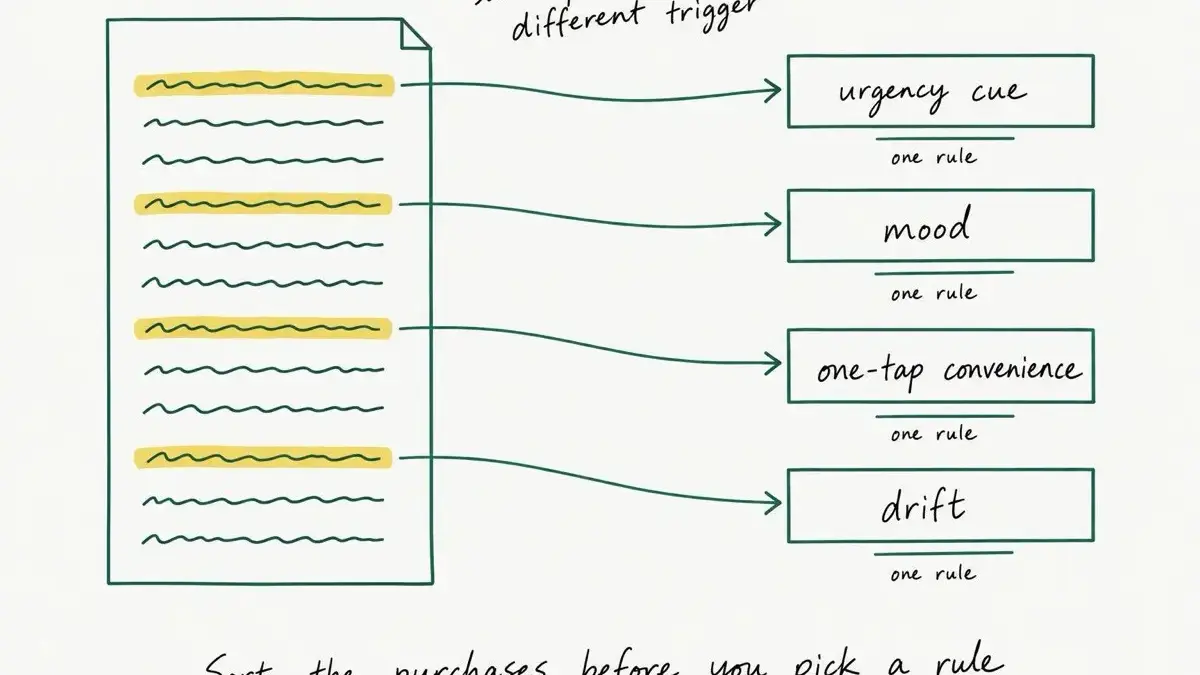
A thorough review of recent transaction history typically reveals purchases falling into distinct trigger categories. Urgency cues encompass limited-time offers, countdown clocks, and low-stock warnings. Research published in Current Psychology indicates that scarcity appeals significantly influence impulse-buying intentions, with the fear of missing out acting as a primary driver, while anticipated regret modulates the overall strength of the response.
Mood represents another significant trigger, though psychological research often highlights specific emotional states rather than general stress or boredom. Studies published in PLOS ONE, including work by Nitika Garg, Lisa Williams, and Jennifer Lerner, demonstrated that sadness can influence economic decision-making, with participants in sad emotional states exhibiting distinct pricing and purchasing behaviors compared to those in neutral moods. While other emotional states like stress and boredom are frequently blamed for spontaneous shopping, individuals who notice consistent personal patterns can address them directly, even if broader academic literature focuses primarily on specific emotional subsets.
Additional categories include one-tap convenience, where saved payment information and persistent application logins eliminate purchase friction, and drift, which occurs when a consumer enters a store or opens an app with no specific objective and encounters items to buy.
Effectively countering these patterns involves establishing precise, actionable rules situated directly at the point of the trigger. For urgency cues, interventions may involve closing browser tabs immediately upon encountering a countdown banner or recording the item in a delayed notes file rather than purchasing instantly. For one-tap convenience, removing saved payment credentials from specific applications and logging out after use introduces necessary friction. For mood-driven shopping, identifying alternative coping mechanisms during vulnerable hours can replace the impulse to browse. For drift, establishing a firm policy against opening shopping platforms without a pre-written target item helps prevent unplanned acquisition.
Monitoring Progress and Recognizing Compulsive Patterns
Evaluating the effectiveness of these adjustments typically involves reviewing spending records after a designated trial period to compare unplanned purchase frequencies and total expenditures. If a specific rule fails repeatedly, financial advisors generally recommend swapping it for a simpler alternative rather than stacking multiple complicated restrictions that become difficult to maintain.
However, standard financial guidelines and spending audits do not address every situation. For some individuals, spontaneous shopping is not an occasional inconvenience but a persistent, distressing pattern. Academic literature in journals such as World Psychiatry and Frontiers in Psychiatry discusses compulsive buying as a condition characterized by excessive shopping thoughts and behaviors tied to significant personal distress, functional impairment, or unmanageable debt. Prevalence estimates in adult populations vary depending on diagnostic thresholds and measurement tools used across international studies.
When shopping behavior feels difficult to control and leads to emotional distress, concealed purchases, or severe financial strain, mental health professionals emphasize that clinical support is often more appropriate than applying further budgeting rules. For most consumers, however, beginning with a straightforward review of the previous month’s statement offers a practical way to identify repeating purchasing habits and regain control over everyday financial decisions.