
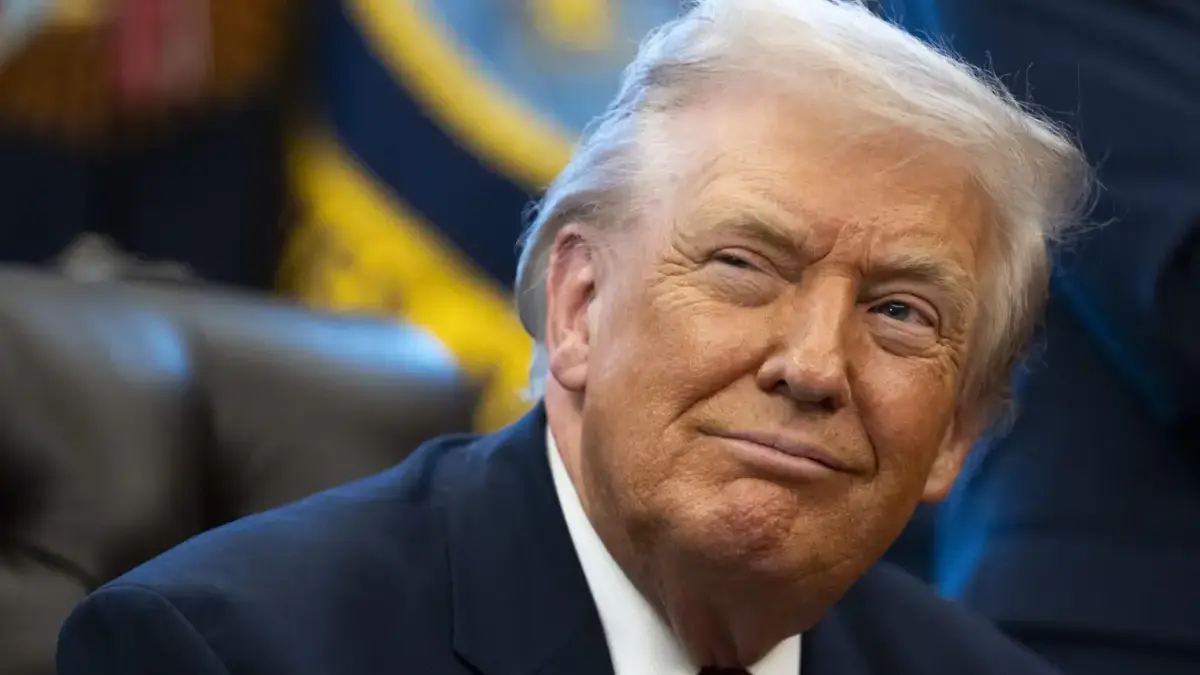
The executive branch of the United States government is officially striking the phrase “artificial intelligence” from its vocabulary, opting instead to rebrand the rapidly evolving technology under a singular, government-mandated moniker: “Super Intelligence.”
The sweeping semantic shift was codified into federal policy following a new executive order signed by President Donald Trump. Moving forward, all official policy websites, white papers, executive documents, and press releases issued by federal agencies will exclusively utilize the term “Super Intelligence,” entirely replacing the previously established statutory definitions of artificial intelligence across the executive branch.
President Trump formally unveiled the rebranding effort during an event earlier on Tuesday, which also marked the launch of the administration’s new portal, America.gov. Addressing attendees and the press, Trump championed the simplicity and strength of the new terminology, arguing that it better reflects the true nature and capability of the technology.
“The word super is the best word of all, and it’s the simplest,” Trump said during the launch event. He added that Chinese President Xi Jinping, who visited the White House the previous week for diplomatic talks, “loves it” as well.
Expounding on the reasoning behind the linguistic pivot, the president voiced a distinct aversion to the word “artificial,” comparing its connotations to media he disagrees with. “We don’t want to hear artificial. Because it’s not artificial. It’s very powerful, it’s very brilliant. It’s mostly going to be put to good use and we’ll stop the bad use,” Trump stated, before adding that the word artificial “is like the news—fake news.”
The administration’s sudden linguistic departure first surfaced during a speech Trump delivered to the United Nations General Assembly the previous week. According to administration officials, the strategic rebrand is also intended to help quell broader public anxieties concerning the rapid advancement of advanced computational systems and the potential safety risks they might pose to society.
While the executive order does not impose a retroactive requirement for executive agencies to comb through and amend historical regulations, past documents, or legacy archives, the mandate still represents a profound, albeit unconventional, administrative shift. Superintelligence has long been utilized by computer scientists, economists, and technology analysts as an industry term to describe hypothetical, highly advanced versions of artificial intelligence that surpass human cognitive capabilities. However, the Trump administration’s directive goes a step further by actively attempting to substitute the term for the broader statutory definitions codified in federal law, such as those outlined in Title 15 of the United States Code. As a result, federal officials operating within relevant administrative settings are now expected to completely avoid acknowledging or utilizing the phrases “artificial intelligence” or “AI.”
The signing of the executive order followed a high-profile luncheon hosted by President Trump at the White House. The gathering brought together key technology sector chief executive officers and prominent government officials to discuss the future of the technology—which the administration is now formally designating under its new title.
Following the conclusion of the closed-door meeting, Trump delivered brief public remarks on the White House grounds. Flanked by prominent technology leaders, including Nvidia CEO Jensen Huang and Tesla and SpaceX CEO Elon Musk, alongside a gathering of other industry executives and government officials, the president characterized the luncheon as remarkably productive and cooperative.
Addressing reporters regarding the regulatory framework surrounding the technology, Trump emphasized a preference for minimal government intervention, suggesting that the industry should lean heavily on internal oversight. “There’s a belief that there should be tremendous self-regulation,” Trump remarked. He further noted that existing legal structures already provide a safeguard, stating, “And we automatically have regulation with the Department of Justice, the FBI, all of that.”
The conversation during the summit also touched upon the physical infrastructure required to sustain the massive computational workloads demanded by advanced technological systems. In recent years, major technology companies have frequently encountered significant regulatory roadblocks, zoning disputes, and community pushback at the local level while attempting to construct the massive data centers necessary to power their growing service networks.
Addressing these localized hurdles, Trump indicated that major technology firms would proactively engage with local populations to secure community buy-in. According to the president, these companies will “work to make the community happy” by furnishing necessary local resources and economic support wherever required. Looking toward the future of local infrastructure development, Trump expressed confidence that public perception surrounding the massive facilities is bound to shift positively, asserting that ultimately, “data centers are going to be very popular.”


Leave a Reply