A federal district court has officially dealt another heavy blow to Virtual Systems, the Ukrainian hosting provider facing a massive legal penalty for its role in facilitating digital piracy. U.S. District Judge Barbara Jacobs Rothstein has denied a motion from the hosting company and its owner to set aside a staggering $41.85 million default judgment secured by pay-TV giant DISH Network last November.
The ruling marks the latest chapter in a high-stakes legal battle that began in 2024, when DISH Network filed a copyright infringement complaint against Virtual Systems—widely known in the digital infrastructure space as VSYS Host. In its initial lawsuit, the television provider alleged that the hosting provider actively ignored more than 500 official Digital Millennium Copyright Act (DMCA) takedown notices. According to the complaint, multiple unauthorized IPTV services were freely streaming proprietary DISH programming directly from infrastructure maintained by the Ukrainian company.
During the initial phases of the litigation, the defendants chose not to appear or formally respond to the allegations before the court entered the default judgment. However, the posture of the hosting provider shifted once DISH’s legal counsel reached out to confirm whether the company would immediately comply with the terms of the permanent injunction.
Within a week, Ukrainian attorney Taras Dementiev responded on behalf of his clients, informing DISH that the hosting firm was actively preparing to challenge the validity of the judgment through legal avenues, including a motion for relief from judgment. Dementiev stated at the time that because the validity of the ruling was being formally contested, his clients could not and would not confirm immediate compliance.

Cox to the Rescue?
Following the entry of the multi-million-dollar judgment, Virtual Systems initially attempted an appeal at the Ninth Circuit Court of Appeals at the end of December. That effort proved short-lived, as the appeals court swiftly dismissed the challenge in January after ruling that the filing was untimely.
Refusing to back down, the defendants subsequently retained Seattle-based law firm Williams Kastner and pivoted their legal strategy back to the district court. In April, they filed a formal motion for relief from the judgment, presenting it as their primary remaining option following a final ruling.
A central pillar of the defendants’ motion relied heavily on a fresh and consequential legal precedent. On March 25, the U.S. Supreme Court completely wiped out a landmark $1 billion copyright infringement judgment that major record labels had previously secured against internet service provider Cox. In that landmark ruling, the Supreme Court significantly narrowed the legal boundaries of contributory copyright liability, establishing that a provider can only be held liable if it actively induces infringement or offers a service specifically tailored to bring about infringement. Virtual Systems argued that this high court decision fundamentally undermined the district court’s earlier findings regarding its own liability.
DISH, meanwhile, maintained continuous surveillance of the hosting provider’s network activities. In an April letter addressed to the defendants’ newly appointed legal representation, DISH documented at least 176 instances spanning approximately three months where the host’s servers were allegedly utilized to broadcast DISH programming in direct violation of the active injunction. DISH noted that many of these streaming sources were the exact same pirate operations originally highlighted in the foundational complaint.

Seattle Servers and Shifting Infrastructure
The legal arguments also centered heavily on geographical infrastructure and data center operations. Virtual Systems contended that DISH had misled the court regarding its servers located in Seattle, Washington, which the host claimed were the sole U.S.-based servers it had ever utilized. According to technical analysis provided by an engineer who reviewed network routing data, none of the specific infringing materials outlined in the complaint were ever actually stored within those Seattle facilities.
DISH vigorously disputed this assertion. A manager at NagraStar, an enterprise responsible for monitoring piracy networks on behalf of DISH, submitted a declaration stating that at least ten distinct IP addresses cited in the complaint initially geolocated directly to the United States. Intriguingly, these same IP addresses began geolocating to Ukraine shortly after the lawsuit was formally initiated.
According to DISH’s filings, this geographical relocation coincided precisely with the timeline of modifications made to the Whois information for the associated IP range on September 4, roughly a week after DISH formally petitioned the court for a default judgment. Furthermore, the NagraStar manager pointed out that at least one of the disputed IP addresses was structurally tied to the exact network number that the host’s own engineer had previously associated with its Seattle infrastructure. Consequently, DISH argued that the defendants deliberately manipulated network and location data after being served with the lawsuit.
Virtual Systems maintained that it no longer maintains any physical servers in Seattle whatsoever. In their April correspondence, defense counsel informed DISH that the court’s injunction had triggered an immediate eviction from the Sabey data center, terminating their housing contracts. Curiously, despite these assertions, the official VSYS homepage continued to list Seattle as an active data center location well after the claims were made.
Court Rejects Motion for Relief
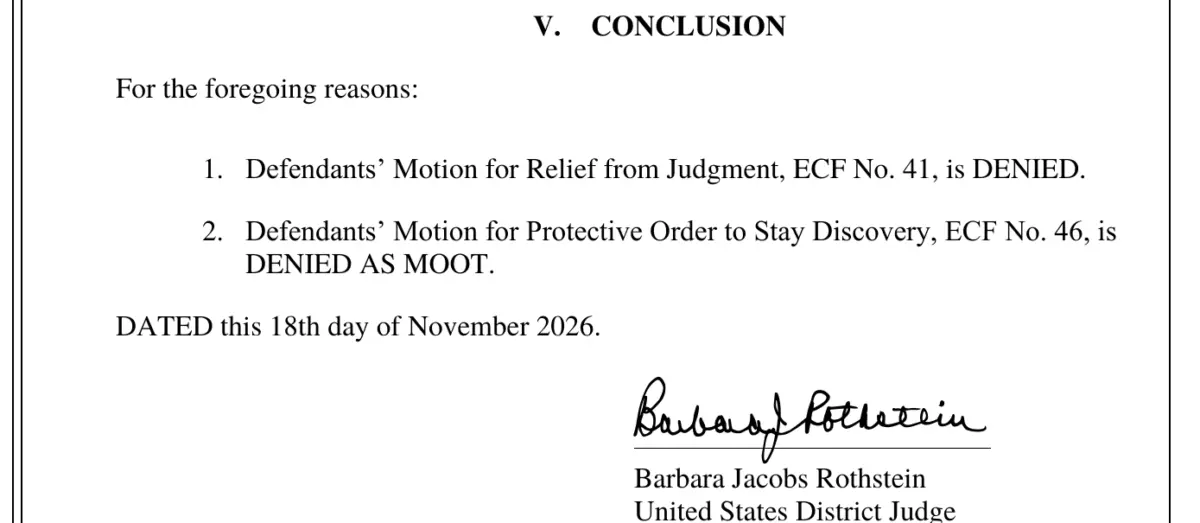
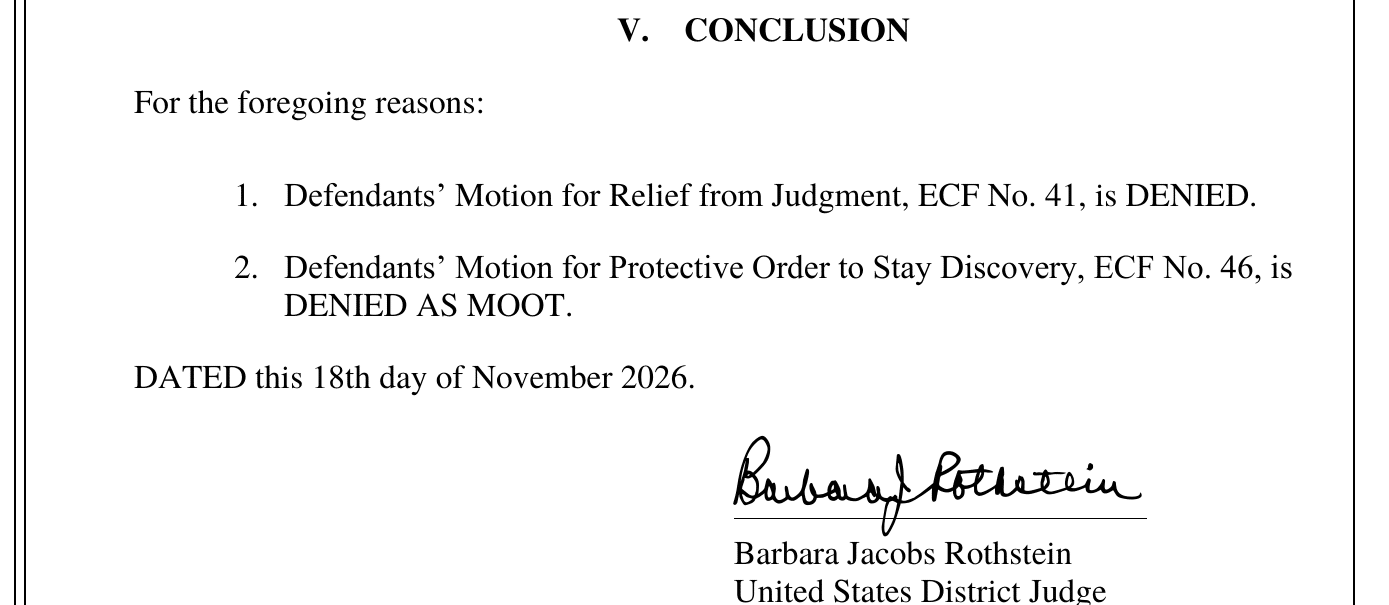
After thoroughly reviewing the extensive arguments and documentation submitted by both opposing parties, Judge Barbara Jacobs Rothstein officially denied the motion for relief from judgment. In her ruling, the judge emphasized that the defendants had waited more than five months after the entry of the initial judgment before filing their motion, while offering no substantive explanation for the considerable delay.
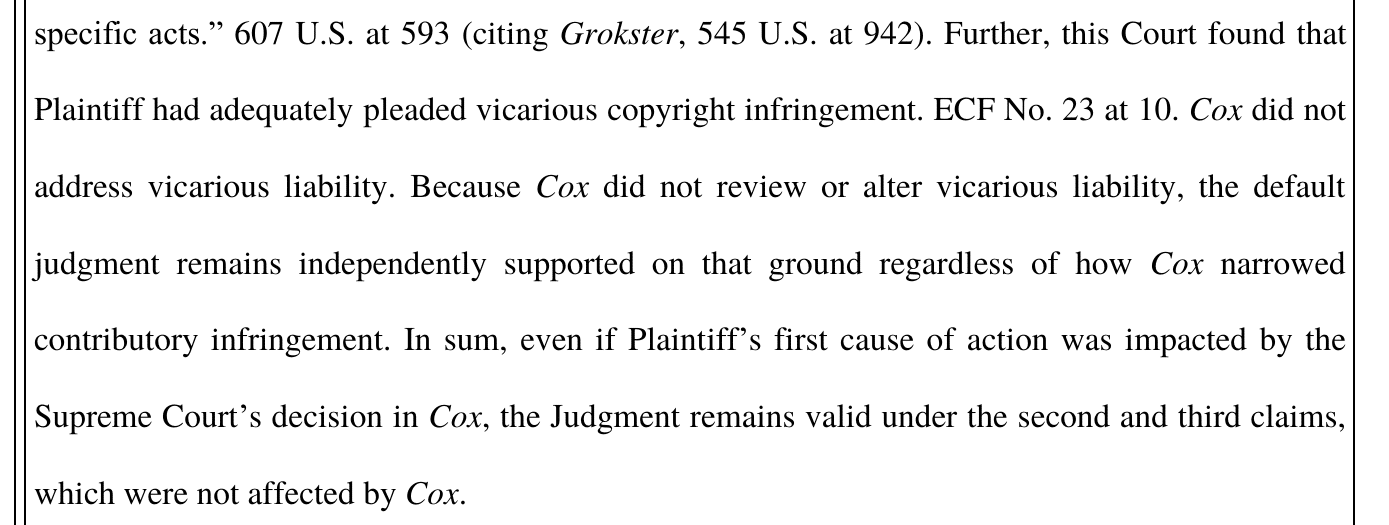
The defendants’ heavy reliance on the Supreme Court’s Cox ruling also failed to sway the court. Judge Rothstein explained that a subsequent shift in case law does not normally serve as an adequate legal basis to reopen a finalized judgment. Moreover, the judge noted that the Cox ruling would not alter the final outcome in this specific matter because the Supreme Court’s decision did not address vicarious copyright liability. Because Cox did not review or modify the legal standards surrounding vicarious liability, the default judgment remained independently supported on those independent grounds, regardless of how narrowly contributory infringement was defined by the high court.
The arguments regarding the Seattle data center servers met a similar fate. The court observed that the hosting company had ample opportunity to challenge DISH’s initial allegations by appearing in a timely manner rather than defaulting. Consequently, the motion for relief from judgment was denied in its entirety, rendering the defendants’ simultaneous request to pause DISH’s post-judgment discovery completely moot.
Contrasting Conduct and Offshore Claims
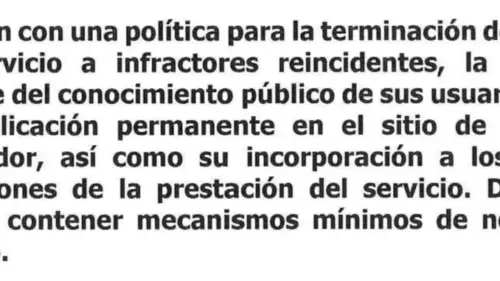
In its comprehensive responses, DISH pointedly contrasted the conduct of Virtual Systems with the facts of the Cox case. DISH highlighted that while the Cox litigation involved internal corporate communications featuring flippant dismissals of the DMCA alongside a track record of terminating only 32 subscribers, the behavior exhibited by Virtual Systems was significantly more egregious. DISH asserted that the Ukrainian host openly and publicly advertised a "DMCA-Ignored" policy specifically designed to attract illicit streaming services, while ultimately failing to take enforcement action against a single copyright infringement notice.
While Virtual Systems partially acknowledged its historical marketing language, the company maintained that U.S. takedown procedures do not automatically apply to infrastructure located abroad. Its legal responses noted that while certain marketing materials historically utilized the phrase "DMCA-Ignored" in connection with servers physically located in Ukraine, the company formally denied maintaining an overarching policy of ignoring copyright law.
Beyond the courtroom battles in the United States, Virtual Systems has faced profound operational disruptions abroad. The company reported that both of its primary data centers located in Kyiv were directly impacted by Russian missile strikes, temporarily halting operations. Although the hosting provider managed to restore most virtual servers from a newly established facility within Ukraine in a matter of days and subsequently expanded operations by opening a new location in Warsaw, Poland, questions regarding its operational philosophy remain.
At the time of review, the company’s offshore hosting promotional materials continued to pitch Ukraine as a favorable destination for IPTV providers, explicitly stating on its website that local data-related regulations in Ukraine are far more tolerant to copyright breaches and other legal disputes.
A complete copy of Judge Rothstein’s order denying the motion for relief from judgment, alongside DISH’s supporting declarations and the defendants’ formal answers, remains accessible through public court documentation archives.