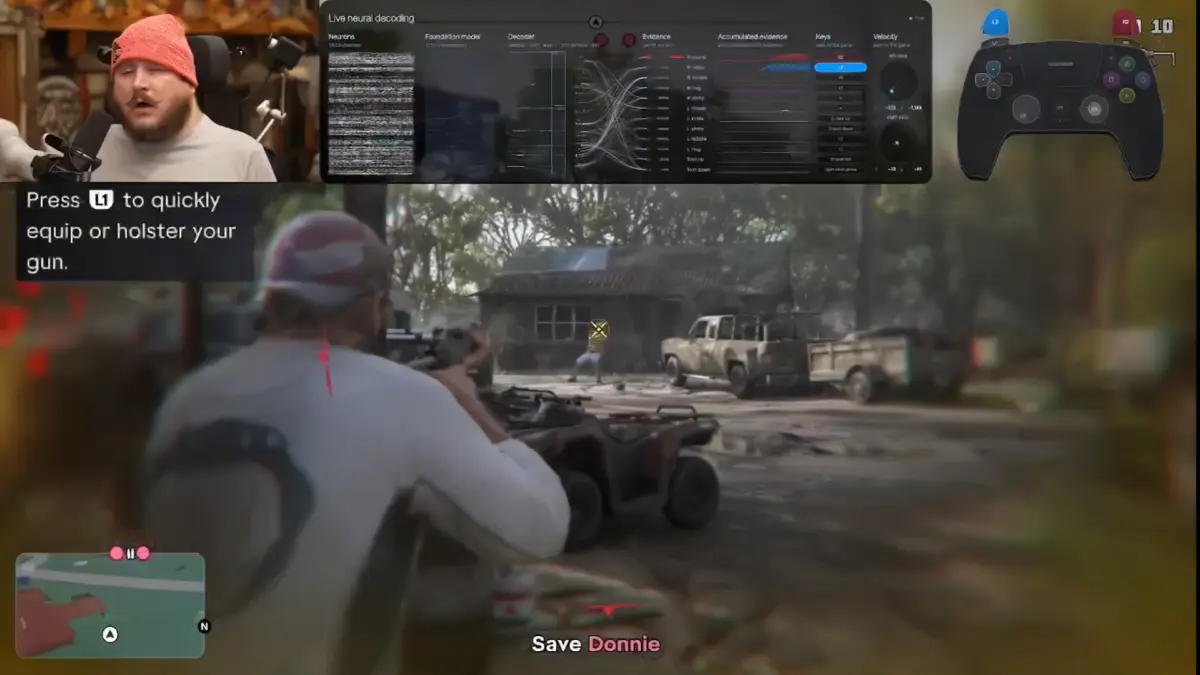
Less than three years after Elon Musk’s neurotechnology company, Neuralink, officially commenced its human clinical trials, patients participating in the research continue to showcase remarkable technological milestones. In the latest development highlighting the capabilities of brain-computer interfaces, a recent video shared on social media reveals an unnamed medical trial participant successfully playing video games using only their thoughts. Specifically, the footage demonstrates the patient interacting with complex gaming software, offering a fascinating glimpse into how modern neural implants are expanding beyond basic cursor control into sophisticated, multi-input digital environments.
The demonstration centers around the translation of human neural signals into functional inputs for traditional gaming hardware. According to details shared alongside the video, the engineering and research team behind the Neuralink implant developed a sophisticated mapping system that links different imagined physical movements directly to inputs on a standard PlayStation 5 controller. By harnessing this translation layer, the patient is able to simulate traditional physical controller actions entirely through thought processes, bypassing physical paralysis to interact seamlessly with the virtual world.
The methodology behind the integration relies on decoding specific mental commands and assigning them to precise controller functions. In the demonstration, the researchers mapped various imagined gestures to standard button presses and analog movements. For instance, when the patient simply imagines the action of tapping their ring finger, the system successfully registers the neural impulse and activates the square button on the controller. Similarly, by visualizing the act of sliding their right hand forward, the patient can manipulate in-game mechanics, such as pulling the nose of an airplane upward during flight sequences. The demonstration also briefly noted that an additional control input had been successfully bound to the patient’s foot, though specific details regarding the exact action or button assignment for this input remain less defined in the current footage.
This latest gaming milestone builds upon a growing foundation of impressive achievements by Neuralink participants since the company began implanting its devices into human subjects. Earlier demonstrations of the technology have highlighted patients utilizing the brain-computer interface for a variety of advanced tasks, ranging from computer cursor navigation and digital communication to creative pursuits like editing video content. In some instances, patients have even paired the neural interface with artificial intelligence systems to restore a sense of personal voice narration, illustrating the rapidly broadening scope of what these brain-implant technologies can achieve for individuals with severe mobility impairments.
The journey of Neuralink from conceptual neurotechnology to human clinical trials has progressed rapidly over a relatively short window of time. The company’s primary focus has been the development of ultra-high bandwidth brain-machine interfaces designed to help people with paralysis regain their independence through the direct translation of neural activity. As these clinical trials advance and researchers refine the software algorithms responsible for decoding complex brain signals, demonstrations involving consumer electronics—such as standard gaming controllers and entertainment systems—underscore the potential for merging advanced neural technology with everyday digital accessibility. While the trials remain ongoing and researchers continue to gather critical clinical data, each new milestone offers a compelling window into the future of human-computer interaction for individuals living with neurological conditions and severe physical limitations.