
The geopolitical vulnerabilities tied to relying on foreign commercial software became glaringly apparent to European nations when the United States government imposed sanctions on the International Criminal Court in early 2025. The immediate and far-reaching consequences of those restrictions demonstrated how quickly access to critical technological infrastructure can be cut off by decisions made abroad.
The punitive measures swiftly severed the ICC chief prosecutor’s access to vital Microsoft services, including institutional email accounts. Shortly afterward, personal and institutional bank accounts linked to the prosecutor were frozen within affected jurisdictions. While these enforcement actions targeted a specific international official, they sent shockwaves through European capitals. In the Netherlands, government officials watched the unfolding events with mounting concern, arriving at the sobering realization that the nation’s access to essential administrative and communication services was fundamentally dependent on political decisions and corporate compliance mandates originating in the United States.
This stark vulnerability catalyzed a strategic response from Dutch authorities, culminating in the creation of DAWO. The acronym stands for Digitaal Autonome Werkomgeving Overheid, or Digital Autonomous Work Environment for Government in English. DAWO is designed as a comprehensive framework intended to overhaul and secure the public sector’s entire digital technology stack. The ambitious initiative covers everything from the operating system and office productivity suites to collaboration software, cloud infrastructure, IT management utilities, and artificial intelligence tools. At its core, the entire framework is built upon a NixOS foundation, marking a significant pivot toward sovereign open-source infrastructure.
How it came to be
The path from a reactionary concept to an official government strategy solidified in July, when the Interdepartmental Commission for Government Business Operations issued a formal directive. This mandate called for the rapid development and implementation of a standardized, digitally sovereign work environment that could protect Dutch administrative operations from external political interference.
To execute this massive undertaking, the government enlisted its three primary central IT service providers: SSC-ICT, DICTU, and DUO-ICT. These entities are responsible for managing the technological backbone of various government branches and will play a crucial role in rolling out the new framework across public institutions.
Active development of the project has been placed in the hands of a specialized team associated with the Ministry of the Interior and Kingdom Relations. Key contributors steering the initiative include notable figures such as Victor Gevers, Rutger Putter, and Bram Buijs. Their work represents a concerted effort to build a resilient, homegrown technological alternative that can withstand geopolitical pressures.
Why go with NixOS?
Selecting the right foundational operating system was a critical decision for the development team, who evaluated several alternatives before settling on NixOS. Initially, the project leads considered mainstream enterprise distributions like openSUSE and Fedora. However, both options were ultimately disqualified due to their deep commercial ties. openSUSE maintains close organizational links to SUSE, while Fedora is owned by Red Hat, a subsidiary of the United States-based technology giant IBM. For a project explicitly designed to achieve digital autonomy from foreign corporate and political influence, relying on US-tied commercial distributions presented an unacceptable risk.
Instead, the team chose NixOS, largely because it is rooted in a decentralized project model with no single corporate entity owning or controlling its development. Furthermore, Nix, the specialized package manager that underpins NixOS, handles system configuration through a dedicated functional programming language. Within this architecture, every software package is installed into an isolated directory with immutable, signed contents.

This functional design ensures that a working system configuration can be precisely reproduced across thousands of different machines. For a public sector rollout that must eventually span dozens of independent government agencies, this high level of reproducibility eliminates vast amounts of repetitive configuration work, saving both valuable time and public funds. Rutger Putter, one of the key developers involved in the project, estimates that roughly 80 to 90 percent of a system configuration seamlessly carries over between different deployments.
Another practical advantage of the NixOS foundation is its hardware compatibility. NixOS is capable of running efficiently on older hardware specifications that modern proprietary operating systems, such as Windows 11, cannot support. Because of this efficiency, current pilot programs are being tested on decommissioned government laptops that would otherwise have been retired and sent out of service, thereby reducing electronic waste and capital expenditure.
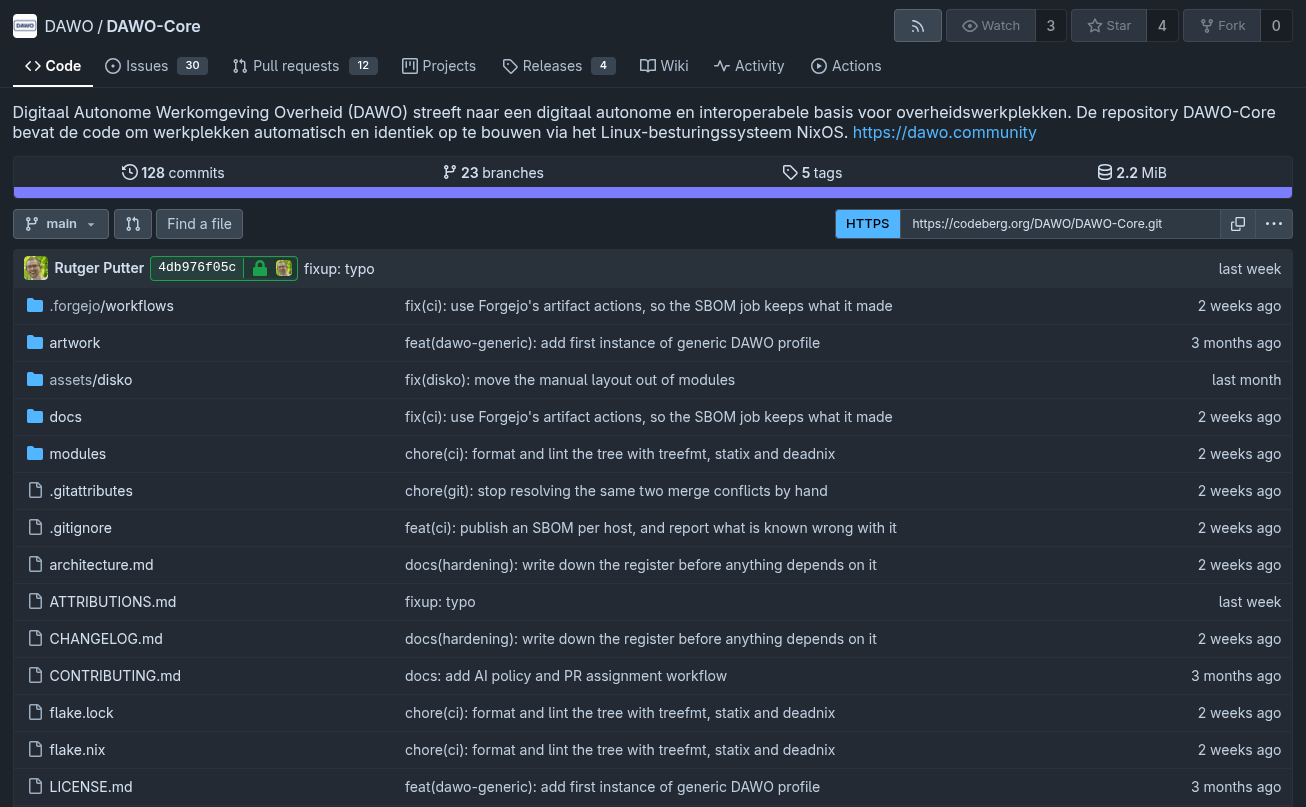
In alignment with its broader philosophy of digital sovereignty, the DAWO initiative has also moved away from mainstream proprietary code hosting platforms. Following a strategy similar to the Netherlands’ earlier migration to Forgejo, all of DAWO’s official source code is hosted on a secure government-managed Forgejo instance. Additionally, a separate Codeberg instance has been established to serve as the primary entry point for external contributors and community developers.
Things are looking up
The DAWO initiative has already moved past the theoretical planning stage and is currently undergoing practical evaluation in the real world. Eight local municipalities are running active trial programs through the Association of Dutch Municipalities to test the framework in everyday administrative scenarios.
The urgency behind these trials stems directly from the ICC incident, which set this open-source push apart from previous government-level IT transitions. By experiencing firsthand the sudden and disruptive consequences of vendor dependency, Dutch officials gained a pragmatic appreciation for the importance of sovereign infrastructure.
The Netherlands is far from alone in pursuing this strategic shift away from proprietary American software ecosystems. Across Europe, governments are increasingly viewing digital sovereignty as a matter of national security. In Germany, the state of Schleswig-Holstein initiated a similar transition away from Microsoft products, redirecting a portion of its former licensing expenditures toward supporting and funding open-source software projects.
Similar modernization and sovereignty initiatives are underway in other European nations as well. Denmark has moved to strip proprietary Microsoft services from its national road traffic authority, while France is pushing a comprehensive transition to Linux across multiple government ministries. Notably, an estimated 80,000 health insurance employees in France have already been successfully migrated to domestic, open-source administrative tools.
As the development teams continue to refine the system based on operational feedback from participating municipalities and administrative bodies, the DAWO initiative remains on track to release its first stable version next year.
Leave a Reply