Your alarm goes off at 6:10. You are upright by 6:12, standing in the kitchen by 6:15, and you still could not recite your own phone number if your life depended on it. You stare blankly at the open refrigerator without making a single decision. You read the same text message three times in a row. Around 6:40, the mental fog finally thins, and you start to feel like a functioning human being—which is precisely the moment you need to walk out the door.
For the rest of the day, you carry the lingering assumption that you must have a chronic sleep disorder.
Perhaps you do. However, the disorienting phenomenon occurring every single morning between 6:10 and 6:40 has an official clinical name, an extensive body of research literature behind it, and a remediation list that bears no resemblance to the standard wellness advice you have been handed for years. Most of those supposed morning fixes are not clever tricks to be performed at 6:12. Instead, they are decisions that must be made the night before, or locked in when you first select your alarm time.
Sleep Inertia Is a Measured State, Not a Character Flaw
In scientific terms, this transition period immediately following wakefulness is known as sleep inertia. During this window, a person’s baseline alertness and both mental and physical performance are significantly degraded, as documented by researchers Hilditch and McHill in their 2019 studies. In clinical literature, it manifests as grogginess, spatial disorientation, and a profound difficulty in becoming fully awake, a state detailed by Dr. Lynn Trotti in 2017.
Crucially, sleep inertia is temporary, entirely ordinary, and happens even to individuals who consistently achieve high-quality sleep. No human being is cognitively sharp the exact second their eyelids snap open.
Yet, millions of people cycle through standard, reactive fixes in frustration. They place their alarm clock across the room. They splash freezing water onto their faces. They leave their smartphones out in the hallway. They pour a larger cup of coffee or attempt an earlier bedtime, only to abandon the habit after three days because nothing changes. Some of these strategies are reasonable in isolation, but none of them alter the heavy texture of those initial twenty minutes. The reason for this failure is not poor execution; rather, it is because almost every intervention with genuine scientific backing must take place before you open your eyes.
The Honest Answer to Eliminating Morning Fog Is Disappointing First, Useful Second
When individuals search for ways to eradicate morning grogginess, they typically look for immediate post-wake remedies, yet those tactics possess remarkably thin and mixed empirical support. The factors that consistently influence the severity of sleep inertia are determined much earlier: the actual volume of sleep obtained and the alignment of the alarm with the body’s internal clock. The proper question is not how to clear the mental fog at 6:12, but rather why the fog is so dense in the first place.
Clinical literature points to three primary drivers of sleep inertia severity. The first is sleep debt. Individuals consistently perform worse after partial sleep deprivation than they do following a full, uninterrupted eight-hour sleep opportunity. Furthermore, an excessively long stretch of wakefulness prior to bedtime can complicate the subsequent wake-up process. Of the three major factors, sleep debt is typically the one over which individuals have the most control, yet none of that control is exercised during the morning hours.
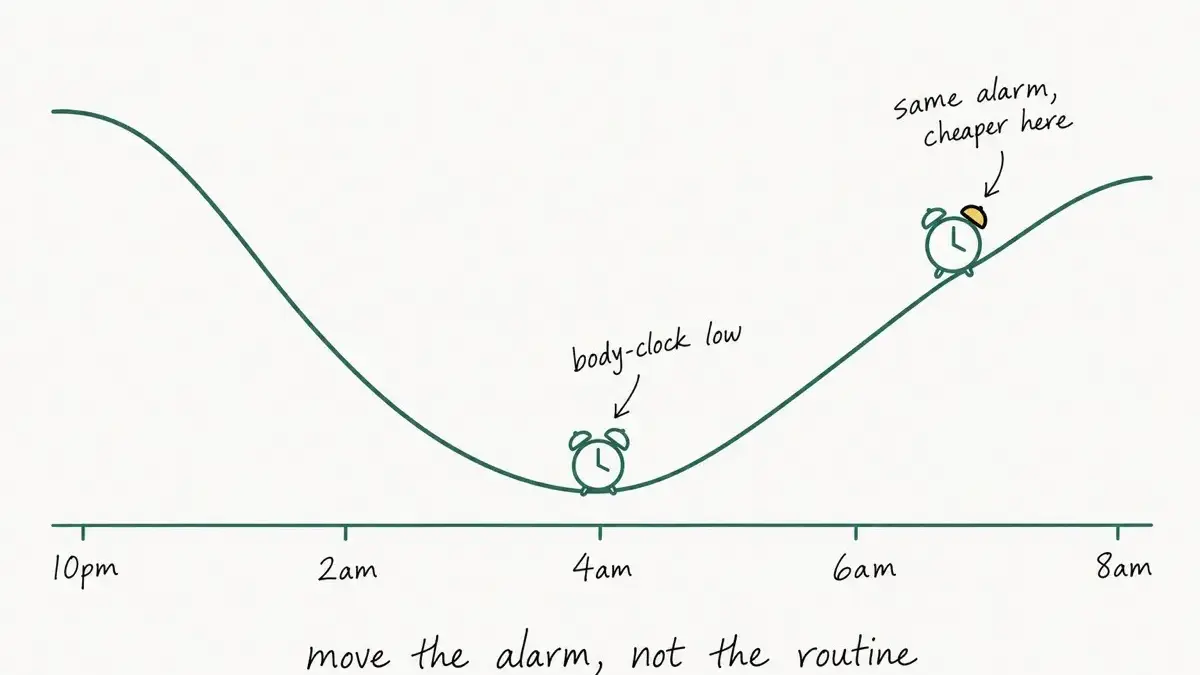
The second factor is body-clock timing. Waking up during the circadian trough—the absolute lowest biological point of the night—intensifies sleep inertia. For a person maintaining a typical schedule of 11:00 PM to 7:00 AM, researchers like Kovac and colleagues noted in 2023 that this biological low typically occurs between 3:00 AM and 5:00 AM. These specific clock hours are not universal; they shift depending on individual schedules and chronotypes. Translated into practical terms, setting an alarm inside your biological low costs significantly more in terms of cognitive friction than setting the exact same alarm thirty minutes later.
The third element involves the specific sleep stage from which a person is abruptly pulled. Several studies link waking directly from deep, slow-wave sleep to heightened sleep inertia, though findings remain somewhat mixed as underlying sleep pressure and timing often confound the apparent stage effect. This scientific nuance provides a clear reason for skepticism regarding commercial applications promising to track sleep cycles and time an alarm precisely to a light stage to spare users from morning grogginess.
What Helps, Ranked by Scientific Evidence
When reviewing the interventions that actually mitigate sleep inertia, two primary adjustments carry the most robust scientific support, and both occur long before the morning alarm sounds: securing adequate sleep volume and moving the alarm outside of the body-clock trough. Caffeine and morning light sit comfortably in a secondary tier where the evidence is real but limited, offering benefits primarily in how waking feels rather than producing a measurable leap in raw cognitive performance. Familiar morning tricks, such as cold water and intense routines, sit at the very bottom of the hierarchy because their effects are weak and fleeting.
Protecting the sleep opportunity must come first. Because sleep loss directly exacerbates morning impairment, the most honest solution is unglamorous: more sleep across more nights, rather than a more intricate morning wake-up ritual. If nights are broken rather than merely short, that points to an underlying issue requiring a different corrective approach altogether.

The second major adjustment is to shift the alarm timing rather than the morning routine. Individuals who feel permanently incapable of functioning in the early hours frequently suffer from a biological timing conflict rather than a deficiency in willpower. Moving an alarm forward by even twenty or thirty minutes—by adjusting evening commitments—can drastically reduce the biological cost of waking.
In the secondary tier of interventions, caffeine functions best when understood as a delayed tool. Limited experimental evidence indicates that caffeine can reduce sleep inertia impairments, but people routinely misunderstand the necessary physiological lag. Studies comparing caffeinated gum and traditional beverages show that median times to peak blood caffeine concentrations hover around 38 to 40 minutes. Treating the first morning sip as the beginning of a twenty-minute waiting period, rather than an instant cure, aligns expectations with biological reality.
Artificial light offers a similar nuance. Home studies and crossover trials demonstrate that artificial dawn simulators and light-emitting glasses reliably improve self-rated alertness and subjective energy levels. However, objective psychomotor vigilance tests often show no immediate parallel improvement in raw cognitive speed. Light may make the morning feel significantly better without instantly making a person measurably sharper. At 6:12 in the morning, that subjective boost is still valuable, provided one understands its limits.
Popular reactive tricks—such as splashing cold water on the face, drinking large volumes of water immediately, consuming heavy breakfasts, or launching into sudden workouts—possess remarkably weak evidence. Major reviews describe these non-pharmacological countermeasures as mixed or limited, yielding short-lived sensations rather than a physiological reset. Hydrate because thirst requires it, eat because of hunger, and move because exercise is healthy, but do not expect these habits to prematurely end sleep inertia.
Giving the First Twenty Minutes Nothing That Can Go Wrong
Because the mental fog of sleep inertia is largely locked in by the time consciousness returns, the most rational strategy involves managing the twenty-minute window rather than fighting it. Stop attempting to win a battle against your own biology. Eliminate any task from that early window that punishes poor decision-making.
Consider the case of Garrett, who maintains a 6:10 alarm and catches a 7:05 train for work. He previously spent his initial twenty minutes trying to be productive by answering overnight work messages, resolving contractor quotes, and choosing between various gym classes. These tasks all demand high-level cognitive decisions. He eventually restructured his morning, moving those decisions to the train ride an hour after waking, while dedicating the 6:12 to 6:32 window to automated tasks that easily survive a foggy brain: taking a shower, dressing in clothes laid out the evening before, starting a cup of coffee, and spending ten minutes standing by a sunlit window.
Nothing about that routine is outwardly impressive, which is precisely the point. The morning window stopped producing costly mistakes, and the start of the day ceased feeling like a personal failure, even though the biological fog dissipated on its own natural schedule.
A distinct variation of this challenge confronts shift workers, such as Janelle, who navigate naps during breaks on night shifts. Laboratory protocols examining post-nap inertia in healthy adults demonstrate that nap duration matters immensely. Ten-minute naps produce minimal post-nap impairment, whereas thirty-minute naps routinely plunge individuals into deep slow-wave sleep, triggering measurable performance deterioration that can persist for nearly an hour after waking. For those operating under strict time constraints, short naps remain the safer option to avoid debilitating sleep inertia.
When Morning Grogginess Belongs to a Clinician
Persistent morning grogginess is not always a simple scheduling or lifestyle problem. Severe, prolonged difficulty waking—frequently referred to as sleep drunkenness—is a recognized clinical feature of conditions like idiopathic hypersomnia. Furthermore, unrefreshing sleep and profound daytime sleepiness frequently accompany obstructive sleep apnea.
Individuals experiencing extreme, unyielding morning impairment are advised to consult a medical professional. Documenting the specific pattern—including the duration of incapacitation, frequency, functional impact, and the exact mismatch between natural biological rhythms and required wake times—provides clinicians with the necessary context to evaluate potential underlying sleep disorders.
Ultimately, the most effective approach to managing morning sleep inertia requires abandoning reactive morning tricks in favor of foundational decisions made the night before. By protecting adequate sleep duration, aligning wake times with biological clocks, and removing high-stakes decisions from the first twenty minutes of the day, individuals can allow sleep inertia to dissipate naturally without paying an unnecessary cognitive toll.