
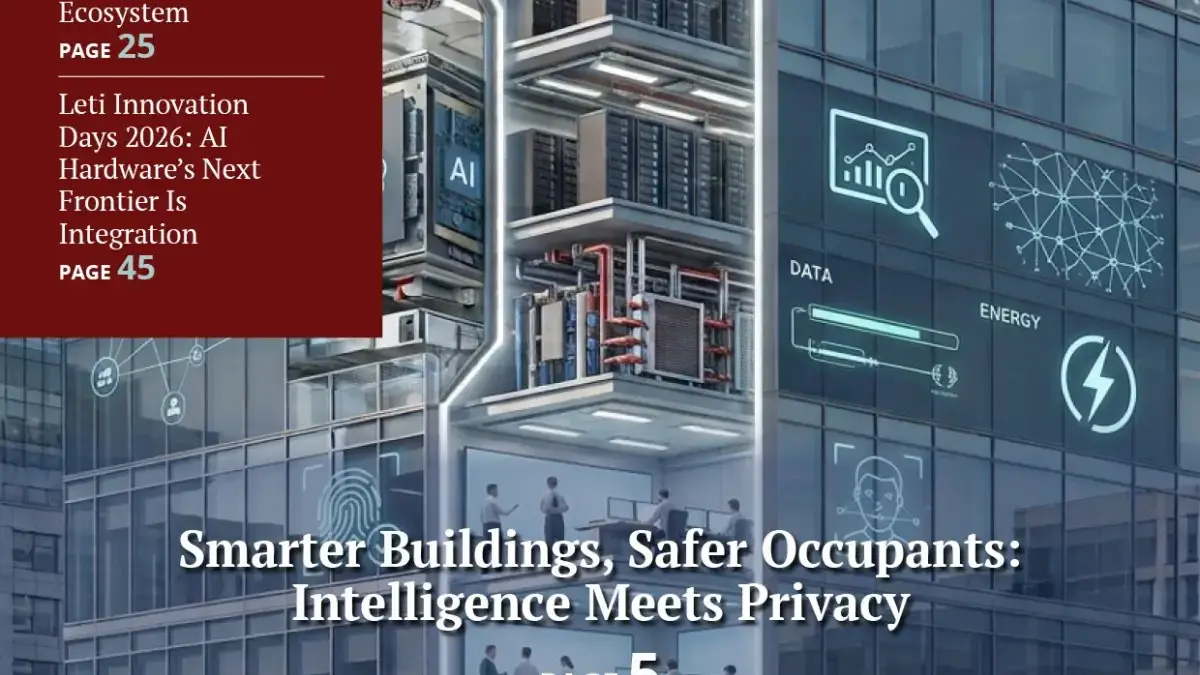
Artificial intelligence is becoming increasingly deeply embedded into Internet of Things (IoT) solutions, evolving to the point where it can generate the very code that enables physical devices to communicate seamlessly across sprawling networks. In theory, leveraging AI offers a surefire mechanism to dramatically elevate productivity across software engineering workflows. Yet, when applied to the complex, multi-layered reality of modern connected systems, the true picture is far more nuanced.
The world is expanding into a hyper-connected global grid, with the total number of active IoT connected devices projected to surge past 40 billion by the year 2034. Within this broader expansion, smart buildings represent one of the most dynamic growth sectors. Industry forecasts place the global smart buildings market size at over $550 billion by 2033, representing a robust compound annual growth rate exceeding 18 percent.
Modern IoT systems do much more than simply relay basic telemetry. They continuously monitor critical environmental indicators including temperature, humidity, ambient lighting, and indoor air quality through fleets of advanced sensors designed specifically to optimize building health, occupational safety, and overall structural efficiency. Furthermore, these connected ecosystems anchor comprehensive physical security measures, integrating sophisticated building access control infrastructure and high-resolution CCTV systems.
During the extraordinary disruptions of the Covid-19 pandemic, IoT frameworks proved instrumental in managing the flow of occupants through large commercial and public spaces. Thermal-imaging cameras and real-time occupancy-monitoring systems worked in tandem to support effective social distancing protocols without requiring exhaustive manual supervision.

To meet increasingly stringent sustainability mandates, smart buildings are increasingly deploying hyper-efficient IoT solutions designed to minimize environmental impact. These connected frameworks deliver deep analytical insights that building infrastructure and facilities managers can draw upon to drastically minimize power wastage and optimize complex energy-distribution networks. At the same time, predictive maintenance solutions systematically aggregate real-time operational data regarding the physical condition of vital equipment. By identifying potential points of failure before they manifest, these systems reduce the necessity for reactive site visits and allow maintenance teams to make far more efficient use of scheduled in-person appointments.
New hardware innovations are continually unlocking fresh opportunities across the IoT landscape. Ambient light harvesting technologies, for instance, are bringing self-powered building sensors closer to commercial viability. As these edge capabilities mature, individual sensors will likely communicate directly with one another, dynamically exchanging granular data regarding localized light intensities, thermal gradients, and immediate power levels without draining central battery reserves.
The Case for AIoT
Building upon these foundational advancements, systems design engineering is now aggressively integrating artificial intelligence directly into the IoT architecture, giving rise to the powerful paradigm known as AIoT.
This integration represents a profoundly logical convergence. IoT infrastructure is exceptionally adept at generating and capturing staggering volumes of raw data at the network edge, while artificial intelligence is uniquely equipped to process, analyze, and act upon that information at scale. The commercial and technical potential of this fusion has drawn intense market interest, with research firm Transforma Insights forecasting that active AIoT connections will surpass 9 billion by the end of 2033. This milestone will represent a dramatic sixfold expansion over a remarkably condensed ten-year period.

One of the most compelling and immediate commercial applications for AIoT lies within the realm of physical and digital security. Because artificial intelligence excels at recognizing complex behavioral patterns and structural deviations, it can identify anomalies with a degree of speed and accuracy that far outstrips traditional human oversight. In practice, this capability can compress threat detection timelines from days down to mere minutes. As the field of agentic AI continues to advance, human operators may eventually step back even further, with intelligent systems configured not only to intercept security breaches autonomously, but also to initiate and execute preliminary remediation workflows in real time.
AI in Software Engineering
Beyond network architecture and device management, artificial intelligence holds the potential to fundamentally transform the practice of software engineering itself. By enabling accelerated code generation and automated problem-solving capabilities, AI coding assistants promise dramatic productivity gains. This value proposition naturally appeals to enterprise organizations striving to compress development cycles, reduce operational expenditures, deliver richer feature sets, and maintain a sharp competitive edge in fast-moving markets.
Naturally, such a profound shift carries significant implications for employment patterns, ongoing skills development, and structural oversight within engineering departments. While some forward-looking organizations are inclined to embrace an AI-first development model immediately, others are exercising a much higher degree of caution.
Recent projections from Gartner indicate that roughly 60 percent of organizations will adopt smaller, more streamlined software engineering teams by the year 2029. However, the analyst firm emphasizes that these newly formed lean teams will largely be the result of strategic organizational restructuring. Gartner stresses that the widespread adoption of AI will ultimately drive long-term structural demand for software engineering talent rather than diminishing it entirely. At the same time, the firm issues a clear warning to enterprise leaders: prematurely cutting entry-level and junior positions simply because AI tools can generate boilerplate code risks hollowing out the foundational software engineering talent pipeline.

Faced with these competing pressures, many companies are carefully re-evaluating whether, and under what specific conditions, they should integrate generative AI tools into their core development pipelines.
Designing for the Long Term
Consider once more the immense complexity inherent in connected applications designed for modern smart buildings. These systems cannot afford to operate as isolated silos; they must remain entirely resilient across the complete, end-to-end design chain, spanning physical edge devices, intermediate communication networks, and centralized cloud or core endpoints. Software engineers and systems designers carry the heavy responsibility of ensuring that every disparate element interacts seamlessly, reliably, optimally, and securely. In this high-stakes environment, poor-quality code has zero margin for error and can trigger severe real-world consequences.
Within the IoT ecosystem, the core engineering challenge extends far beyond merely utilizing AI to write software applications at a faster rate. The underlying code must demonstrate long-term stability and performance as underlying technologies, hardware specifications, and operating environments inevitably evolve. Comprehensive maintenance and unyielding security protocols remain paramount; they can never be treated as secondary considerations or, in the worst-case scenario, compromised for the sake of speed.
Consequently, modern IoT solutions must be engineered from the ground up with connectivity, structural security, operational resilience, and robust data management embedded into every layer. This rigorous approach represents the only viable method for minimizing costly in-life corrections that inevitably damage customer satisfaction and business outcomes while consuming excessive time and financial resources.

Keeping human engineers actively involved in the workflow remains essential, though not merely as a passive failsafe designed to catch mistakes. Human beings are inherently fallible, and treating human review as a simple safety net underestimates the complexity of the task. Instead, the true objective is to apply deep engineering expertise where it fundamentally alters the ultimate outcome, rather than relying on human oversight merely to clean up what an artificial intelligence tool has missed.
In daily practice, this balance translates into structured workflows where AI-generated code destined for production environments is thoroughly reviewed by a human engineer before any code integration takes place. Similarly, autonomous software agents may run first-line diagnostics when an operational incident occurs and subsequently propose a comprehensive remediation plan, but a qualified human professional retains absolute authority over whether that plan is ultimately executed.
AI Governance and Control
Artificial intelligence will inevitably continue to expand its footprint within the IoT ecosystem, influencing both high-level application logic and foundational system design. While market appetite for these capabilities remains exceptionally strong, it is matched by an understandable undercurrent of operational caution.
Enterprise organizations must maintain total clarity regarding what artificial intelligence is doing across every integrated business and technical process. They must deeply understand why the system makes specific decisions and maintain the exact level of operational control required to prevent costly behavioral deviations. Ultimately, the organizations that achieve long-term success in this space will not necessarily be the ones that adopt artificial intelligence tools with the greatest speed. Rather, success will belong to those enterprises that can precisely define where they draw the line of automation and maintain that operational boundary with absolute discipline.


Leave a Reply