

Pirate streaming platforms that specifically cater to a Chinese-speaking audience have historically operated outside the primary crosshairs of Hollywood’s major anti-piracy forces, such as the Alliance for Creativity and Entertainment (ACE) and the Motion Picture Association (MPA). While these international conglomerates frequently target massive, globally accessible English-language pirate networks, specialized regional operations often fly under the radar of traditional Western enforcement efforts.
This dynamic has long applied to Olevod, a prominent streaming platform operating across .com and .tv domains. Over the years, the site has managed to appear on various industry radar screens, including a batch of Digital Millennium Copyright Act (DMCA) subpoenas secured by ACE and an Australian federal blocking order requested by entertainment giants like Netflix and Disney. Despite these regulatory hurdles, Olevod never managed to secure a spot on the United States Trade Representative’s (USTR) annual lists of key foreign piracy threats, allowing it to maintain a stable and dedicated user base.
Operating primarily outside mainland China, the platform has cultivated a loyal following among Chinese-speaking expatriates and diaspora communities around the globe, with a significant concentration of users residing within the United States. However, that relative comfort zone came to an abrupt end when Chinese streaming titan Tencent decided to take direct legal action in a U.S. federal court, setting the stage for a high-stakes jurisdictional showdown that could reshape how foreign copyright holders target overseas streaming platforms.
Tencent Sues ‘Chinese’ Pirate Site in Florida
In an aggressive bid to shut down the operation, Tencent filed a comprehensive copyright infringement complaint against Olevod in a federal court in Florida last October. As one of China’s dominant entertainment and streaming powerhouses, Tencent’s legal filing listed more than 150 of its proprietary shows, including major blockbuster hits that have collectively accumulated tens of billions of streams worldwide.
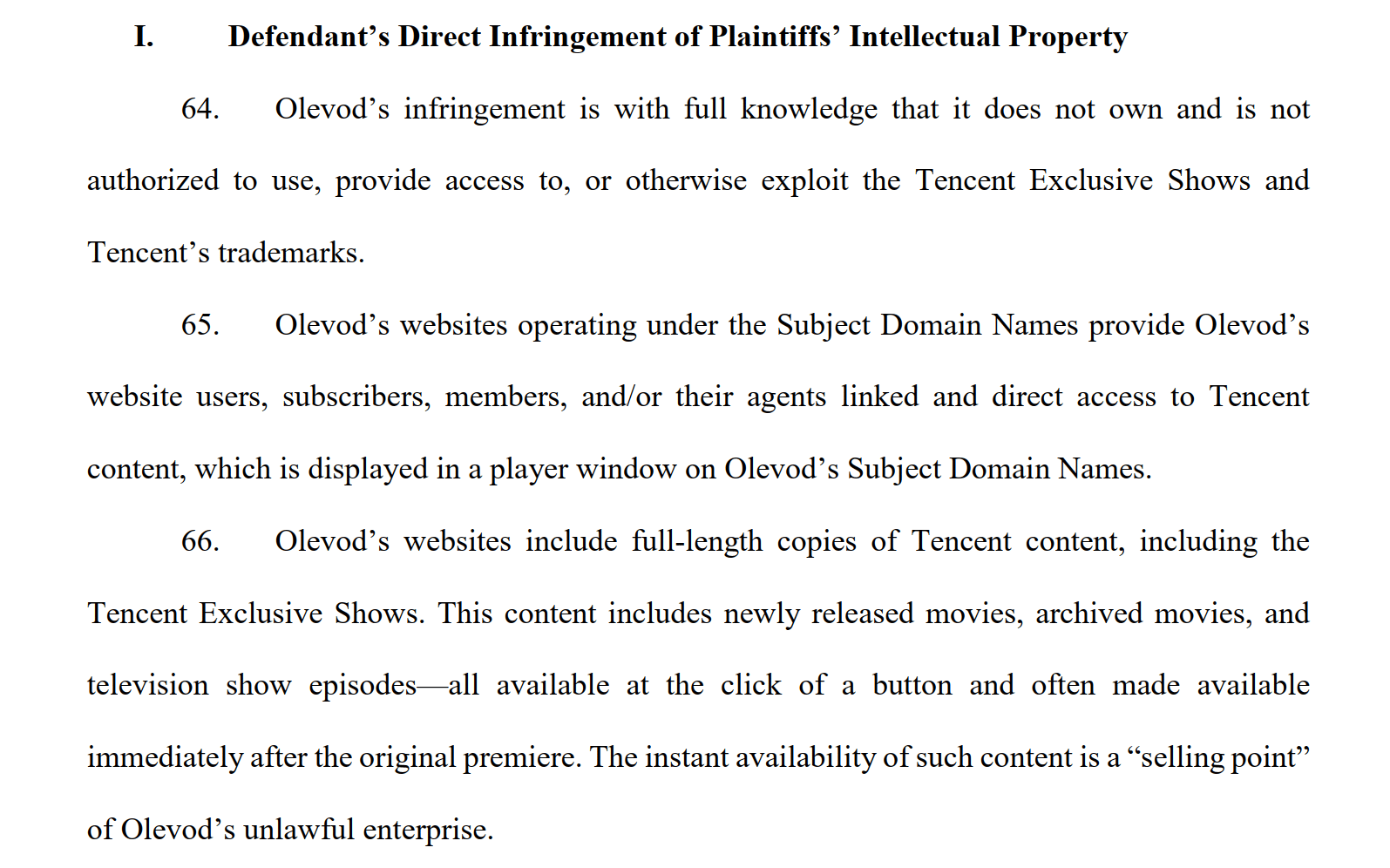
According to the details outlined in the court documents, Olevod.com and Olevod.tv functioned as repositories for full-length, unauthorized copies of Tencent’s extensive library of films and television series. Visitors to the platform were given two primary options to consume the stolen material: they could watch the content for free while enduring advertisements, or they could purchase a paid VIP membership tier designed to remove ads and presumably offer enhanced streaming perks.

The complaint underscored the brazen nature of the platform’s distribution model, noting that the websites featured newly released theatrical films, archived cinematic classics, and individual episodes of television shows. This material was allegedly made available at the simple click of a button, frequently appearing on the pirate platform immediately after its official commercial premiere in Asia.
Tencent also highlighted the calculated marketing strategies employed by Olevod. In its search engine optimization and Google advertisements, the site explicitly marketed itself as an online video media platform tailored specifically for overseas Chinese audiences. Interestingly, Tencent pointed out that Olevod deliberately blocked incoming web traffic originating from mainland China. By restricting domestic access, the site operator sought to sidestep immediate friction and enforcement actions from local copyright holders within China, focusing its exploitation entirely on international markets.
$100 Million in Potential Damages and Broad Injunction Requests
The legal complaint filed by Tencent went far beyond standard allegations of direct copyright infringement. The media giant also incorporated claims of trademark infringement, drawing attention to the commercial environment surrounding its intellectual property. According to the filing, advertisements for online gambling services, adult pornography, and counterfeit academic diplomas frequently appeared directly adjacent to Tencent’s proprietary branding and corporate logos on the pirate pages.
The scale of the alleged infringement laid out in the court papers was massive. The complaint cataloged 670 registered television and movie episodes, with Tencent requesting the maximum statutory damages of up to $150,000 for each individual work. This calculation brought the theoretical maximum financial liability to a staggering sum exceeding $100 million.
Recognizing that operators of pirate streaming domains rarely settle or pay multi-million-dollar statutory judgments in full, Tencent’s legal team also pressed for a broad and aggressive injunction. The plaintiffs asked the presiding federal court to issue sweeping orders compelling internet service providers (ISPs), web hosting companies, Domain Name System (DNS) resolvers, virtual private network (VPN) providers, banks, and online payment processors to completely sever ties with and block the pirate site within a strict seven-day window.
Olevod Fights Back Over Jurisdiction

While many defendants named in international copyright lawsuits choose to default by failing to appear in court, Olevod mounted an active defense. The company behind the platform retained Florida-based legal counsel and moved to have the entire lawsuit thrown out of court, arguing fundamentally that a U.S. court lacked the personal jurisdiction required to adjudicate the dispute.
The corporate entity defending the site identified itself as Jiayi Network Technology SL, a registered Spanish business entity with no physical infrastructure, employees, offices, or formal corporate connections within the United States. To reinforce its argument regarding a lack of domestic ties, the defense pointed out that the physical servers hosting the pirated media files were located overseas in Germany and France. Furthermore, the site’s subscription prices were denominated in Chinese yuan and euros, and financial transactions were primarily processed through popular Asian digital payment gateways like Alipay and WeChat Pay rather than traditional American banking systems.
Tencent countered these jurisdictional arguments by presenting digital evidence demonstrating commercial engagement with the United States. The plaintiff showed that Olevod actively accepted U.S. dollars through PayPal transactions, aggressively sold digital advertising space to generate revenue, and utilized specific IP addresses managed through a mail drop facility located in Destin, Florida.
The initial legal skirmish produced a favorable outcome for the defense when Magistrate Judge Panayotta Augustin-Birch issued a report and recommendation in June. She concluded that while Tencent had successfully established that individuals residing in Florida could technically access the website, the streaming giant had failed to provide concrete evidence proving that even a single Florida resident had actually streamed a Tencent show on the platform.
The magistrate warned that ruling otherwise would set a dangerous legal precedent. She reasoned that if mere accessibility of a website were deemed sufficient to establish jurisdiction, it would effectively subject every company, individual, or hobbyist operating a website anywhere in the world to lawsuits in Florida simply because their pages could be loaded over internet connections within the state.
Judge Rules Olevod Cannot Escape Florida Lawsuit
Despite the magistrate’s recommendation, District Judge David Leibowitz delivered a sharp reversal last week. Judge Leibowitz rejected the recommendation to dismiss the case, thereby keeping Tencent’s multi-million-dollar lawsuit alive and pushing the litigation forward.
The pivotal turning point in the judge’s reasoning followed the submission of fresh traffic analytics data by Tencent, sourced from the digital market intelligence platform Semrush. The data revealed that Olevod.com had attracted an impressive 123,400 visits originating specifically from the state of Florida during the single month of June, elevating the state to the site’s fourth-largest source of U.S. traffic.
While the high volume of localized traffic bolstered Tencent’s arguments, the presence of localized commercial activity proved to be the decisive factor for the court. The active sale of advertising space visible to Florida consumers and the commercial offering of paid premium subscriptions to U.S. residents satisfied the legal thresholds for doing business within the state. Judge Leibowitz explicitly compared the platform’s operations to an online vendor of counterfeit luxury goods, referencing a prior jurisdictional ruling where a seller of fake designer merchandise lost a similar legal challenge.
In his written order, Judge Leibowitz emphasized that the core of Tencent’s claims rested on the assertion that Jiayi traffics extensively in pirated content. The evidentiary record clearly established that the company built a lucrative commercial enterprise by engaging in that exact conduct within Florida—both by monetizing advertising space viewed by state residents and by selling paid subscriptions to consumers inside the United States and Florida.
The judge noted that the digital nature of streaming media, as opposed to physical counterfeit goods like designer handbags, did not alter the fundamental legal reality. Furthermore, he characterized Olevod not as an isolated hobbyist operating out of a residential home, but rather as a sophisticated corporate entity orchestrating interactive web platforms designed for profit.
A Roadmap for Chinese Rightsholders?
Tencent is not the only major Chinese entertainment platform testing the viability of U.S. federal courts for anti-piracy enforcement. In the previous year, rival streaming service iQIYI initiated a strikingly similar lawsuit against the pirate streaming site Aiyifan TV within the exact same Florida court, utilizing the same legal representation.
In the iQIYI case, the anonymous operators behind Aiyifan TV failed to make an appearance, resulting in a default judgment entering against them within months. However, when iQIYI subsequently moved to secure $196.55 million in statutory damages alongside a sweeping domain-transfer injunction, the presiding judge intervened. The court granted a liability judgment but demanded rigorous additional evidence regarding both the exorbitant damages calculation and the requested domain seizures, openly criticizing the rightsholders for seemingly plucking their per-work damages figures out of thin air. That specific financial determination remains pending.

Unlike the anonymous operators of Aiyifan TV, Olevod chose to mount a formal defense, though it suffered a major setback in the preliminary legal rounds. The recent ruling does not address the underlying merits of the copyright infringement claims itself; rather, the court has merely established that it possesses the legal authority to hear and decide the case. Whether Olevod actually infringed upon Tencent’s copyrighted works, and what financial penalties should apply, remains to be determined at a later stage.
Olevod has been given a legal deadline of October 2 to officially file its substantive answer to the original complaint. It remains unclear whether the defense will continue to contest the allegations in court or ultimately abandon the defense, potentially following Aiyifan TV down the path of default. At the time of publication, both of Olevod’s primary web domains remained fully operational and accessible online.
For Chinese media companies and international rightsholders, the court’s order provides a strong indication that foreign pirate platforms relying on ad-supported streaming models and paid subscriptions can indeed be hauled into U.S. courts in Florida. This holds true even in the absence of a domestic U.S. plaintiff, locally based corporate offices, or servers physically stationed within the United States. Whether this precedent will trigger a broader wave of litigation against other Chinese-language pirate networks operating globally remains to be seen as the legal battle progresses.

Leave a Reply