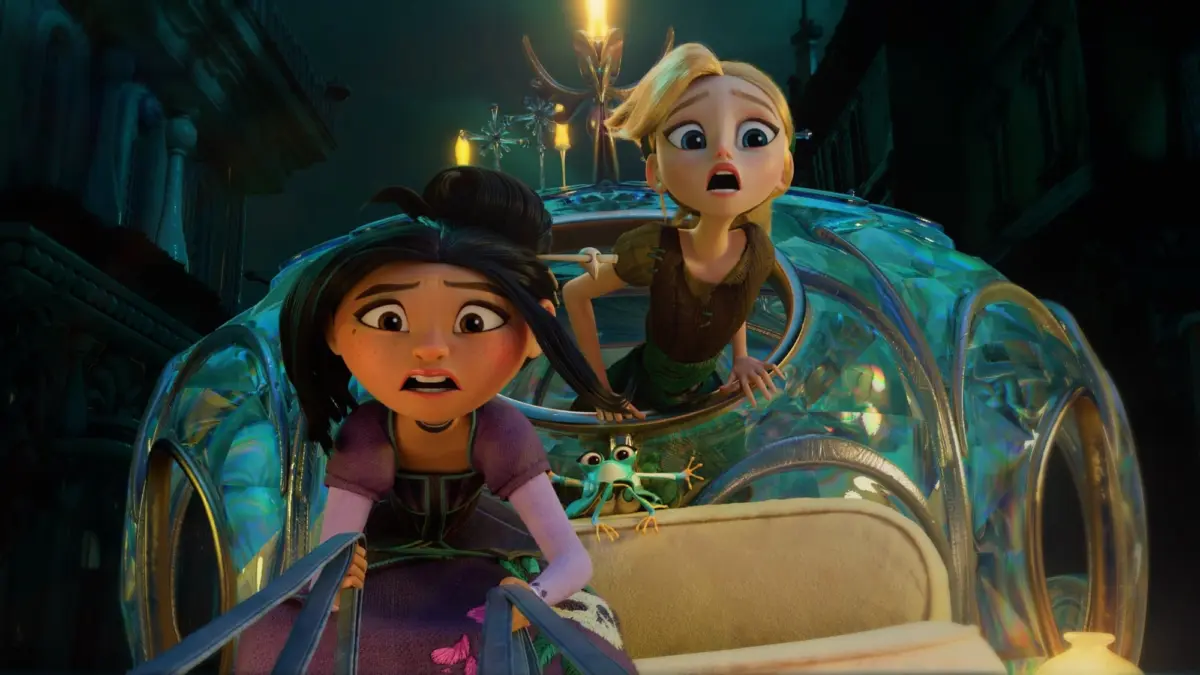
While dark, cynical spins on classic fairy tales have steadily carved out a notable niche in contemporary cinema—such as the horror-tinged 2025 release The Ugly Stepsister, which used body-horror tropes to critique societal pressures on young women—Netflix is opting for a significantly more family-friendly approach with its upcoming animated feature, Steps. Debuting on the platform on November 20, 2026, the movie reimagines the traditional Cinderella narrative through the eyes of the notoriously maligned stepsisters, blending familiar folklore tropes with a distinctly modern, alternative aesthetic.
Directed at family audiences, Steps builds upon the foundation laid by decades of animated fairy tale parodies from studios like Disney and DreamWorks. Much like classic princess movies, the film features a picture-perfect maiden in Cinderella—voiced by Amanda Seyfried—who is unfailingly kind, endlessly cheerful, and prone to conversing with woodland creatures and bursting into song. However, in a narrative framing device reminiscent of Shrek, the movie opens by subverting a traditional storybook tale. A snarky protagonist immediately steps into the frame, expressing exhaustion with how history has misrepresented her and her family.

In this universe, the narrator is not a misunderstood ogre, but rather a so-called "Evil Stepsister." Lilith, voiced by Ali Wong, is admittedly far from a saint in her treatment of the orphaned Cinderella. She is the one who assigns Cinderella the arduous task of cleaning the fireplace, who scorns her animal companions, and who ultimately tears up the dress Cinderella intended to wear to the royal ball. Yet, within the context of the film’s narrative, these actions are framed less as genuine malice and more as classic teenage angst. Steps pivots away from a traditional princess story to explore themes of being an outsider, alternative fashion, sisterhood, and the intense social pressure to assimilate.
‘Steps’ Offers a Parable About Being True to Yourself
Lilith’s vocal objection to her designated villainous moniker drives the narrative as she sets out to reclaim the story of Cinderella from her own perspective. While audiences are well-acquainted with the traditional elements—the bad behavior, the bursts of magic, the romance, and the kingdom-wide search for the owner of the lost glass slipper—Lilith’s very name hints at a deeper, more complicated legacy. In folklore, Lilith is a figure who has been alternately demonized and revered depending on the perspective of the storyteller. In Netflix’s film, she is depicted as an accidental witch sporting a distinctly Gothic sense of fashion.

Before her magical tendencies emerge, Lilith is simply the new girl in town, navigating a difficult transition alongside her younger sister, Margot (voiced by Stephanie Hsu). The two siblings had previously traveled from town to town with their seamstress mother, selling her wares until romance struck and brought them into Cinderella’s household. While Cinderella and her father warmly welcome the newcomers, the broader, predominantly white kingdom reacts with open hostility toward the Asian seamstress and her daughters, who wear Eastern styles of dress and share folklore about a slithering snake-woman.
At Lilith’s very first social event in her new home, she is publicly and harshly shunned by the resident mean girl, Priscilla, voiced by Nikki Glaser. When the surrounding crowd of village girls quickly follows suit, Cinderella—despite her noble and gentle reputation—does nothing to intervene.
This rejection prompts a classic cinematic makeover montage set to Olivia Rodrigo’s "Brutal." Lilith enthusiastically follows in the Doc Martens-wearing footsteps of generations of ostracized cinematic teenagers before her. For anyone who has ever quoted The Craft line "We are the weirdos, mister," or sincerely insisted to a parent that a dark phase was permanent, Lilith’s journey will feel instantly recognizable. While her peers meticulously copy Priscilla’s white bouffant hairstyle and poofy pink gowns, Lilith embraces an aesthetic dominated by black and purple, a DIY asymmetrical haircut, homespun skirts adorned with embroidered skulls, and heavy leather boots. Her philosophy is simple: if the townspeople are going to stare, she will give them something worth looking at.

However, Lilith’s fierce dedication to self-expression becomes entangled with her lingering resentment and jealousy toward her seemingly perfect stepsister. That rivalry sparks a rebellion that ultimately threatens not only Cinderella’s impending romance with the prince, voiced by Daniel Radcliffe, but also puts Lilith and her family in active physical danger. Consequently, the stepsister and the princess are forced to form an uneasy alliance to rewrite their shared narrative before a rampaging Priscilla can destroy everything around them.
‘Steps’ Makes Moves Disney Would Never
In the early acts of the film, Cinderella appears to be a standard caricature of a Disney princess, complete with her cheerful demeanor, agreeable disposition, animal sidekicks, and an irrepressible urge to burst into song. However, the introduction of the fairy godmother, voiced by Bette Midler, reveals a hidden truth to Lilith: her stepsister has been secretly aided by a magical guardian all along.

This revelation transforms Steps into a pointed parable about privilege. The fairy godmother’s magic afforded the wealthy, white princess distinct advantages that her stepsisters were entirely denied. While Lilith is understandably furious upon discovering this disparity, the dynamic shifts once the protective spell is broken. Cinderella, suddenly forced to confront the realities of human biology like perspiration and body odor, naively stumbles into one perilous situation after another. Fortunately for her, Lilith’s character is far more complex and compassionate than her reputation implies, leading her to repeatedly rescue Cinderella whether she wants to or not.
The film’s screenplay benefits from a collaborative writers’ room, featuring contributions from Ava Tramer, James Madejski, Jen Chuck, Dana Schwartz, Felicia Ho, Riki Lindhome, and Kate Micucci. Together, they utilize familiar fairy-tale tropes to explore complex, real-world concepts that are often difficult to explain to younger audiences—such as the unspoken social pressure to assimilate in order to avoid alienation. The narrative makes it clear that the kingdom’s rejection of Lilith stems less from a genuine aversion to her spooky clothing or folklore and more from a generalized fear of Priscilla’s cruelty. Through the escalating conflict between two sisters—one privileged and playing by the established rules, the other marginalized and defiant—both characters learn valuable lessons about self-acceptance, empathy, and how kindness can ultimately become contagious.
Alongside these thematic explorations, Steps incorporates a bizarre array of supporting elements, including a rowdy biker gang of trolls who ride goats like motorcycles, a maniacal manservant voiced by Peter Dinklage, and a surprisingly dashing troll voiced by Young Mazino. This unexpected romantic interest evokes comparisons to Nicolas Cage in Moonstruck, delivering a lanky yet muscular presence with an expressive approach to both his hair and his emotional confessions.

Blending these eccentric comedic touches with genuine emotional resonance, Steps emerges as a distinctively unconventional fairy tale that honors both Cinderella and Lilith by acknowledging their respective virtues and flaws with equal compassion. The resulting animated feature offers an entertaining viewing experience that positions itself as a strong contender for repeated viewings among Netflix subscribers when it arrives on the streaming service later this month.