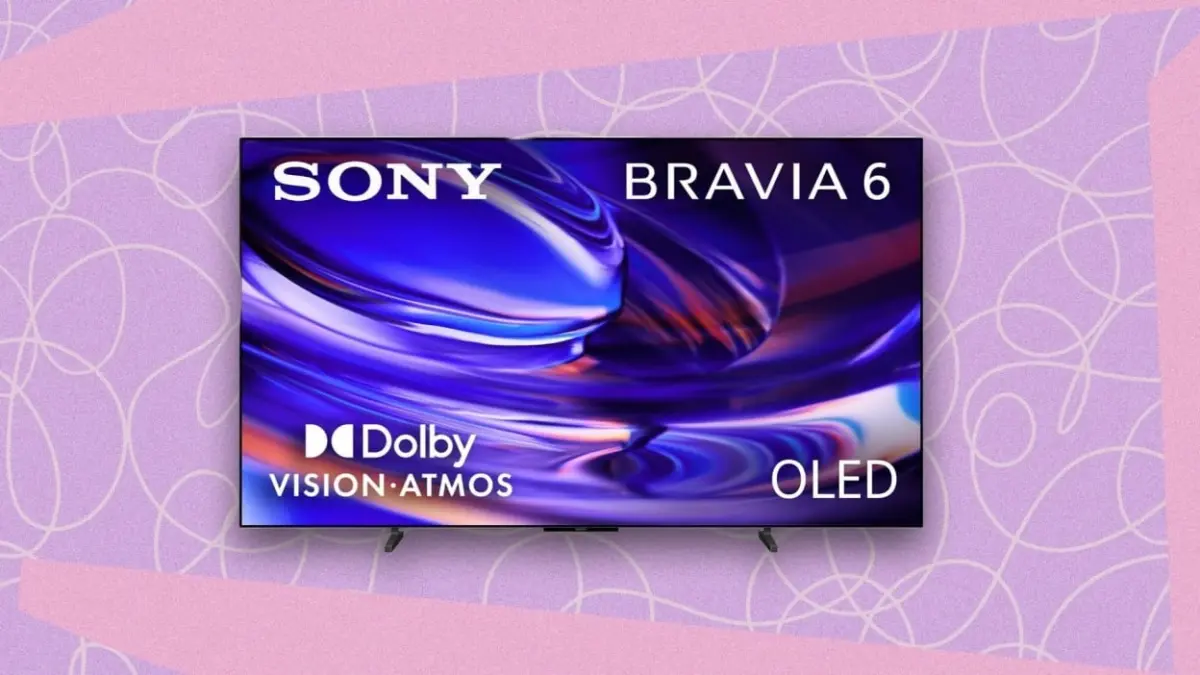
Sony’s popular Bravia 6 OLED TV line, which originally entered the consumer display market in the summer of 2026, has received a substantial price reduction across its entire range of screen sizes, with discounts reaching up to 40 percent off original retail prices. Under the current promotional pricing, the baseline 55-inch Sony Bravia 6 OLED TV has dropped to $998, down from its standard list price of $1,499.00. The discount represents a notable shift for the model, pushing a modern OLED television panel beneath the thousand-dollar mark. In addition to the entry-level 55-inch model, the larger configurations in the lineup—comprising the 65-inch, 77-inch, and 83-inch screen sizes—have all been reduced in price by 40 percent, marking one of the most widespread price cuts on the model line since its market release.
Since its release, the Bravia 6 has established itself as one of the most recognized choices within the budget-friendly OLED television segment. Positioned directly against established mid-range and value-focused OLED offerings from competing display manufacturers such as LG and Samsung, the television is designed to offer premium visual characteristics—such as self-emissive pixel technology and refined picture processing—at a lower entry point than top-tier flagship displays. While high-end OLED displays frequently command significant price premiums, the updated pricing makes the Bravia 6 a key point of comparison for consumers looking to transition to OLED panel technology without committing to premium pricing structures.
At the technical center of the Bravia 6 is MediaTek’s modern Pentonic 800 chipset, a central processing platform responsible for handling system navigation, smart software functions, and video signals. The integration of the Pentonic 800 processor is key to the overall feature set of the television, as it provides the bandwidth necessary to support four full-bandwidth HDMI 2.1 ports across the back of the set. This specific hardware configuration distinguishes the Bravia 6 from a majority of Sony’s television lineup, including many of the brand’s higher-end and flagship OLED displays.
Historically, standard Sony display architecture has limited full-bandwidth HDMI 2.1 capability to just two ports, even on premium models. On setups utilizing that standard two-port design, one of those high-speed inputs doubles as the display’s Enhanced Audio Return Channel (eARC) port. As a result, consumers connecting an external soundbar or multi-channel audio receiver through eARC are frequently left with only a single remaining high-bandwidth input for high-performance external sources. By utilizing the Pentonic 800 chipset to offer four fully enabled HDMI 2.1 ports on the Bravia 6, Sony has addressed a longstanding point of friction for multi-device home theater and gaming configurations.
The inclusion of four full-bandwidth HDMI 2.1 ports provides significant practical versatility, particularly for setups featuring multiple high-performance media sources. Users can simultaneously connect current-generation gaming consoles, high-end PC gaming towers, and dedicated sound equipment without relying on external HDMI switches or manually swapping cables behind the set. Each port is capable of transferring high data loads required for modern video formats, allowing connected devices to run at their maximum technical potential without encountering interface speed constraints or reduced color sampling.
From a performance perspective, the Bravia 6 offers a comprehensive suite of hardware specifications aimed at both high-definition video playback and interactive media. The panel natively supports 4K resolution output at frame rates up to 120Hz, providing the high temporal clarity required for fast-moving visual content and high-frame-rate gaming output. To ensure smooth motion and prevent screen artifacts, the television incorporates Variable Refresh Rate (VRR) technology. VRR dynamically matches the refresh rate of the physical display panel to the real-time frame output of a connected source, effectively eliminating screen tearing and minimizing stutter during unpredictable frame rate fluctuations.

Alongside VRR, the display integrates Auto Low Latency Mode (ALLM), a standardized feature that automatically detects when a connected source device is outputting a game signal. Upon detection, ALLM automatically switches the display’s picture profile into a dedicated low-latency mode to reduce signal processing overhead and minimize input lag. For audio transmission, the TV supports eARC alongside native decoding for DTS:X surround sound formats. The eARC protocol allows high-bitrate, uncompressed multi-channel audio signals—including object-based surround sound formats—to pass through the TV to compatible external AV receivers or soundbars, preserving audio fidelity across home theater setups.
The fundamental visual characteristic of the Bravia 6 relies on its OLED (Organic Light-Emitting Diode) panel technology. Unlike traditional LCD displays that rely on LED backlights pushing illumination through liquid crystal layers, OLED screens consist of self-emissive pixels that generate their own light independently. Because every individual pixel can be independently dimmed or turned off completely, the screen achieves absolute black levels with zero light leakage into neighboring pixels. This capability yields theoretically infinite contrast ratios, allowing fine shadow details and deep dark tones to sit directly beside bright elements without visual blooming or backlight bleed.
While the Bravia 6 delivers high picture contrast and precise color rendition, the display involves specific design trade-offs regarding absolute light output. Compared to higher-tier mid-range models within Sony’s own lineup, such as the Bravia 8, the Bravia 6 delivers a lower overall peak brightness ceiling. However, despite possessing lower peak luminance metrics than higher-tier models, the display’s contrast management and image processing allow it to maintain strong visual performance across varied room lighting conditions. The absolute dark levels produced by the self-emitting pixels help maintain perceived image depth and color vibrancy, allowing the display to perform well even in rooms with ambient day lighting.
Visual processing is further enhanced by support for Dolby Vision, an advanced High Dynamic Range (HDR) standard that incorporates dynamic metadata. Unlike static HDR standards that apply uniform brightness and contrast curves across an entire piece of content, Dolby Vision adjusts metadata parameters on a frame-by-frame or scene-by-scene basis, optimizing highlights, shadow detail, and color accuracy based on the specific requirements of each scene. On the software side, the Bravia 6 operates on the Google TV smart interface. Google TV aggregates media content from various subscription streaming services into a centralized home screen, providing access to application libraries, tailored content discovery, and voice-assisted navigation options.
The combination of full-bandwidth connectivity, advanced display processing, and lower pricing places the Bravia 6 in a distinct position within the mid-range OLED TV market. In previous years, consumers searching for entry-level or cost-effective OLED solutions primarily looked toward models manufactured by LG and Samsung, which have historically held significant market share in accessible OLED price tiers. By engineering the Bravia 6 with four high-speed HDMI 2.1 inputs and combining that connectivity with Sony’s proprietary picture processing, the company offers a distinct alternative that caters directly to the requirements of high-frame-rate gaming and high-fidelity video reproduction.
The application of the 40 percent discount across the larger screen sizes extends the value proposition to a range of room layouts and seating distances. While the $998 pricing on the 55-inch model offers an accessible point of entry for standard living rooms, bedrooms, or dedicated gaming spaces, the corresponding price cuts on the 65-inch, 77-inch, and 83-inch variants make large-format OLED viewing significantly more achievable for broader home entertainment setups. As display sizes scale up, the visual impact of OLED contrast and 4K sharpness becomes increasingly pronounced, making discounted pricing on larger sizes particularly relevant for home theater installations.
Ultimately, the broad promotional discounts on the Sony Bravia 6 OLED TV lower the cost barrier to high-performance OLED display technology. By featuring four full-bandwidth HDMI 2.1 ports powered by the Pentonic 800 processor, full support for 4K 120Hz output, VRR, ALLM, eARC, DTS:X, Dolby Vision, and the Google TV operating system, the model offers a flexible hardware foundation for a variety of home entertainment needs. For consumers evaluating an upgrade to OLED technology, the current price structure presents a notable opportunity to acquire a feature-rich, high-contrast display across any of its four available size options.