
Unlike subordinate keys in the DNSSEC hierarchy, the root key occupies a uniquely sensitive position because it lacks a parent key. For standard zone-signing keys or key-signing keys, authenticity is verified through a chain of trust established by a parent domain. When a standard key changes, the parent key simply signs across the new key value. However, because the root zone has no parent, updating its key-signing key requires a delicate process where the old key signs the new key, followed by a mandatory waiting period for validating resolvers to recognize and trust the incoming update.
According to RFC 5011, which governs trust anchor updates, resolvers must observe a hold-down time of at least 30 days—or the original time-to-live expiration of the first trust point resource record set containing the new key, whichever is greater. This requirement ensures that resolvers encounter multiple validated resource record sets featuring the new key before accepting it into their local trust anchor sets. When these hold periods are strictly observed, the entire root key rollover process functions automatically.

The 2026 event does not introduce a new cryptographic algorithm; rather, it represents a routine transition of the private and public key pair. The incoming key-signing key, designated as KSK-2024, was published on the Internet Assigned Numbers Authority website in July 2024 and integrated into the root zone’s DNSKEY resource record in January 2025. The scheduled rollover date on October 11, 2026, marks the moment when this key will actively generate the digital signature for the root zone’s DNSKEY resource record set.
Evaluating whether recursive resolvers worldwide have successfully incorporated KSK-2024 into their trust anchor sets requires specialized measurement techniques. Industry observers rely primarily on two established methods to peer into the global DNS infrastructure and assess resolver adoption rates.
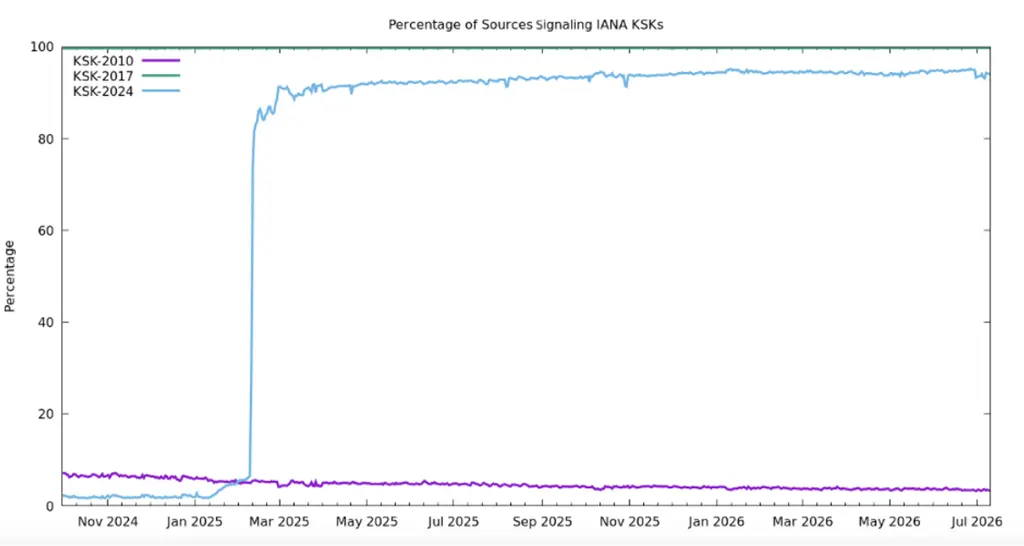
The first technique, outlined in RFC 8145, involves recursive resolvers embedding the key tags of their trusted keys directly into queries sent toward the authoritative servers of the root zone. This is accomplished either by appending tag values into the query name or utilizing the EDNS key tag option. Analysis of these trust signals by root server operators, including Verisign, provides broad visibility into resolver behavior. Data collected up to July 2026 indicated that approximately 90% of reporting resolvers had added KSK-2024 to their trust anchor sets, though this metric reflects resolver counts rather than the actual volume of end users they serve.

The second method, defined in RFC 8509, introduces a Root Key Trust Anchor Sentinel mechanism. Instead of forwarding trust signals upstream to root servers, this approach reflects the query back to the querier. Depending on whether a resolver trusts a specific key tag, it responds with either the original answer or a SERVFAIL status. This mechanism allows operators and measurement systems to test recursive resolvers directly. Organizations such as Cloudflare provide web-based testing tools for network administrators, while APNIC utilizes its ad-based measurement platform to perform millions of tests daily, quantifying the end-user population behind resolvers that have yet to trust KSK-2024.
Large-scale ad-based measurements conducted between May and July 2026, and resumed in October, averaged roughly 16 million tests per day. Within this sample, approximately six million daily tests confirmed that the tested end systems operated behind DNSSEC-validating recursive resolvers, with about 1.8 million tests clearly signaling support for the RFC 8509 Sentinel mechanism. Among those supporting the measurement standard, roughly 70% indicated that KSK-2024 had been successfully loaded as a trusted key.
While aggregated global percentages offer a general overview, they obscure significant regional and network-specific variations. Closer examination of the data highlights numerous autonomous systems where acceptance rates for the incoming key remain notably low, even among networks where a substantial volume of tests confirm resolver support for the Sentinel mechanism.
Data compiled from these measurements identifies dozens of telecommunications providers and network operators worldwide showing low KSK-2024 trust signals. Prominent entries in these metrics span multiple continents, including operators in Costa Rica, Eswatini, South Africa, Sri Lanka, Thailand, Bangladesh, Mauritania, Djibouti, Libya, India, the Philippines, Myanmar, Armenia, Ukraine, the United States, the Netherlands, Iceland, Algeria, Pakistan, the Czech Republic, Australia, Iraq, Canada, Switzerland, Saudi Arabia, Malaysia, Luxembourg, Angola, Botswana, Oman, Madagascar, Bulgaria, Azerbaijan, and Reunion. For instance, major carriers such as Telefonica de Costa Rica, Hutchison Telecoms in Sri Lanka, Globe Telecom in the Philippines, Vodafone Libertel in the Netherlands, and Reliance Jio in India appeared in evaluations exhibiting lower rates of immediate KSK-2024 integration relative to their total validating test volume.
The presence of these networks on tracking metrics indicates that their underlying DNS infrastructure may encounter friction or resolution failures if local resolvers fail to complete their trust anchor updates prior to or shortly after the rollover event. End users operating behind affected networks are encouraged to verify their DNS configuration using available validation tools and consult their respective internet service providers to ensure their systems are fully prepared for the cryptographic transition.

Leave a Reply