
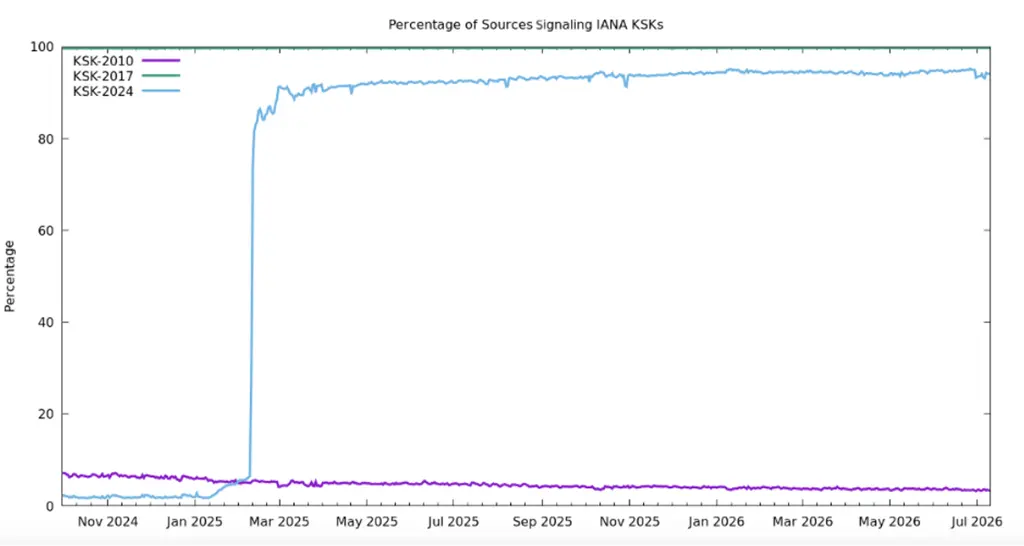
Unlike subordinate cryptographic keys within the DNS hierarchy, which rely on a parent key to validate their authenticity, the root key occupies a unique position because it lacks a parent. For standard Zone-Signing Keys and Key-Signing Keys (KSKs), validation is achieved when a parent key signs across a subordinate key value through a signed Delegation Signer resource record. The root key, however, requires a different mechanism. Authentication occurs when the legacy KSK signs across the incoming KSK, followed by an extended observation period to allow DNSSEC-validating clients sufficient time to adopt and trust the new credential.

Guidance outlined in RFC 5011, titled "Trust Anchor Update," governs this sensitive process. The standard mandates an add hold-down time of 30 days or the expiration time of the original Time-To-Live (TTL) of the first trust point resource record set containing the new key, whichever is greater. This safeguard ensures that validating resolvers observe at least two authenticated resource record sets containing the new key before accepting it into their local trust anchor sets. When these minimum hold periods are respected throughout each phase of the rollover, the process is designed to proceed automatically as resolvers retrieve updated records from the root zone.
The rollover event focuses exclusively on updating the public and private key pair rather than altering the underlying cryptographic algorithm. The incoming KSK, designated as KSK-2024, was published by the Internet Assigned Numbers Authority (IANA) in July 2024 and subsequently integrated into the root zone’s resource record set in January 2025. Following this extensive preparation period, the rollover event marks the transition point where KSK-2024 will be utilized to generate the digital signatures for the root zone’s resource record set.

To evaluate the readiness of the global internet infrastructure, network researchers employ specific measurement techniques to determine whether recursive resolvers have successfully incorporated KSK-2024 into their local trust anchor collections. Monitoring this operational behavior requires specialized observation methods capable of peering into the vast and decentralized architecture of the global DNS.
Two primary techniques provide visibility into trust anchor adoption. The first approach relies on RFC 8145, which defines methods for signaling trust anchor knowledge in DNSSEC. Under this specification, recursive resolvers embed the key tags of their trusted keys directly into queries directed toward authoritative root zone servers. This can be accomplished either by encoding tag values within the query name itself or by utilizing the EDNS key tag option within the query structure. Root server operators, including Verisign, collect and analyze these signals to gauge broader adoption trends across reporting infrastructure.
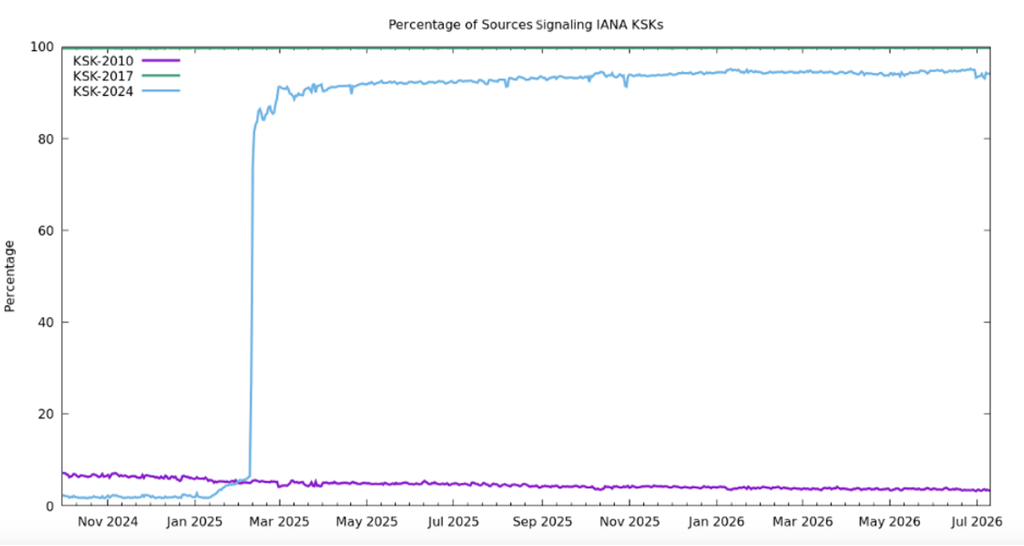
While operator logs demonstrate that a high percentage of reporting resolvers have successfully integrated KSK-2024 into their configurations, aggregate figures alone do not fully capture the end-user impact. Recursive resolvers vary widely in scale, with some serving millions of active users while others support isolated single-user environments. To address this limitation, an alternative methodology defined in RFC 8509 introduces a Root Key Trust Anchor Sentinel mechanism.
Rather than forwarding signals upstream to root servers, RFC 8509 folds the measurement query back toward the querier. By embedding specific query labels that prompt resolvers to evaluate their trusted key sets, researchers can determine whether a resolver recognizes a specific key tag. If a validating resolver trusts the queried key, it returns a normal response; if the key is untrusted, it responds with a SERVFAIL status. This mechanism allows measurement systems to quantify the proportion of end users situated behind validating recursive resolvers that have failed to adopt the incoming key.
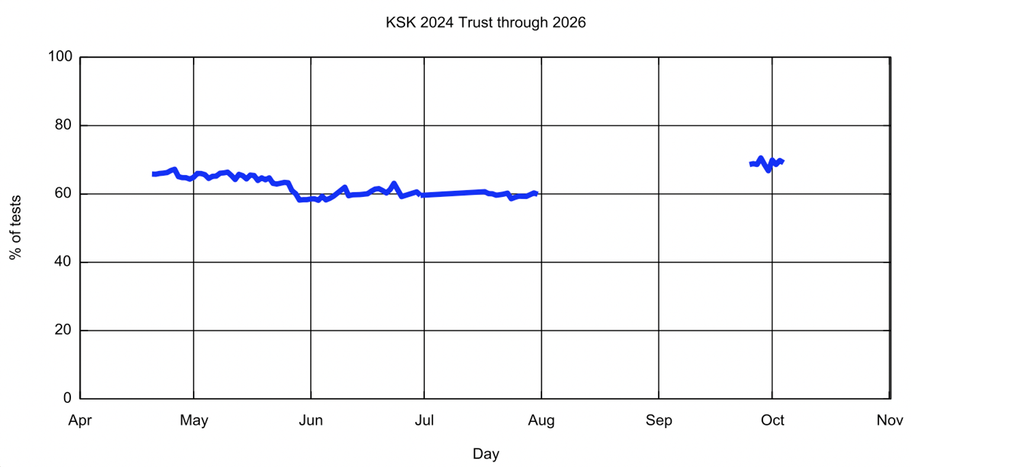
Large-scale measurements utilizing ad-based testing platforms have provided continuous daily insights into KSK-2024 adoption trends. While millions of daily tests evaluate end-user environments, a significant subset successfully identifies systems operating behind DNSSEC-validating recursive resolvers that support the Key Sentinel mechanism. While general adoption averages indicate substantial progress across many regions, aggregate statistics obscure notable variations at the autonomous system level.
An examination of specific networks reveals that a subset of internet service providers and telecommunications operators exhibit markedly lower rates of KSK-2024 trust signal adoption. Network operators and administrators whose autonomous systems register low adoption rates face potential resolution failures once the rollover takes effect, as validating clients encountering untrusted keys may reject traffic and return resolution errors to end users. Organizations identified through these measurement frameworks are advised to review their DNS configurations and verify trust anchor settings to prevent service disruptions for their subscriber bases.

Leave a Reply