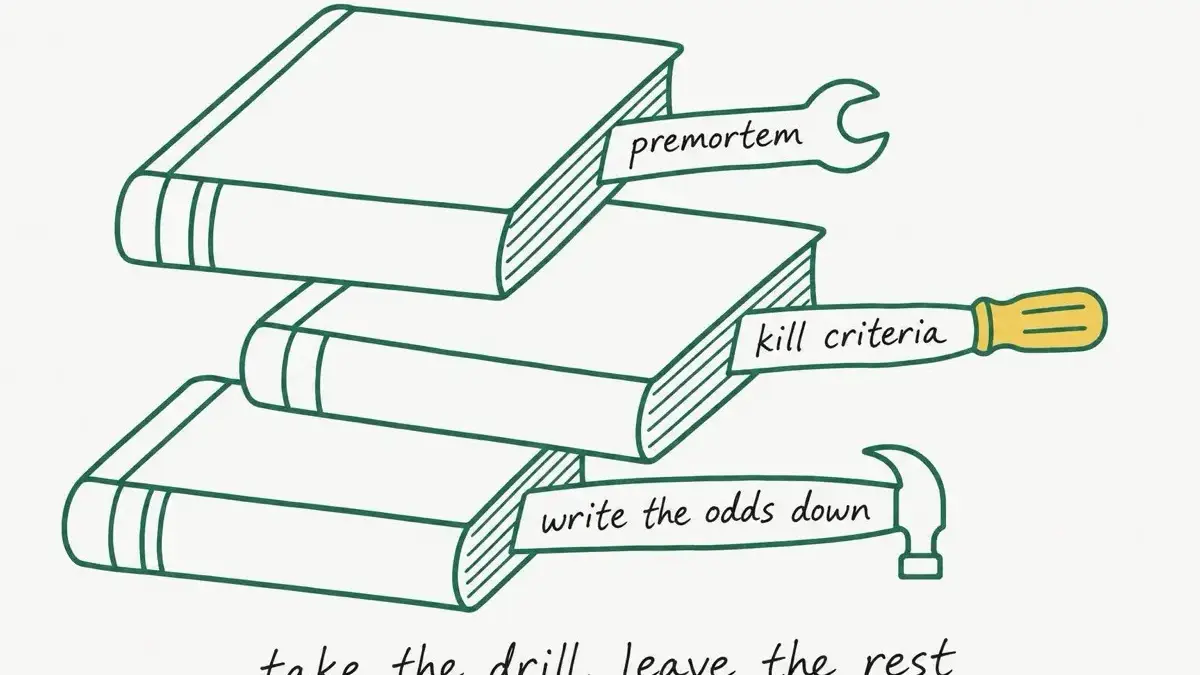
When faced with a high-stakes crossroads—such as a critical job offer requiring an immediate response, a real estate purchase at the absolute ceiling of financial comfort, or a fledgling side enterprise propped up through two years of mounting losses—standard reading recommendations frequently offer little practical relief. The typical response from traditional reading lists is an identical, rigid stack of titles, headed almost invariably by Daniel Kahneman, followed by nine theoretical volumes that rarely address the immediate, pressing nature of the dilemma at hand.
Rather than categorizing books by traditional sales rank, a more functional approach evaluates these titles based on specific real-world scenarios. Analyzing what each book does to cognitive processing, identifying the single actionable drill worth executing, and recognizing the precise limits of each text provides a clearer roadmap for navigating difficult choices. At the same time, separating genuinely useful methodology from overhyped theory helps readers avoid investing time in popular titles that offer little practical guidance when a real-world deadline looms.
How the Selections Were Graded
Evaluating the best books for decision-making requires moving away from standard literary reviews and focusing instead on functional utility. Three core evaluative questions drive this assessment: whether the book provides a repeatable procedure rather than abstract concepts, whether the core technique is anchored in verifiable behavioral research, and whether the framework can be deployed within a tight operational window.
The first question carries the heaviest weight, primarily because empirical research has consistently measured the impact of structured practice. In a four-year series of geopolitical forecasting tournaments sponsored by the United States intelligence community, researchers observed a measurable improvement in accuracy. Specifically, a training module taking under an hour improved forecasters’ accuracy—measured by the Brier score—by six to 11 percent compared to a control condition, according to findings published in the journal Judgment and Decision Making by Chang, Chen, Mellers, and Tetlock.
Structured drills yielding quantifiable improvements demonstrate clear value, whereas the indirect cognitive effects of simply reading a book are rarely captured by such studies. Consequently, each title on this evaluated list is scored according to the practical drill a reader can extract and execute immediately. Finishing a book without deploying a concrete exercise amounts to little more than observing a nature documentary about one’s own mind.
The Seven Works Worth Your Time
Chip and Dan Heath launched Decisive: How to Make Better Choices in Life and Work from the premise that most people make choices within artificial boundaries established by others. Individuals frequently frame dilemmas too narrowly—asking whether to accept a specific job rather than evaluating the broader landscape of potential career paths over the coming years. This tunnel vision mirrors organizational decision-making patterns. In a profile of 78 corporate decision case studies conducted by Paul Nutt, most processes were found to be solution-centered, starting from a favored answer that ultimately suppressed both innovation and the number of alternatives explored.
The Heaths’ WRAP framework is explicitly designed to counter this tendency: widen your options, reality-test your assumptions, attain distance before deciding, and prepare to be wrong. The final step—preparing to be wrong—is frequently overlooked by readers, yet it offers significant utility. Executing a premortem, which involves assuming the decision has already failed and listing the reasons why, draws upon the research of Gary Klein. Klein’s work indicates that prospective hindsight raises an individual’s ability to identify potential failure points by approximately 30 percent, as outlined in his Harvard Business Review article Performing a Project Premortem.
While the book’s examples lean heavily toward corporate environments and rely partly on borrowed concepts—such as Suzy Welch’s 10/10/10 distancing rule—the core mechanism remains highly effective for immediate application.
Shifting the focus from choosing to walking away, Annie Duke’s Quit: The Power of Knowing When to Walk Away addresses the harder, less frequently scheduled half of decision-making. Duke emphasizes the importance of establishing exit conditions while maintaining emotional equilibrium. Setting explicit parameters—such as closing a business if it fails to clear specific monthly revenue targets by a set date, or abandoning a professional certification if it generates no paid work within six months—prevents individuals from negotiating with themselves when the act of quitting begins to feel like personal failure. However, this framework carries limitations. If the immediate challenge involves choosing a path rather than terminating one, this text is less effective as a primary resource. Furthermore, its underlying poker framing assumes a transactional cost model that translates less smoothly to complex personal arenas like careers, marriages, or long-term community roots, where the costs of exit are distributed across multiple lives.

Duke’s companion work, Thinking in Bets: Making Smarter Decisions When You Don’t Have All the Facts, addresses the cognitive trap of "resulting"—the tendency to judge the quality of a decision entirely by its eventual outcome. Accepting a job offer only for the company to fold a year later frequently leads individuals to conclude they made a poor choice, even if the decision was sound given the information and odds available at the time. Separating the quality of the process from the final outcome prevents anomalous external events from imparting false lessons. While maintaining a written decision record to curb hindsight bias is an operational suggestion rather than a universally validated intervention, it serves as an effective personal safeguard against outcome-based self-blame.
Daniel Kahneman’s Thinking, Fast and Slow provided an entire generation with its operational vocabulary, introducing the concepts of an automatic, fast system and an effortful, slow system. The book remains an authoritative account of anchoring, availability heuristics, loss aversion, and overconfidence. At the same time, it is intentionally structured as an exploratory account of human judgment rather than an operational manual. Readers must also navigate the reality that certain underlying studies have faced academic scrutiny. Kahneman himself publicly acknowledged that he placed too much faith in underpowered social-priming studies, conceding weaknesses in that specific chapter following independent critiques published by Retraction Watch. Despite these historical revisions, the foundational two-system framework and prospect theory remain robust benchmarks for understanding cognitive vulnerabilities.
Expanding on organizational blind spots, Noise: A Flaw in Human Judgment distinguishes between systemic bias, which pulls judgments in a single predictable direction, and noise, which represents undesirable scatter. This scatter manifests when two underwriters price identical risks differently, two interviewers rate the same candidate with conflicting scores, or a medical professional evaluates scans inconsistently across different days of the week. The primary practical takeaway is decision hygiene—specifically, breaking complex evaluations into isolated components that are assessed independently and synthesized afterward, preventing a single overarching impression from skewing the final verdict. Because these principles are designed primarily for institutional environments, they offer limited utility for isolated personal choices, such as selecting between two residential leases.
Among the more procedural titles, Smart Choices: A Practical Guide to Making Better Decisions relies on a systematic sequence: defining the problem, clarifying objectives, identifying alternatives, projecting consequences, and evaluating tradeoffs. The construction of a structured consequence table remains its most valuable contribution, as it forces decision-makers to acknowledge competing priorities and frequently exposes unviable options that can be discarded immediately. The primary drawback lies in its dry presentation and aging examples. Additionally, it treats psychological traps as a secondary consideration, assuming readers can accurately articulate their own preferences—an assumption modern behavioral research frequently challenges.
Concluding the core survey, Philip Tetlock and Dan Gardner’s Superforecasting: The Art and Science of Prediction addresses the reality that most difficult choices hinge on underlying forecasts. Determining whether a specific industry role will remain viable or whether a neighborhood will retain its financial value requires systematic projection. Tetlock’s top forecasters achieved superior results by quantifying their beliefs, breaking broad questions into granular sub-components, and updating their estimates incrementally as new evidence emerged. While the measurable accuracy gains demonstrated in geopolitical tournaments stemmed from structured training modules rather than casual reading, the underlying discipline of tracking and scoring personal predictions remains a powerful educational tool.
Navigating the Alternatives and Limitations
While the market is saturated with popularized behavioral economics and psychological overviews, not all titles translate effectively into actionable methodologies. Rolf Dobelli’s The Art of Thinking Clearly serves as an extensive glossary of cognitive biases organized into short chapters, functioning well as a reference book for browsing rather than a step-by-step framework for resolving an immediate professional dilemma. Similarly, Dan Ariely’s Predictably Irrational offers an engaging tour of human irrationality and self-defeating behaviors, yet it lacks an operational procedure designed to guide a decision-maker through an urgent crossroad.
Furthermore, the broader literature occasionally suffers from empirical turbulence. High-profile retractions within behavioral science—such as the withdrawal of a prominent paper concerning honesty interventions by the Proceedings of the National Academy of Sciences—underscore the necessity of verifying striking behavioral findings before institutionalizing them.
Ultimately, decision-making literature yields results only when paired with active execution. Engaging in structured preliminary drills, such as forcing alternative options or conducting a prospective premortem on an open dilemma, transforms passive reading into practical operational clarity. As complex choices continue to demand immediate attention, the utility of any text is measured directly by its capacity to move a decision forward before the deadline arrives.