
Somewhere in your house, there is a kit. It might be a watercolor set with only three colors used, a guitar sitting in the corner with a single broken string, or a sophisticated telescope that cost significantly more than you care to admit to others. Each of these items arrived with real intent, purchased during a moment of optimism, yet each has quietly transitioned into a storage ornament.
The conventional explanation for these abandoned pursuits is simple loss of interest. However, a closer examination suggests that narrative reads the situation backward. Almost nobody over the age of 70 suffers from an actual shortage of ideas. Lists recommending hobbies for seniors are ubiquitous, yet they frequently repeat the same generalized suggestions. What is consistently missing is a practical way to evaluate—before money leaves your bank account—whether a hobby actually fits the reality of your daily life: your hands on an ordinary morning, your transportation options after dark, and your personal tolerance for a loud, crowded room.
The core principle is selecting pursuits by their fit rather than their surface appeal. A hobby that looks wonderful on paper but fits poorly into daily routines inevitably ends up gathering dust in the closet right alongside the unused telescope.
What Constitutes a Good Hobby After 70?
Good hobbies for seniors over 70 are those that accurately align with four critical factors: what your physical body can comfortably manage on an average day, how easily you can access the activity, how much social company you desire, and what a single session leaves behind. Activities such as gardening, walking groups, card clubs, choir participation, birdwatching, woodworking, quilting, photography, genealogy, language study, and volunteering all qualify for various individuals. Yet, observers note that the specific category matters far less than the underlying fit.
Engaging in hobbies tracks consistently with overall well-being. A comprehensive 2023 study pooling five longitudinal surveys covering 93,263 adults aged 65 and older across 16 countries found that active hobby engagement is closely associated with fewer depressive symptoms and higher self-reported health, happiness, and life satisfaction. While these are broad associations across whole populations rather than a guaranteed personal outcome, studies cannot predict which specific hobby will resonate with an individual.
Why Traditional Hobby Lists Stop Working After 70
Standard hobby lists tend to fail past the age of 70 because they are typically written for an average body and an entirely empty calendar. They rarely factor in the realities of arthritic hands, hearing loss that transforms a busy craft room into an exhausting chore, driving limitations that end after dusk, or the responsibilities of caring for a spouse at four in the afternoon. The original idea is rarely the problem; rather, the friction between that idea and an ordinary Tuesday creates the barrier.
A systematic review published in 2024 examining 37 studies across 26,961 adults aged 70 to 101 identified health and fitness concerns as among the most commonly reported barriers to leisure activities, alongside environmental and practical obstacles. These constraints are entirely common rather than exotic. Approximately half of United States adults aged 65 and older live with arthritis, while nationally representative audiometric samples indicate that hearing loss is present in 63.1 percent of adults aged 70 and older.
Crucially, neither statistic rules out specific activities; plenty of individuals with arthritis successfully quilt, and many with hearing aids sing actively in choirs. These numbers simply explain why a generic recommendation to join a pottery class lands differently at 74 than it might at 44, and why an abandoned kit should never be viewed as a personal character failure. Adding activities to an otherwise empty week without considering practical friction fails to solve retirement boredom.
The Four-Fit Check: Body, Access, Company, and Payoff
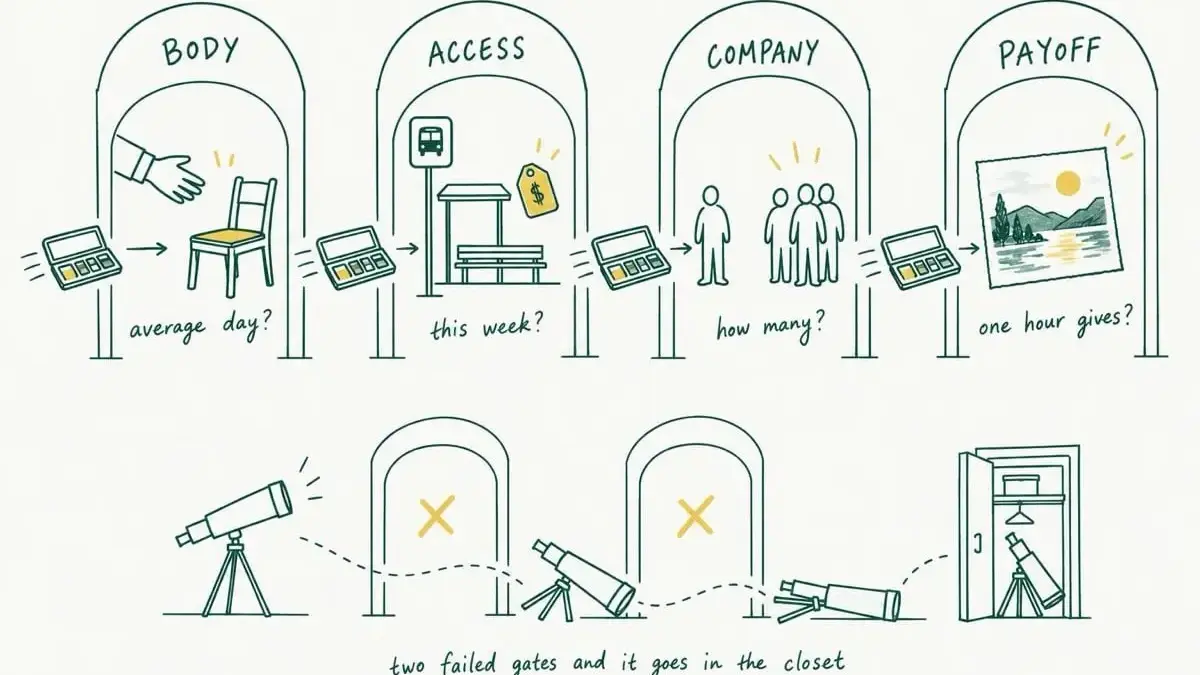
To determine whether a hobby will survive past the initial wave of novelty, analysts suggest running candidates through a Four-Fit Check. This test evaluates whether an activity can be performed on an average day rather than a best day, whether it can be started without extraordinary favors or major purchases, whether the social environment matches personal preferences, and whether a single session leaves a tangible outcome. A helpful rule of thumb is that failing one filter usually allows a hobby to be adapted, while failing two typically sends it back to the shelf. Running these checks before purchasing equipment can prevent costly mistakes.

Body fit requires scoring a hobby against a normal Tuesday, including any morning stiffness. Questions include how long one must stand, what is demanded of grip strength, knees, balance, eyes, and ears, and whether the activity can be stopped halfway through without ruining the work. Federal health guidance for older adults recommends specific minutes of moderate aerobic activity and muscle-strengthening weekly, with the explicit caveat that individuals should remain as physically active as their chronic conditions and abilities allow. Balance deserves particular attention, given federal data showing that over a quarter of US adults aged 65 and older reported at least one fall in the previous year.
Access fit is frequently overlooked, yet it quietly terminates more hobbies than waning interest. Considerations include transportation logistics, the cost of the first month, and whether participation requires relying on others. A hobby requiring a lengthy drive after sunset, an expensive starter purchase, and a rigid external schedule contains multiple fragile points, whereas a library genealogy session down the street has none.
Company fit addresses the balance between social interaction and solitude. While research indicates that social leisure activities carry strong associations with health, longevity, and well-being, solitary pursuits are equally valid. Researchers emphasize designing around personal preferences rather than enforcing rigid social rules. However, addressing isolation remains critical; extensive longitudinal data has linked poor social relationships to increased risks of cardiovascular issues, early mortality, and cognitive decline, justifying a deliberate design choice to incorporate shared spaces for those whose weeks feature little human contact.
Payoff fit dictates that a hobby must return something within a single session—whether that is a finished product, newly acquired knowledge, or a meaningful conversation—rather than relying purely on fleeting willpower.
Mobility, Cost, and Social Integration
For individuals managing limited mobility or lower energy, experts recommend hobbies that can be performed while seated, stopped cleanly at any moment, and managed without complex transportation. Container gardening, watercolor painting, drawing, knitting with larger needles, model building, genealogy research, letter writing, audiobooks paired with discussion groups, and seated musical instruments all provide viable paths. Simple adjustments, such as raising work surfaces to protect wrists and shoulders or breaking sessions into manageable 20-minute blocks, make these pursuits sustainable.
Inexpensive entry points often rely on existing community resources such as public libraries, local parks, and home kitchens. Library book clubs, walking groups, drawing with basic pencil sets, cooking, houseplant cultivation, memoir writing, and community volunteering allow individuals to test interests without financial pressure. Purchasing specialized equipment should be postponed until a routine is firmly established.
For those seeking social connection, structured formats such as choirs, community bands, bridge and mahjong clubs, bowling and pickleball leagues, community garden plots, and pottery co-ops offer built-in environments where socialization occurs naturally. Taking on defined roles, such as managing a sign-in sheet, can ease the transition into new social settings by providing a clear initial purpose.
Running a structured two-week trial—engaging in four sessions using borrowed gear at the actual time of day the activity would normally occur—helps prospective participants evaluate their genuine commitment. If the body feels fine the following morning and the desire to continue remains high, the pursuit is a keeper. If not, the trial simply provides valuable information rather than indicating failure, guiding individuals toward a sustainable weekly routine that enhances their later years.


Leave a Reply